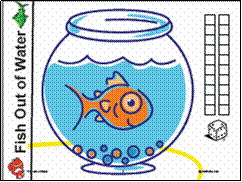
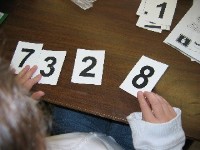
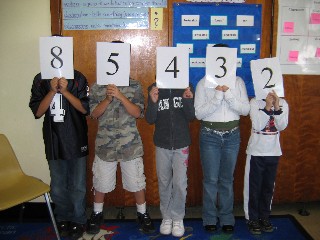
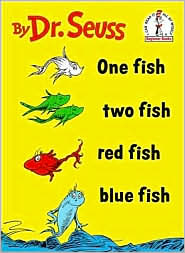
This is a simple counting game, designed by a Monmouth University student. It's a great game for Dr. Seuss day, accompanying One Fish, Two Fish, Red Fish, Blue Fish. Students begin with 20 fish out of water, toss a die, and place that many fish back in the bowl.
While the file provides a game mat, teachers might choose to use a bowl and fish manipulatives. It's fairly easy to find plastic fish in dollar stores. Plastic fruit containers from the grocery store simulate a fish bowl and the lid can be used to store the pieces in the fish bowl for use in the math center.
Although the game was designed as counting practice for young students, it may be enriched to provide a data collection activity for older students. Given the premise of the game, students are asked to estimate how many times they will have to toss the die to get all of the fish back in the bowl. Students then play the game several times, collect data and add it to class results. Students analyze the data in small groups and draw conclusions backed up by the data. The teacher then leads a class analysis of the data.
Download Fish out of Water, which includes game mats for a single player, two players, center icons, and directions. Add this game to the math center for independent practice.
Showing posts with label game. Show all posts
Tuesday, February 21, 2012
Wednesday, February 15, 2012
Domino Flash Game
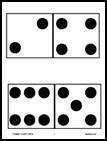
Play Domino Flash to help your students master the domino patterns. Each student needs a domino mat and counters. Teachers may use overhead dominoes or Domino Flash Cards, copied on card stock, cut apart and laminated for classroom use.
The teacher shows a domino for a count of 5-10 seconds, depending on the ability level of the students, then covers it. Students look at the domino as it is shown, then build the domino from memory, using a domino mat. Students may use round chips to recreate the domino. Alternately, if the mat is inserted in a sheet protector, students may use a dry erase marker to draw the pips.
The teacher circulates around the room as students work, to observe student performance, After some time, the teacher asks students to describe the domino they saw and how they remembered the patterns to build. Finally, the teacher shows the domino again so that students are able to self-correct.
Center Activity: make the Domino Flash Game materials available for students to play as pairs or triads at center time. Students love to rotate playing teacher for this game!
The teacher shows a domino for a count of 5-10 seconds, depending on the ability level of the students, then covers it. Students look at the domino as it is shown, then build the domino from memory, using a domino mat. Students may use round chips to recreate the domino. Alternately, if the mat is inserted in a sheet protector, students may use a dry erase marker to draw the pips.
The teacher circulates around the room as students work, to observe student performance, After some time, the teacher asks students to describe the domino they saw and how they remembered the patterns to build. Finally, the teacher shows the domino again so that students are able to self-correct.
Center Activity: make the Domino Flash Game materials available for students to play as pairs or triads at center time. Students love to rotate playing teacher for this game!
Tuesday, February 14, 2012
Domino Parking Lot
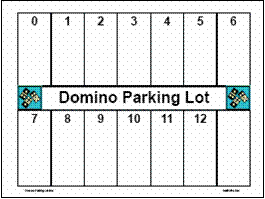
Students use a set of regular dominoes and a domino parking mat. Each student selects a domino, counts the total number of dots (pips) and places the domino in that parking spot. Dominoes with the same number of dots may be stacked on top of each other in the parking spot, if necessary.
Center Activity: Teachers may use craft foam and a sharpie marker to create the parking lot mat or download the Domino Parking Lot game mat, copy it on card stock, and laminate the mat for student use. Provide sets of dominoes for pairs or small groups of students to sort.
Challenge: As a variation of the game, select target sums and give students a point for each domino they find to park in those spaces. This motivates students to search for those particular combinations and heightens interest in finding those dominoes to win the most points for the group. Have one member of the group use a Domino Parking Lot recording sheet, write in the day's winning numbers, then draw in the dots of the dominoes the group finds for those numbers.
Center Activity: Teachers may use craft foam and a sharpie marker to create the parking lot mat or download the Domino Parking Lot game mat, copy it on card stock, and laminate the mat for student use. Provide sets of dominoes for pairs or small groups of students to sort.
Challenge: As a variation of the game, select target sums and give students a point for each domino they find to park in those spaces. This motivates students to search for those particular combinations and heightens interest in finding those dominoes to win the most points for the group. Have one member of the group use a Domino Parking Lot recording sheet, write in the day's winning numbers, then draw in the dots of the dominoes the group finds for those numbers.
Friday, December 16, 2011
Snowman Probability
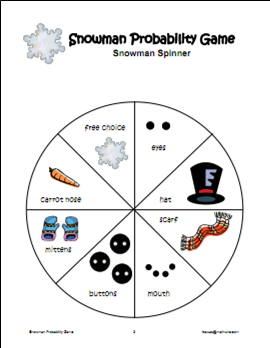
This activity is designed as a fun, seasonal data collection activity that introduces students to the probability of a spinner. Although each piece of the snowman is equally likely to be spun, the actual game results are often quite different.
In this game, students spin to win all of the pieces to create the snowman. Students may place a transparent spinner over the spinner template, or use a pencil and paper clip to create a spinner.
Before playing, ask students to estimate how many spins they think they will need to collect all of the pieces for their snowman. Call on students to share both their number of spins and why they think that is a reasonable number. Record these estimates for later discussion.
Give each student a copy of the game mat and insert the mat into a clear sheet protector. Students may then use dry erase pens to draw the pieces as they collect them.
Have students use the Snowman Probability Recording Sheet to collect data on how many spins it takes to get all of the pieces. Insert this sheet in a clear sheet protector for a renewable activity. Be sure to collate the class data and analyze this larger sample to get an approximate number of spins required.
Download the Snowman Probability Game file which includes the game mat, spinner, directions and recording sheet.
In this game, students spin to win all of the pieces to create the snowman. Students may place a transparent spinner over the spinner template, or use a pencil and paper clip to create a spinner.
Before playing, ask students to estimate how many spins they think they will need to collect all of the pieces for their snowman. Call on students to share both their number of spins and why they think that is a reasonable number. Record these estimates for later discussion.
Give each student a copy of the game mat and insert the mat into a clear sheet protector. Students may then use dry erase pens to draw the pieces as they collect them.
Have students use the Snowman Probability Recording Sheet to collect data on how many spins it takes to get all of the pieces. Insert this sheet in a clear sheet protector for a renewable activity. Be sure to collate the class data and analyze this larger sample to get an approximate number of spins required.
Download the Snowman Probability Game file which includes the game mat, spinner, directions and recording sheet.
Thursday, December 8, 2011
Catch the Gingerbread Man Game
For this game, students toss two dice (one regular and one marked A-B-C-D-E-F), form an ordered pair (e.g. B5), then remove the gingerbread man from that space, if there is one. Play continues until the timer rings or until one player has caught 10 gingerbread men. Students love playing the game and they get to practice their coordinate graphing skills in the process.
Coordinate Pairs: This seasonal version of the classic Battleship game provides practice in forming coordinate pairs, identifying the x-coordinate (A-F), then the y-coordinate (1-6) so that spaces are identified as C3 or E6. Hopefully, lots of practice will help students transition to the algebraic ordered pairs (x,y) where x and y are both numbers. Just be certain to reinforce the notion that the x-coordinate (across) comes before the y-coordinate (up or down). The alphabetical cues (across comes before up or down) help some students remember the order.
Download Catch the Gingerbread Man Game which includes game mat, directions and game pieces.
Friday, December 2, 2011
Counting Game: Run, Gingerbread Men, Run!
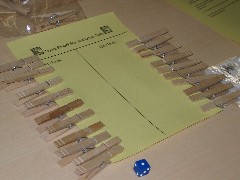
This game was designed to introduce students to the randomness of spinners and dice. Each color gingerbread man starts at the same place and has the same chance of winning by crossing the finish line, but does it work out that way? Students will enjoy playing the game AND use a clothespin graph [see sample on right] to collect some useful data on the winners.
Once students have collected class data from playing many games, they will come together to analyze the clothespin graph results. Students will be asked to discuss whether or not they think the game is fair for all of the gingerbread men and explain their reasoning.
Download the Run, Gingerbread Men, Run! game so that students can get started playing and collecting data. The pdf file contains the spinner, gameboard, clothespin graph icons, and an optional tally sheet.
Wednesday, November 16, 2011
Number Line Madness Game
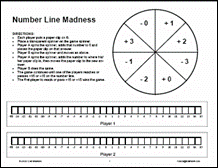
This game was designed to provide practice in adding integers, using the number line model. In this model, students move to the right for a positive integer and to the left when adding a negative integer.
Each player starts at 0. The first player spins the spinner, then adds that number to her current position. The second player spins and moves accordingly. Play continues back and forth until one of the players reaches +15 or -15 or beyond these endpoints.
Download the Number Line Madness Game. The PDF file includes extra number lines and optional spinners to differentiate levels of challenge to best meet the needs of varied learners.
Each player starts at 0. The first player spins the spinner, then adds that number to her current position. The second player spins and moves accordingly. Play continues back and forth until one of the players reaches +15 or -15 or beyond these endpoints.
Download the Number Line Madness Game. The PDF file includes extra number lines and optional spinners to differentiate levels of challenge to best meet the needs of varied learners.
Monday, October 17, 2011
Fat Bat Game
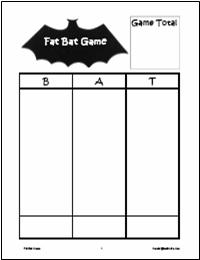
Students roll a die to see how many insects their bat eats. Students may continue rolling, in this Bat version of Pig, until they elect to stop, or until they roll a 1. But be careful! If your bat is still eating (collecting points) when a one is tossed, you are a Fat Bat and lose all of your points for that round.
This game is designed to provide a fun experience in the experimental probability of a single die toss. However, students get lots of practice adding a string of single digit numbers, as they total up their winning points for each round. A data analysis option is included to formally extend the analysis of the game's probability for older students.
Download Fat Bat for the student recording sheet, directions for whole class play, and data analysis option for extending the game.
Sunday, October 9, 2011
Heads & Tails Game
The Heads & Tails Game was designed to introduce young students to the probability of a single coin toss. By playing the game and adding results to a class tally, students will learn that the outcomes of heads and tails are equally likely.
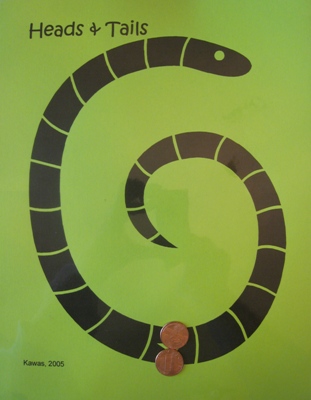
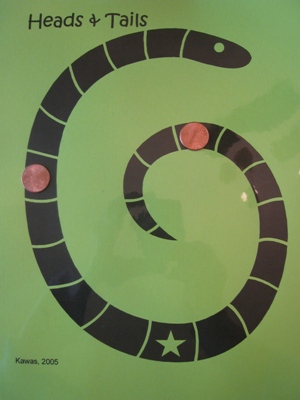
To start the game, each player places a penny on the star of the snake. The heads player places the penny heads side up. The tails player places the penny tails side up.
The heads player tosses a coin. If it is heads, he moves the penny one space toward the head of the snake. If it is tails, he does not move but the tails player moves her coin one space toward the tail.
Next, the tails player tosses a coin. If it is tails, she moves her penny one space toward the tail of the snake. If it is heads, she does not move but the heads player moves his penny one space toward the head of the snake.
Play continues back and forth until one of the players reaches either the head or the tail of the snake, thereby winning the game.
The players post their results on the classroom tally, adding to the Heads Won or Tails Won count. Players should play several games, if possible, to create a large sample which more closely approximates the actual probability.
Download the Heads & Tails game mat.
To start the game, each player places a penny on the star of the snake. The heads player places the penny heads side up. The tails player places the penny tails side up.
The heads player tosses a coin. If it is heads, he moves the penny one space toward the head of the snake. If it is tails, he does not move but the tails player moves her coin one space toward the tail.
Next, the tails player tosses a coin. If it is tails, she moves her penny one space toward the tail of the snake. If it is heads, she does not move but the heads player moves his penny one space toward the head of the snake.
Play continues back and forth until one of the players reaches either the head or the tail of the snake, thereby winning the game.
The players post their results on the classroom tally, adding to the Heads Won or Tails Won count. Players should play several games, if possible, to create a large sample which more closely approximates the actual probability.
Download the Heads & Tails game mat.
Wednesday, April 13, 2011
Ladybug Game
The Ladybug, Fly Away Home! game uses a one-die toss to move that numbered ladybug one space closer to her home. Students add their results to the Class Recording sheet by adding a tally mark for the winning ladybug. Class discussion focuses on the fairness of the game by asking if each ladybug has an equal chance to win? PDF file includes directions, game mat, recording sheet and math center icons
- Download the Ladybug, Fly Away Home! directions, game mat, recording sheet and math center icon.
Monday, April 4, 2011
Free the Animals Game
Who will free their animals first? Students toss two dice, calculate the difference and free an animal from that number cage. Younger students will enjoy this animal version of the Release the Prisoners game and learn subtraction facts as well. Both the 6-sided dice game mat and the 12-sided dice game mat are included with directions.
- Download the Free the Animals game directions and game mats for 6-sided dice to practice easier subtraction facts or 12-sided dice to practice harder subtraction facts.
- Download the Free the Animals game recording sheet designed so that students can track how many animals each player places in his/her cages and who wins. Hopefully, students will learn something about probability while mastering subtraction facts.
Tuesday, March 29, 2011
Place Value Game
Games provide extended place value practice for students and allow them to use their conceptual understanding to develop appropriate strategies to win the game. The best games encourage students to try out many options in search of the best solution. This search for the best solution prompts additional practice in a highly-motivational setting.
Place Value Game: Students use number cards to create the largest number possible.
Materials:
- Deck of digit cards for each set of partners (2-4 each of #0-9, depending on the level of students and the size of the numbers they will create) Note: Spinners with #0-9 may be used instead of cards, if desired.
- Place value mat for each player.
- Recording sheet, if desired.
- Partner A turns over the first card and decides where to place that card on his/her place value mat. Once the card is placed, it may not be moved.
- Partner B turns over a card and decides where to place that card on his/her place value mat. Again, the card may not be moved once it is placed.
- Play continues with each partner turning over a card and deciding where to place it on the place value mat in hopes of building the largest number.
- When all slots are filled on the place value mats, partners compare numbers to see who created the larger number. That partner wins a point for the round.
- Partners record both numbers on their recording sheet and circle the larger number
- Students clear their mats, shuffle the cards and play additional rounds, as time allows.
- Students try to form the smallest number.
- Students try to form a number that is closest to 500 (or 2000 or...)
- Students try to form a number that is less than 1000.
- Students form numbers and earn a different number of points, depending on the range within which the number falls (e.g. 1 point for numbers from 0-500, 2 points for numbers from 501-1000, etc.)
Friday, March 4, 2011
Game Day: Number Line-Up
This activity is designed to actively involve students in using place value concepts to build numbers. Student teams are given digit cards and asked to form numbers that fit specific conditions:
Materials:
These activities are very easily differentiated by varying both the number of digit cards used and the difficulty level of prompts to appropriately challenge the different ability levels within the classroom.
- Build the largest number.
- Build the smallest number.
- Build a number between 50,000 and 60,000.
- Build a different number between 50,000 and 60,000.
- Build the largest number between 40,000 and 50,000.
- Build the smallest multiple of 5.
- Build an even number that is less than 25,000,
- Continue to give conditions to tailor instruction to targeted skills.
Materials:
- Download demo digit cards (large size).
- Download individual digit cards (small size).
- Read more about the Number Line-Up Game and other place value activities, including decimal place value activities.
- Copy enough of the individual digit cards so that all students have a set in a plastic baggie in their desks. Use these cards frequently to prompt active participation, asking all students to respond to appropriate prompts such as what number is in the hundreds place, the thousandths place, etc.
- Copy the digit cards on a transparency and cut apart to create digit cards for the overhead. Students may use these digit cards to explain their thinking.
- These activities are perfect for a quick do-now review at the beginning of a class period.
- Challenge students to develop original challenges. They should provide the digit cards that may be used and appropriate challenge prompts. Use student challenges in class and place them in the math center. Be sure to label each challenge with the student's name and year they wrote it. Siblings and friends will enjoy these challenges in future years.
These activities are very easily differentiated by varying both the number of digit cards used and the difficulty level of prompts to appropriately challenge the different ability levels within the classroom.
Wednesday, March 2, 2011
Happy Birthday, Dr. Seuss!
Fish Out of Water
- Download the directions, game mat and center icons for the Fish out of Water game.
Data Analysis: Even very young students can learn about probability by predicting how many dice rolls it will take them to get all of the fish back in the water. A simple tally chart may be used to record both predictions and actual counts. Lead a discussion with students to probe their understanding of the probability of a single die toss and to introduce basic concepts of probability -- equally likely, fair, probability, outcome.
Friday, February 25, 2011
Landmark Shark Game
Everyday Math uses the Landmark Shark Game to help students practice and master the statistical landmarks of range, median and mode. Students are dealt 5 cards and they may exchange 1-3 cards, if desired. Next, students choose which of the statistical landmarks will give them the most points for the round and enter the correct number to score.
Try out the online demo of the Landmark Shark Game at the Everyday Mathematics site. The site includes online directions for playing the game. It's a well-designed game and students really learn the difference between these statistical landmarks as they try to earn the most points for each hand.
Tuesday, February 22, 2011
Clothespin Graph
Write each student's name on a clothespin. A piece of foam core board or laminated oak tag makes a great two-choice (Yes/No) graph board. Students simply affix the clothespin to the correct side to indicate their response. Students can easily "see" the results and count to verify the outcome.
- Use this method to record the results of informal classroom surveys:
- Literature: Which character do you like best? What do you think the character will do next? Which version of the story do you prefer?
- Daily Routines: Are you buying lunch or did you bring lunch? Present or Absent?
- Ask students to report the results of who won two-player games so that the class can analyze the fairness of the games.
In this game, each student places a penny on the star. One student is heads and the other student is tails. Students should place their pennies with the appropriate side up.
The heads student tosses a penny and moves a space toward the head if the outcome is heads. If the outcome is tails, the student does not move. Play repeats with the tails student, who moves only if his/her toss is tails, moving toward the tail of the snake. The first player to read the head or the tail of the snake wins. The winning player should add a clothespin to the graph to record the win as heads or tails.
Class discussion should focus on analyzing the data to determine if the game is fair or not. Directions and gameboard are included in the download. This game was developed by a Monmouth University student for the Probability Fair.
Download the Heads & Tails Game which includes the game mat, directions and icons for centers work boards. This game is an excellent addition to a classroom math center, as students may play with a partner and record the results for class discussion at a later time.
Labels:
clothespin graph,
coin toss,
data analysis,
data collection,
fair,
game,
math center
Thursday, February 10, 2011
Game of Pig
Game of Pig: one die version
This is best introduced as a class activity. Students collect points for each toss of the die unless a ONE is tossed, which means they lose all of the points they have collected in the round. To prevent losing their points, students may elect to stop at any point in the game before a ONE is tossed and they get to keep the points they collected but get no further points. Students love the game and begin to appreciate that theoretical probability and experimental probability are often quite different!
Game Analysis: Once students are familiar with the game, encourage small groups to develop a "winning strategy" and explain it to their classmates. Then play the class game with groups competing to see who has the best strategy in the actual game. Repeat, as necessary, for students to modify strategies. NOTE: Some student strategies are: stopping after 5 tosses, stopping when they have 20 points, stopping after the second toss of a 6 or a 5, etc. Be sure to ask students to explain the thinking behind the strategy.
Terry's Note: I have used this with students in Grades 1-12 as well as in teacher training sessions and everyone loves it! Students record each toss and then must add up a string of numbers providing great practice in mental math. Students also continue to search for that magic strategy that will help them win. Along the way, they informally experience, and thus learn, a lot about experimental probability. I found this game to be a great use of those few minutes at the end of class to keep students actively engaged. No student ever groaned when I said we were going to play pig!
- Download directions for playing the Pig Game in a whole class setting.
- Download the Pig Template to use as a recording sheet. Place the sheet in a plastic sheet protector and use dry erase markers to create a reusable recording sheet.
- Have students record each die toss in a Pig Tally Template for easy data collection. This method also groups data so that students see a visual representation of the frequency of each outcome.
- Use copies of the Pig Handout as a writing activity. Encourage students to write about the probability in Pig and what they have learned from playing the game. OR use these sheets for student groups to write out their "winning strategy" and post them on a bulletin board for future reference. Keep a running total of times each strategy is successful in winning.
- Play Pig online.
Game of Pig: Two dice version
Students should be familiar with the one-die version of Pig before playing the 2-dice version. Tossing a one on either die means that the player loses all points collected in that round, if he/she has not stopped before the one is thrown. Any player who is still playing when snake-eyes (double ones) are thrown, loses all points collected thus far in the whole game!
Game Analysis: Students need to develop different strategies for playing this 2-dice version of Pig. After playing several times, student pairs might analyze the two-dice frequency chart to calculate the probability of a one being tossed. Students can use this information to develop a winning strategy and compete against other teams to see whose strategy is most successful.
- Download a two-dice toss frequency chart for students to use in determining the probability of different outcomes.
- See online directions for playing Two-dice Pig.
- Play an online version of Two-dice Pig against the computer.
- See Two Dice Roll for an online simulation of two-dice toss that graphs the outcomes. This is a great way for students to collect larger samples of data to analyze experimental probability against theoretical probability. Groups of students might also use this simulator to generate dice tosses to test their winning strategies.
Game of Skunk
After students have mastered the Pig Game, analyzed the probability of the game and identified winning strategies, introduce the Game of Skunk and challenge students to analyze the probability used in this game and develop a winning strategy. How are the games alike and how are they different? Does the same "winning strategy" work for both games?
- See Skunk Game Lesson Plan from NCTM Illuminations.
- Download a Skunk Game Recording sheet that may be inserted in a plastic sheet protector and used with erasable markers for a renewable recording sheet.
- Play online Skunk Game at the NCTM Illuminations site.
Saturday, January 22, 2011
Penguin Bowling Game
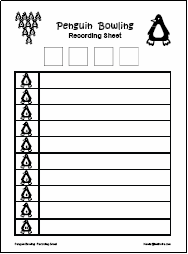
The Penguin Bowling Game was designed to provide mixed basic facts practice. Students toss 4 dice, then use the numbers from the dice throw and any of the four operations (+, -. *, /) to form expressions to knock down penguin pins. They are trying to create expressions that result in answers of each number from 1-10. Each student uses a recording sheet to write their expressions. Insert the recording sheet into a plastic sheet protector and use dry erase markers for a renewable option.
Students use a score sheet to record group scores as one does in real bowling games. Remember to model the scoring process, using an overhead of the scoring sheet, if students are not familiar with scoring regular bowling games. Teachers will especially have to model how to score a strike, as students will be strongly motivated to knock down all ten penguins in each round to gain these extra strike points.
This activity is a great do-now for students at the beginning or end of class to provide basic facts practice that students find highly motivating in a game format. Additionally, students profit from seeing and hearing the expressions their peers created and they are more likely to incorporate similar strategies in future play.
Penguin Bowling Game Materials:
Students use a score sheet to record group scores as one does in real bowling games. Remember to model the scoring process, using an overhead of the scoring sheet, if students are not familiar with scoring regular bowling games. Teachers will especially have to model how to score a strike, as students will be strongly motivated to knock down all ten penguins in each round to gain these extra strike points.
This activity is a great do-now for students at the beginning or end of class to provide basic facts practice that students find highly motivating in a game format. Additionally, students profit from seeing and hearing the expressions their peers created and they are more likely to incorporate similar strategies in future play.
Penguin Bowling Game Materials:
- Download the recording sheet and directions.
- Download the score sheet.
Labels:
basic facts,
bowling,
dice,
game,
math seasonal activities,
operations,
penguin
Wednesday, January 19, 2011
The M&M Game
M and M Game: 2-dice Version
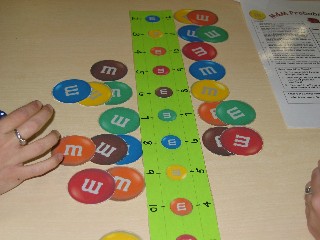
Students place M&M markers on the numbers 2-12. Students may place one M&M marker on each number or place several on some numbers and leave other numbers blank. Next, students toss two 6-sided dice, find the sum, and remove an M&M marker from that number, if there is still one. The first player to remove all markers wins the game.
This game helps students develop an understanding of the probability of a two-dice throw. As students play the game, they practice addition facts, but they also learn that some sums are tossed more frequently than others. This hands-on experience is then solidified with a discussion of all of the possible outcomes, creating a chart to visually capture the data.
Next, students play the game again with this mathematical knowledge and discuss how this information impacts the placement of M&Ms. Couple this game-playing with class data collection and students may then compare theoretical and experimental probability of a larger sample.
This is just one example of how a simple game may be used as a data collection activity to develop student understanding of theoretical and experimental probability concepts. Some teachers question the use of games in the classroom pressed for time. In my experience, this rich use of games to practice basic facts AND as a data collection activity is time well-spent and students respond positively to both the practice and the discussion of these hands-on, fun experiences.
NOTE: This game, created by Susie Siegel as a grad school project, uses a sentence strip as the number line. The M&M pieces were created using PowerPoint. Teachers may choose to laminate the pieces for use in a classroom math center.
MATERIALS:
- Download Ms. Siegel's M&M Game directions and recording sheet.
- Download a picture, alternate recording sheet and directions for using that recording sheet. NOTE: This recording sheet was designed to fit into a sheet protector so that students may use dry erase markers to play and record data. This option may be used without the M&M game pieces.
- Download the 2-dice toss recording sheet for a discussion of the theoretical probability of tossing two dice. Students write one outcome that produces that sum in each box to create a visual display. NOTE: use different colored dice for this activity so that students are able to see that tossing 4 on the red die and 3 on the blue die is different from tossing 3 on the red die and 4 on the blue die. Both must be counted as outcomes. Students might benefit from actually using two different color markers to record these outcomes as well.
- Download M&M pieces for use in playing the game.
Thursday, September 30, 2010
Climb the Ladder
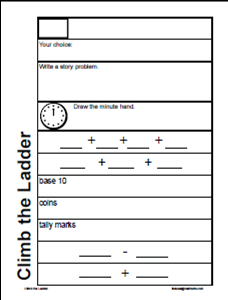
Some students need prompts to help them write mathematical expressions for target numbers. Climb the Ladder is an activity that prompts students to move from all addition or subtraction problems and include many mathematical topics to generate equivalent names. The student starts at the bottom of the ladder and completes the first rung using the prompt provided. He/she then moves up to the next rung, etc. and works to complete as many rungs as possible in the allotted time. The teacher may also include a traditional name-collection box for students to use after they reach the top so that they continue to generate equivalent expressions of their choice. Many students write more diverse mathematical expressions as a result of using this prompted approach.
Classroom Management Suggestions:
- Have students write equivalent expressions for the day's date.
- Ask students to write equivalent expressions for the school day count.
- Pick a random number from a hundred board.
- Insert the Climb the Ladder template into clear sheet protectors and have students use dry-erase markers so that the form may be reused each day.
Differentiation Strategies:
- Let pairs of students or small groups work together to generate as many different expressions as possible in a given amount of time.
Materials:
- Read more about Mathwire's Climb the Ladder and download different versions of the templates.
Subscribe to:
Posts (Atom)