Strategy: Make a Path
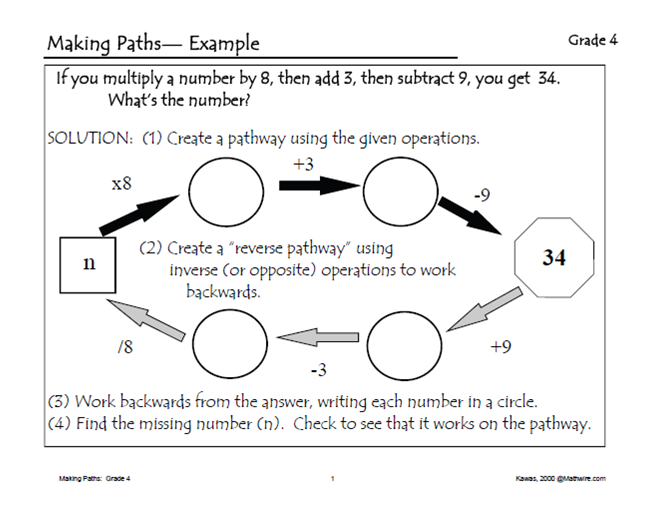
Sometimes students must work backwards to solve a problem. This method also works as an introduction to some algebraic problems in which the starting number is unknown. This method and the accompanying problem sets were developed to introduce students to one method of recording these problems by creating the forward path, then reversing the operations to create a backward path students may use to work backwards and identify the starting number.
Once students learn this method, they become quite proficient at using the paths to identify the starting number. The paths are easily generated on blank paper or on whiteboards so that these problems are a great do-now for the beginning or end of class periods.
Suggestions for modeling this strategy:
- Read the problem through, then model creating and labeling the forward path step-by-step, using an overhead or whiteboard.
- Draw arrows and circles to create a backward path that is matched arrow to arrow and circle to circle.
- Label the backward path by using the opposite operation since students are working backwards (undoing).
- Start at the end number and work backward along the new backward path, writing the correct number in each circle until students reach the beginning number.
- Check work by using the beginning number along the forward path to make sure that it creates the ending number.
Suggestions for Guided Practice:
- Read a problem slowly, pausing at each step to allow students to create a forward path and correctly label it.
- Read the problem once again so that students may check their forward path.
- Challenge students to create the backward path with labels then work backwards to identify the starting number.
- Encourage students to check their work by using the starting number across the forward path to make sure that it works.
- Distribute copies of the Making a Path problem sets for students to work on independently or in pairs.
Enrichment:
- Challenge students to create their own original problems, complete with a solution and answer. Use them as do-nows for the class and/or place these problems in the classroom math center.
Materials:
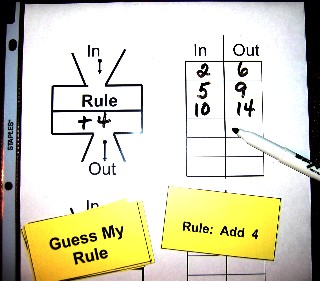
This function machine game was created to give students practice in saying and writing the rule, given an input/output table. One student has the rule which the other student has to guess. The guesser records an input number in the table. The rule person must apply the rule and tell the output number. Student pairs repeat this until the guesser correctly identifies the rule by saying and writing it. Students then switch places and repeat the activity.
Download three different levels of rules for play: simple addition & subtraction, multiplication or two-step rules.
Differentiation: This game is easily differentiated by varying the rule cards provided to students. Use simple one-step addition and/or subtraction for basic skills students and challenge better students by graduating them to 2-step rules. Consider printing the different level rules on different color paper so that students may easily select the proper level from the math center.
Enrichment: Provide blank cards for students to create their own rules to challenge their peers. Be sure that students try their rule on at least 3 other students to be sure that they have written it correctly.
Introduce elementary students to the concept of functions by investigating growing patterns. Visual patterns formed with manipulatives are especially effective for elementary students and allow them to concretely build understanding as they first reproduce, then extend the pattern to the next couple of stages. Finally, students explain the pattern in words and try to write a rule that works for any stage.
See Mathwire's Investigating Growing Patterns for specific suggestions on using these patterns to help elementary students develop a concept of functions. The article includes activities with handouts that teachers can use to introduce this topic to elementary students. A Function Scrapbook of function ideas is included and examples of function problems created by elementary students will be added as they are completed. Literature connections and web links to relevant sites on the internet are also included in the article.
Introduce elementary students to the concept of functions by investigating growing patterns. Visual patterns formed with manipulatives are especially effective for elementary students and allow them to concretely build understanding as they first reproduce, then extend the pattern to the next couple of stages. Finally, students explain the pattern in words and try to write a rule that works for any stage.
See Investigating Growing Patterns for specific suggestions on using these patterns to help elementary students develop a concept of functions. The article includes activities with handouts that teachers can use to introduce this topic to elementary students. A Function Scrapbook of function ideas is included and examples of function problems created by elementary students will be added as they are completed. Literature connections and web links to relevant sites on the internet are also included in the article.