Showing posts with label experimental probability. Show all posts
Monday, October 17, 2011
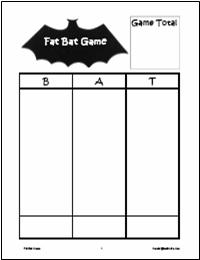
Fat Bat Game
Students roll a die to see how many insects their bat eats. Students may continue rolling, in this Bat version of Pig, until they elect to stop, or until they roll a 1. But be careful! If your bat is still eating (collecting points) when a one is tossed, you are a Fat Bat and lose all of your points for that round.
This game is designed to provide a fun experience in the experimental probability of a single die toss. However, students get lots of practice adding a string of single digit numbers, as they total up their winning points for each round. A data analysis option is included to formally extend the analysis of the game's probability for older students.
Download Fat Bat for the student recording sheet, directions for whole class play, and data analysis option for extending the game.
Monday, April 4, 2011
Free the Animals Game
Who will free their animals first? Students toss two dice, calculate the difference and free an animal from that number cage. Younger students will enjoy this animal version of the Release the Prisoners game and learn subtraction facts as well. Both the 6-sided dice game mat and the 12-sided dice game mat are included with directions.
- Download the Free the Animals game directions and game mats for 6-sided dice to practice easier subtraction facts or 12-sided dice to practice harder subtraction facts.
- Download the Free the Animals game recording sheet designed so that students can track how many animals each player places in his/her cages and who wins. Hopefully, students will learn something about probability while mastering subtraction facts.
Thursday, February 10, 2011
Game of Pig
Game of Pig: one die version
This is best introduced as a class activity. Students collect points for each toss of the die unless a ONE is tossed, which means they lose all of the points they have collected in the round. To prevent losing their points, students may elect to stop at any point in the game before a ONE is tossed and they get to keep the points they collected but get no further points. Students love the game and begin to appreciate that theoretical probability and experimental probability are often quite different!
Game Analysis: Once students are familiar with the game, encourage small groups to develop a "winning strategy" and explain it to their classmates. Then play the class game with groups competing to see who has the best strategy in the actual game. Repeat, as necessary, for students to modify strategies. NOTE: Some student strategies are: stopping after 5 tosses, stopping when they have 20 points, stopping after the second toss of a 6 or a 5, etc. Be sure to ask students to explain the thinking behind the strategy.
Terry's Note: I have used this with students in Grades 1-12 as well as in teacher training sessions and everyone loves it! Students record each toss and then must add up a string of numbers providing great practice in mental math. Students also continue to search for that magic strategy that will help them win. Along the way, they informally experience, and thus learn, a lot about experimental probability. I found this game to be a great use of those few minutes at the end of class to keep students actively engaged. No student ever groaned when I said we were going to play pig!
- Download directions for playing the Pig Game in a whole class setting.
- Download the Pig Template to use as a recording sheet. Place the sheet in a plastic sheet protector and use dry erase markers to create a reusable recording sheet.
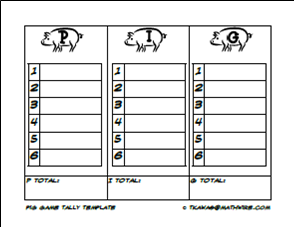
- Have students record each die toss in a Pig Tally Template for easy data collection. This method also groups data so that students see a visual representation of the frequency of each outcome.
- Use copies of the Pig Handout as a writing activity. Encourage students to write about the probability in Pig and what they have learned from playing the game. OR use these sheets for student groups to write out their "winning strategy" and post them on a bulletin board for future reference. Keep a running total of times each strategy is successful in winning.
- Play Pig online.
Game of Pig: Two dice version
Students should be familiar with the one-die version of Pig before playing the 2-dice version. Tossing a one on either die means that the player loses all points collected in that round, if he/she has not stopped before the one is thrown. Any player who is still playing when snake-eyes (double ones) are thrown, loses all points collected thus far in the whole game!
Game Analysis: Students need to develop different strategies for playing this 2-dice version of Pig. After playing several times, student pairs might analyze the two-dice frequency chart to calculate the probability of a one being tossed. Students can use this information to develop a winning strategy and compete against other teams to see whose strategy is most successful.
- Download a two-dice toss frequency chart for students to use in determining the probability of different outcomes.
- See online directions for playing Two-dice Pig.
- Play an online version of Two-dice Pig against the computer.
- See Two Dice Roll for an online simulation of two-dice toss that graphs the outcomes. This is a great way for students to collect larger samples of data to analyze experimental probability against theoretical probability. Groups of students might also use this simulator to generate dice tosses to test their winning strategies.
Game of Skunk
After students have mastered the Pig Game, analyzed the probability of the game and identified winning strategies, introduce the Game of Skunk and challenge students to analyze the probability used in this game and develop a winning strategy. How are the games alike and how are they different? Does the same "winning strategy" work for both games?
- See Skunk Game Lesson Plan from NCTM Illuminations.
- Download a Skunk Game Recording sheet that may be inserted in a plastic sheet protector and used with erasable markers for a renewable recording sheet.
- Play online Skunk Game at the NCTM Illuminations site.
Tuesday, February 1, 2011
Valentine Probability
These Valentine's Day activities are based on the small candy hearts popular around this holiday. Instead of sayings, these mathematical hearts have letters.
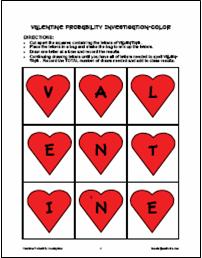
Students are trying to accumulate all of the letters in the word VALENTINE or HEART. They first predict how many letters they will have to draw from the bag, then they conduct the experiment, collect and organize data and analyze the class results.
Materials:
- Download Valentine Probability for a straightforward probability handout.
- Download Valentine Probability Investigation for the hearts and recording sheet to conduct the probability investigation on how many letters students will have to draw (with replacement) to get all of the letters in the word VALENTINE.
- Download Heart Probability Investigation for the hearts and recording sheet to conduct the simplified probability investigation on how many letters students will have to draw (with replacement) to get all of the letters in the word HEART.
Wednesday, January 19, 2011
The M&M Game
M and M Game: 2-dice Version
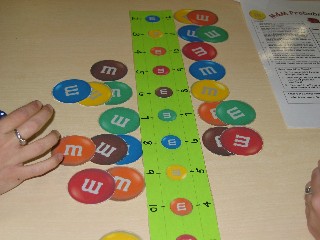
Students place M&M markers on the numbers 2-12. Students may place one M&M marker on each number or place several on some numbers and leave other numbers blank. Next, students toss two 6-sided dice, find the sum, and remove an M&M marker from that number, if there is still one. The first player to remove all markers wins the game.
This game helps students develop an understanding of the probability of a two-dice throw. As students play the game, they practice addition facts, but they also learn that some sums are tossed more frequently than others. This hands-on experience is then solidified with a discussion of all of the possible outcomes, creating a chart to visually capture the data.
Next, students play the game again with this mathematical knowledge and discuss how this information impacts the placement of M&Ms. Couple this game-playing with class data collection and students may then compare theoretical and experimental probability of a larger sample.
This is just one example of how a simple game may be used as a data collection activity to develop student understanding of theoretical and experimental probability concepts. Some teachers question the use of games in the classroom pressed for time. In my experience, this rich use of games to practice basic facts AND as a data collection activity is time well-spent and students respond positively to both the practice and the discussion of these hands-on, fun experiences.
NOTE: This game, created by Susie Siegel as a grad school project, uses a sentence strip as the number line. The M&M pieces were created using PowerPoint. Teachers may choose to laminate the pieces for use in a classroom math center.
MATERIALS:
- Download Ms. Siegel's M&M Game directions and recording sheet.
- Download a picture, alternate recording sheet and directions for using that recording sheet. NOTE: This recording sheet was designed to fit into a sheet protector so that students may use dry erase markers to play and record data. This option may be used without the M&M game pieces.
- Download the 2-dice toss recording sheet for a discussion of the theoretical probability of tossing two dice. Students write one outcome that produces that sum in each box to create a visual display. NOTE: use different colored dice for this activity so that students are able to see that tossing 4 on the red die and 3 on the blue die is different from tossing 3 on the red die and 4 on the blue die. Both must be counted as outcomes. Students might benefit from actually using two different color markers to record these outcomes as well.
- Download M&M pieces for use in playing the game.
Sunday, January 16, 2011
Penguin Math Games
Capture the Penguins Game uses the outcome of two-dice toss to form a coordinate pair. Students toss two dice (one regular and one A-F) in this fun game that introduces students to coordinate graphing in the spaces. Students form a coordinate pair based on the dice toss and capture a penguin, if possible. Students use the accompanying recording sheet to keep score during the game.
- A-F Dice: Create A-F dice using plain dice or purchase small wooden cubes at a craft store to make the dice.
- Penguin Pieces: Penguins pictured to the right were created by painting wooden clothespins and doll stands, both readily available at craft stores.
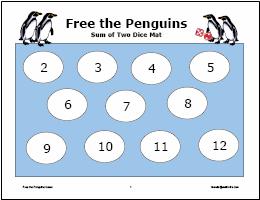
Free the Penguins Game: The penguins are stuck on the ice floes. Only a roll of the die can free them to search for food in the ocean. Students will practice addition or subtraction facts as they try to be the first to free their penguins. Use mats with clothespin penguins for the most fun!
These games are not only an excellent opportunity to practice basic facts but they allow students to collect data and reflect on the probability inherent in the game. Suggestions are included with this game for students to keep tallies of all dice tosses, organize the class data in a line plot, and then analyze the data for patterns and trends.
Download Free the Penguins game mat, instructions and suggestions for data collection.
Saturday, December 18, 2010
Gingerbread Man Math Activities
Check out Mathwire's Gingerbread Man Math collection for timely math gingerbread activities to accompany this seasonal unit. The collection includes activities to develop measurement, probability, symmetry, problem solving, games and literature links to popular gingerbread books.
Older students will practice coordinate graphing skills as they play Catch the Gingerbread Man, a Battleship-type game where students try to capture their opponent's gingerbread men.
Younger students will enjoy the Run, Gingerbread Man, Run! game which comes with a colored spinner, gameboard and directions for small group play. Students will practice simple counting skills as they try to be the first to move through the colored board.
Students may use a copy of the gameboard to analyze the results of winners:
Problem solving activities involve combinations. Gingerbread Bake Sale challenges students to figure out if Ruby can make each of the 12 gingerbread cookies on a cookie sheet different, given the possible eyes and noses. Gingerbread Man Combinations is a harder version of this problem, with more choices to challenge older students. Gingerbread Man Chain requires students to use measurement skills to figure out how many gingerbread men will be needed to create borders at the top and bottom of a bulletin board.
Older students will practice coordinate graphing skills as they play Catch the Gingerbread Man, a Battleship-type game where students try to capture their opponent's gingerbread men.
Younger students will enjoy the Run, Gingerbread Man, Run! game which comes with a colored spinner, gameboard and directions for small group play. Students will practice simple counting skills as they try to be the first to move through the colored board.
Students may use a copy of the gameboard to analyze the results of winners:
- Did the red, yellow, blue or green gingerbread man win more often?
- Does each color have an equal chance of winning? Explain your thinking
Problem solving activities involve combinations. Gingerbread Bake Sale challenges students to figure out if Ruby can make each of the 12 gingerbread cookies on a cookie sheet different, given the possible eyes and noses. Gingerbread Man Combinations is a harder version of this problem, with more choices to challenge older students. Gingerbread Man Chain requires students to use measurement skills to figure out how many gingerbread men will be needed to create borders at the top and bottom of a bulletin board.
Saturday, August 28, 2010
Data Collection: Tossing Two Dice
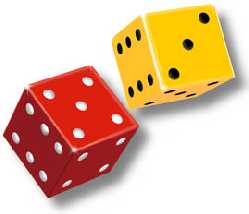
Students LOVE working with dice, almost forgetting that they're doing math. While standard probability lessons ask students to calculate the probability of tossing an even number, a sum of 10, etc., students are more highly motivated when they generate their own experimental data.
The Mathwire collection contains many examples of both one-die toss activities and two-dice toss activities. These data investigations begin with a game but make data collection an integral part of the activity, so that students begin to examine the underlying probability of the game and can use appropriate strategies in future play.
Students will generate their own small set of data, which should be combined with the whole class data for a larger set. Teachers may ask questions to help students draw conclusions and make generalizations about the probability of dice tosses.
After this initial hands-on data collection and analysis, extend the activity by asking students to use online dice simulators to generate even more data to test their hypotheses and generalizations. This option allows students to quickly generate large sets of random data. It is helpful to pair students for this activity: one student at the computer keyboard and the other student recording the results of each simulated dice toss. Again, ask students to post their results to a class data collection display (e.g. tally chart, graph, etc.) so that the class is able to analyze the larger sample.
Check out these online dice-toss simulators:
The Mathwire collection contains many examples of both one-die toss activities and two-dice toss activities. These data investigations begin with a game but make data collection an integral part of the activity, so that students begin to examine the underlying probability of the game and can use appropriate strategies in future play.
Students will generate their own small set of data, which should be combined with the whole class data for a larger set. Teachers may ask questions to help students draw conclusions and make generalizations about the probability of dice tosses.
After this initial hands-on data collection and analysis, extend the activity by asking students to use online dice simulators to generate even more data to test their hypotheses and generalizations. This option allows students to quickly generate large sets of random data. It is helpful to pair students for this activity: one student at the computer keyboard and the other student recording the results of each simulated dice toss. Again, ask students to post their results to a class data collection display (e.g. tally chart, graph, etc.) so that the class is able to analyze the larger sample.
Check out these online dice-toss simulators:
- Coins & Dice: A Probability Simulator records the results of each dice toss, making it easy for students to record the result of each dice toss
- Dice Roll displays the results in a bar graph so that students visually see the results of extended dice tosses
Labels:
conclusions,
dice,
dice toss,
experimental probability,
generalizations,
simulator
Sunday, August 1, 2010
Three Strikes and You're Out!
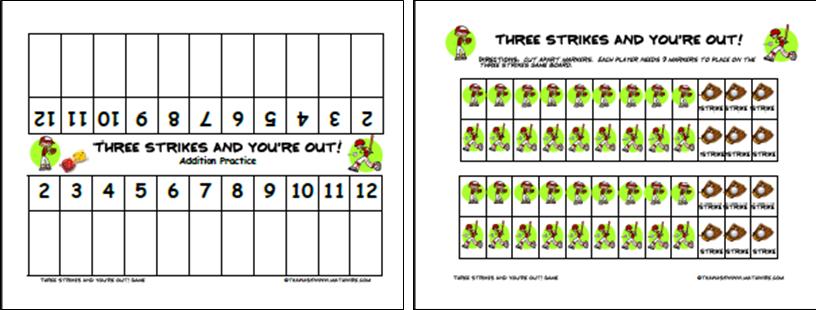
Summer means baseball games so capitalize on this favorite sport with the game Three Strikes and You're Out! The game was designed to practice addition and subtraction facts while incorporating a basic introduction to probability outcomes.
Players will enjoy choosing the numbers for their players and their strikes. As they play the game, they'll learn which numbers are best for placing players and which numbers are best left as strikes, developing a basic understanding of probability. They'll practice addition or subtraction facts while learning that the dice toss is often unpredictable and random.
The game uses the sum of two dice to practice addition facts, but may easily be adapted to practice subtraction facts by using two 12-sided dice and finding the difference. The game handouts include directions, variations in play and scoring, game boards for both the addition and subtraction games, as well as game pieces that may be used to support the baseball theme.
Download the directions and gameboards for Three Strikes and You're Out.
Thursday, July 15, 2010
The Game of Pig
Pig is one of my favorite probability games. I have played the game with kindergarten through college level students and used it in teacher training sessions. Everyone LOVES the game and it's fun to watch who plays it safe and who's the risk-taker.
In my own classroom experience, I have found that this is best introduced as a class activity. Students collect points for each toss of the die unless a ONE is tossed, which means they lose all of the points they have collected in the round. To prevent losing their points, students may elect to stop at any point in the game before a ONE is tossed and they get to keep the points they collected but get no further points. Students love the game and begin to appreciate that theoretical probability and experimental probability are often quite different!
I devised a method that uses only one die tossed by the teacher, so this is a great transition activity that quiets a class as they strain to hear and record the results of the die toss AND decide if they will stop or continue to play. It's a win-win because students feel that they're playing, but they're actually learning a lot about the probability of a one-die toss.
Extending the Data Collection & Analysis:
In my own classroom experience, I have found that this is best introduced as a class activity. Students collect points for each toss of the die unless a ONE is tossed, which means they lose all of the points they have collected in the round. To prevent losing their points, students may elect to stop at any point in the game before a ONE is tossed and they get to keep the points they collected but get no further points. Students love the game and begin to appreciate that theoretical probability and experimental probability are often quite different!
I devised a method that uses only one die tossed by the teacher, so this is a great transition activity that quiets a class as they strain to hear and record the results of the die toss AND decide if they will stop or continue to play. It's a win-win because students feel that they're playing, but they're actually learning a lot about the probability of a one-die toss.
Download Pig directions.- Download Pig template or Pig Tally template, and place in a sheet protector to record die tosses. Students may use dry erase markers for a reusable recording sheet. The Pig Tally template requires students to use tally marks to record each toss of the die. This recording sheet is a very visual presentation of the results and proves extremely useful when students devise winning strategies, as described below.
Extending the Data Collection & Analysis:
- Ask pairs or small groups of students to talk about the game and come up with a winning strategy. For example, some groups decide to stop once they have 20 points. Another group decides to stop when they get 3 of any number.
- Have each group share their winning strategy and explain why they think it is a winner.
- Play the game again. Groups MUST play according to their winning strategy.
- Discuss the results and allow groups to refine their strategies, if desired, before playing 1-2 more times.
- Finally, ask students to write about what they learned from this game. Is there really a winning strategy that works all the time? Explain your thinking.
Subscribe to:
Posts (Atom)