Showing posts with label multiplication. Show all posts

Monday, February 27, 2012

Napier's Bones

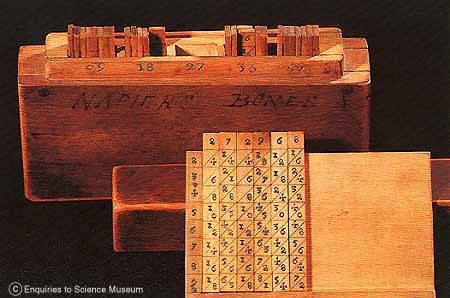
Once students are comfortable with lattice multiplication, Napier's Bones is a great enrichment activity. Students order the bones as they would write the problem in the lattice. They are then able to read the answer without any writing. It's magic!


Download the Napier's Bones template that students may cut apart to create the bones. The file contains three different versions including blank bones that students fill in to create the bones, developing a richer understanding of the magic of the bones. Copy the handout on card stock and laminate before cutting to create more durable classroom sets.  Teachers may also elect to create a transparency of the bones and cut apart for use on the overhead.


Interactive Napier's Bones:
This site allows students to manipulate the Napier's Bones to multiply large numbers and check the accuracy of their answers.  Simply click on Get Multiplication to start, then click the appropriate bones to add them to the problem on the left.  Students then read the correct answer, post it in the answer box and click Check answer.


Note that the site may also be used to do any problem.  Simply click Reset, then click on the bones needed, and read the answer.  This would be a powerful introduction to Napier's Bones using a whiteboard or projector. 

Thursday, February 23, 2012

Lattice Multiplication

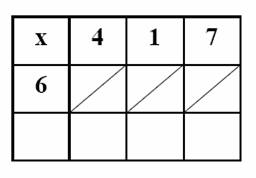
This algorithm works well for students who are developing multiplication fact fluency. Students may begin using a template to solve multiplication problems, but they quickly learn to draw their own lattice matrix to solve problems. Students love the method and it is very successful with both whole numbers and decimals. Teach students this multiplication algorithm as one of many different algorithms they may elect to use.  Students will very quickly learn to multiply large numbers, using basic multiplication facts and addition/regrouping skills.


Procedure:
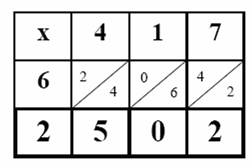
  • Student writes the problem in the grid (e.g. 6 x 417).
  • Student then writes the answer to each single digit multiplication in the appropriate square.
  • The tens digit is placed above the diagonal; the ones digit below the diagonal.
  • When all squares have been completed, the student sums the numbers between each set of diagonals, and writes the sum at the bottom of the grid. NOTE: If the sum is greater than 10, regroup the ten to the next diagonal to the left.
  • The student can now simply read the answer from left to right and insert commas, as appropriate.
For a complete overview of this method, see Cool Math's explanation of Lattice Multiplication to view the step-by-step procedure.  Take a cue from the site's explanation and use colored markers when introducing this algorithm to students on the overhead or whiteboard.  

Practice:
Templates:   Three different templates are included for Lattice Multiplications.   Templates are designed to be used in sheet protectors.   This strategy allows students to use dry-erase markers and re-use the same paper for many multiplication problems.

Thursday, October 20, 2011

Bats on Parade

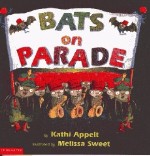
This book is a literary introduction to square numbers and the patterns they form as square arrays.   The bats march in parade formation and different sections of the band, being different sizes, march in different arrays: "In nine rows of nine those trombones reported, while there, right behind them, the tubas retorted."   The pictures and rhyme reinforce the mathematics of the patterns and teachers can easily ask students to predict how many bats will be in the next section or ask them to figure out how many bats are in the whole band before reading those pages.   Add this book to your collection of problem-solving literature prompts.


  • Multiplication Arrays: The book is a great introduction to multiplication arrays. Use the book illustrations to show students how to use an array to model a multiplication problem then ask students to create arrays for different multiplication facts.
  • Class on Parade Book: Challenge students to design an array and a rhyme for an original page in theClass on Parade book. Decide on a theme and let pairs of students work on both the math and the language for a page.

Bat Jamboree by Kathi Appelt

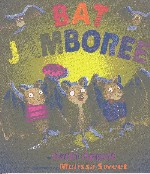
Bat Jamboree introduces the triangular number pattern as bats assemble for the final number beginning with 10 bats in the bottom row, 9 in the next row, etc. to the very top row with 1 bat.   Students are introduced to the 55 bats in formation and their various acts but the book "isn't over until the bat lady sings."   Students will enjoy this introduction to an important mathematical pattern.   Teachers can find many problems that build upon this triangular number pattern and extend the experience.
  • Student Written Problems: ask students to write original problems that use the triangular number pattern. Being able to write similar problems and solve them require higher-order thinking skills as students apply, synthesize and evaluate both the problems and the solutions.

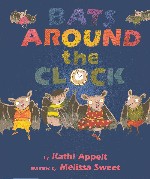
Bats Around the Clock by Kathi Appelt

Take a humorous dance through time.   Click Dark and American Batstand introduce a new dance each hour.   Students move through time, enjoy some rhyme and learn the names of some oldie-but-goodie dances along the way.
  • Making Time: For the second reading, give students individual clocks and ask them to move the hour hand to the next hour and say the time before reading the book section for that hour.
  • School Time: Provide copies of the  School Time Template and have students choose a time in the school day, draw the hands on the clock, write a verse and draw an illustration that shows what the class does during that hour. Assemble the individual hours into a class booklet or booklets, depending on the number of students in the class. This activity is easily differentiated to feature time on the hour, or to use the real time schedule of activity changes the class follows. The template clock deliberately shows no hands, allowing teachers to customize the activity to the appropriate mathematical level of students in the class.

Tuesday, May 31, 2011

Problem Solving: Multiplication Arrays

Arrays are one graphical representation of multiplication that students must understand.  These problems were created to provide practice in creating arrays.

  • Ants Marching assesses student understanding of the concept of multiplication as arrays.
  • Third Grade Parade also assesses student understanding of the concept of multiplication as arrays.
  • Cheerleader Competition was designed to assess student understanding of multiplication as an array.

Sunday, September 26, 2010

Factor Blaster

Students must think about the factors of each number as they play this game.   Students quickly learn the value of selecting prime numbers as a strategy.   The beauty of the game design is that students will review the factors of many numbers and mentally add the sum of these factors together in search of the "best move." 

Basically, start with the numbers 1-25.  The first student may choose any number and gets that many points.  The second student identifies and keeps any factors of that number that are still on the board.  Play then switches with the second student picking any number, and the first student identifying and taking any factors of the chosen number that still remain on the playing board.

This means that students have to think carefully about the number they choose, mentally identifying and tallying any factors left on the board.  So, the game provides lots of practice in identifying all of the factors of these numbers.  Students quickly strategize and learn that prime numbers make great early picks that provide no points for their opponent.


Note:  Factor Blaster is very close to Factor Game, but Factor Blaster allows students to take numbers, even if there are no factors left on the board.  Students not only learn factors; they also master the prime numbers which is a great skill for prime factorization.

Classroom Management Suggestions:
  • Introduce the game by playing against the class or by dividing the class into two teams and playing on the overhead or using large numbers on the board.
  • Use cheap cookie sheets and magnetic number cards to create easy versions of the game for partner play.  All of the numbers fit on the cookie sheet and the cookie sheets nest within each other for easy storage.  Dollar stores are a great place to find cheap cookie sheets for this purpose. 

 Differentiation:
  • Use different ranges of numbers to challenge students or remove a couple of numbers to shake up the usual game
  • Allow basic skills students to use lists of factors as they begin to play the game OR begin with the numbers 1-12 and increase the range as students master the factors of these numbers 


Check out Factor Blaster on Mathwire for additional discussion of the rules, classroom management suggestions and to download number cards and directions for the game.