- Give students the chalk or marker and ask them to come to the board or overhead to explain their thinking. Resist asking students to tell you what they did while you write what they did. Asking students to write as they explain allows them to organize their thinking and provides insight to teachers about what strategies and organizational methods students use effectively and independently. This strategy also provides practice for the expected independent test performance.
- Ask another student to repeat a student's explanation or insight. Resist the urge to repeat or paraphrase each student's response. Ask classmates to do this instead, fostering active participation/listening skills in all students.
- Ask students to read directions or problems aloud rather than reading them yourself. Once again, this practice encourages students to develop effective reading skills for math activities and tests. If reading levels are an issue in your classroom, you might begin with buddy reading, pairing students to effectively mitigate this issue.
- Ask students to define math vocabulary terms in their own words. Post the best definitions around the room.
- Post samples of effective problem-solving solutions that meet tough requirements of the problem-solving rubric you use to grade student responses. Make overheads of student samples and review them regularly so that all students see examples of effective ways to organize solutions and explain thinking.
- Expect students to be capable of some independent work. Voice this expectation to students as in "I want to see how each of you does on Math Boxes #3 and #4 today, so please begin with those boxes. I believe that everyone can do these by themselves and I will be around to check. After you finish these two math boxes, you may do the others in any order you choose."
- Quickly spin off students who are capable of independent work. Provide enrichment activities that go beyond current grade-level expectations and require higher-order thinking skills for solutions. Encourage these students to play harder versions of math games (i.e. more cards, larger numbers, etc.)
- Differentiate and scaffold instruction to effectively meet the varied needs of learners in your classroom. Provide enrichment activities for talented students while you work with small groups who need additional instruction or scaffolded support/encouragement during independent practice. Use flexible grouping based on informal assessment of student responses during instruction.
Tuesday, August 23, 2011
Active Participation Strategy: Let Go and Let Students...
Monday, August 22, 2011
Morning Math Routines
Mathwire offers a short description of the most common morning math routines for teachers to check out. Your math series may also prescribe many of the same activities so be sure to read through the introduction of your teacher's manual for more information.
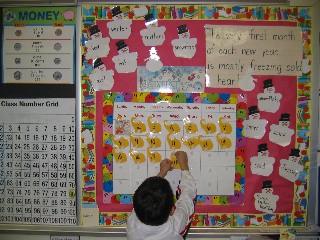
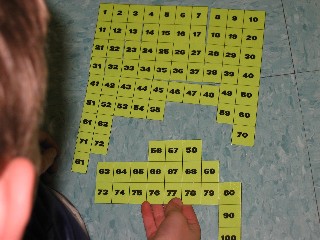
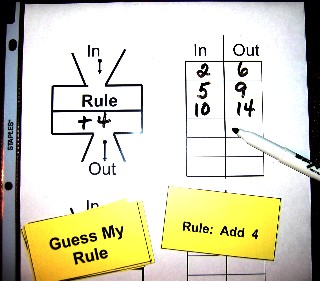
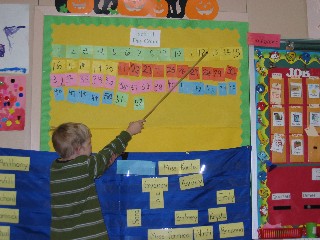
Teachers use many different charts and organizational practices to streamline these routines, so Mathwire added a Morning Math Routines: Photo Gallery. This photo gallery reflects how different teachers integrate these routines into real classrooms. Teachers use many charts and varied organizational methods to provide visual cues for these important mathematical routines. Hopefully, this photo gallery will provide ideas for teachers looking for different ways to integrate these mathematical routines into daily classroom bulletin boards.
Most importantly, however, is the student role in morning math routines. Your goal, as a teacher, is to introduce and structure these activities so that students become the active participants. Some teachers post names next to each station so that student leads the activity for the day or week. Remember, that these activities are designed to build number sense in students, so it is imperative that students are in control and have the opportunity to demonstrate their understanding and proficiency in number operations. Kindergarteners are capable of leading their peers and almost all students enjoy the opportunity to be teacher for a day, so let go and let the students take charge. You'll learn a lot by observing.
Wednesday, May 11, 2011
Active Participation: Let Go and Let Students...
- Give students the chalk or marker and ask them to come to the board or overhead to explain their thinking. Resist asking students to tell you what they did while you write what they did. Asking students to write as they explain allows them to organize their thinking and provides insight to teachers about what strategies and organizational methods students use effectively and independently. This strategy also provides practice for the expected independent test performance.
- Ask another student to repeat a student's explanation or insight. Resist the urge to repeat or paraphrase each student's response. Ask classmates to do this instead, fostering active participation/listening skills in all students.
- Ask students to read directions or problems aloud rather than reading them yourself. Once again, this practice encourages students to develop effective reading skills for math activities and tests. If reading levels are an issue in your classroom, you might begin with buddy reading, pairing students to effectively mitigate this issue.
- Ask students to define math vocabulary terms in their own words. Post the best definitions around the room.
- Post samples of effective problem-solving solutions that meet tough requirements of the problem-solving rubric you use to grade student responses. Make overheads of student samples and review them regularly so that all students see examples of effective ways to organize solutions and explain thinking.
- Expect students to be capable of some independent work. Voice this expectation to students as in "I want to see how each of you does on Math Boxes #3 and #4 today, so please begin with those boxes. I believe that everyone can do these by themselves and I will be around to check. After you finish these two math boxes, you may do the others in any order you choose."
- Quickly spin off students who are capable of independent work. Provide enrichment activities that go beyond current grade-level expectations and require higher-order thinking skills for solutions. Encourage these students to play harder versions of math games (i.e. more cards, larger numbers, etc.)
- Differentiate and scaffold instruction to effectively meet the varied needs of learners in your classroom. Provide enrichment activities for talented students while you work with small groups who need additional instruction or scaffolded support/encouragement during independent practice. Use flexible grouping based on informal assessment of student responses during instruction.
- Download Active Participation Strategies for Math Classes: a one-page text-only summary of the strategies discussed above
- Download Active Participation Strategies for Math Classes: the full text of this section with pictures
Wednesday, May 4, 2011
Active Participation Strategy: Show Me The Answer
- Use student digit cards to have students form the largest or smallest number from those digits. Or dictate a number and have students form the number using their digit cards. The teacher may then ask students to hold up the digit in the hundreds place or in the ten-thousands place. See More Place Value Activities for additional suggestions.
- Give students small response cards: even/odd, prime/composite, yes/no, area/perimeter and ask students to hold up the correct card to respond to questions.
Friday, September 10, 2010
Math Templates
Using math templates during instruction keeps each student actively involved and allows the teacher to informally assess each student's proficiency with the skills and concepts addressed in the day's lesson. Many teachers regularly use whiteboards to have students record answers, write terms, draw pictures, etc. The use of templates in sheet protectors extends this practice and eliminates the time spent drawing diagrams, etc., allowing students more time to demonstrate mathematical proficiency. Teachers who regularly use math templates include planned task items that assess student proficiency. Careful observation of student responses allows teachers to form flexible small groups for additional instruction or enrichment and also better plan for instruction.
The Mathwire Template Library is a collection of generic math templates available in PDF format for easy downloading and printing. Students insert each template into a clear sheet protector, then use dry erase pens and erasers to extend the life of these templates.
- Read more about using math templates in the classroom.
- See all templates in the Mathwire Template Library.
Monday, April 12, 2010
Using Whiteboards and Math Templates to Encourage Active Participation
Teachers who effectively incorporate whiteboard and/or template activities gather useful data about which students understand or are proficient, which students need some additional guided practice or instruction and which students are missing some of the prerequisite skills for the particular lesson or need a different approach to the concept or skill.
Be sure to check out these Mathwire collections for ideas on incorporating white boards and templates in math lessons:
- Instructional Strategies: Active Participation
- Active Participation: Using Math Templates
- Mathwire Template Library
Tuesday, August 11, 2009
Active Participation: Using White Boards

A few years back, NCTM sold buttons that said “Math is not a spectator sport.” This is so true as we know that students have to be ACTIVELY involved in math lessons in order to construct meaning for themselves. White boards are my favorite tool for easily adding participation to classroom lessons and activities. Each student must write on his/her white board, allowing the teacher to see what each student is thinking. This makes it easy to evaluate learning throughout the lesson and modify, reteach or enrich, as needed, to meet these identified needs. Teachers who sprinkle these quick, written checks throughout lessons find it easy to form small groups for additional instruction or guided practice. They also identify more capable students who do not need the extra practice and would benefit from some enrichment activity.
Cheap White Board Alternative
Each student should have a whiteboard, dry erase marker and eraser that is kept in his/her desk for easy retrieval. If you do not have whiteboards, or need more to have one for each student, consider using the cheap alternative. Place a sheet of white card stock in a shiny sheet protector and use this as a white board. You could use regular paper, but the card stock is heavier and holds up better. It will also remain upright when students hold up their white boards for checking. Erasers can also be small pieces of black felt so each student can have his/her own.
Use White Boards to Assess and Differentiate Instruction
Students love working with white boards. There’s something about the dry erase marker and the ability to wipe the slate clean and start over that appeals to even the most reluctant students. Unlike paper and pencil, wrong answers and mistakes are easily wiped away in the process of learning. Focusing on only one problem at a time also helps students who need chunking to reduce visual clutter or students who are overwhelmed by a whole blank worksheet or workbook page. So, get out the white boards, markers and erasers this year and start planning to use them throughout each math lesson. They are an extremely valuable tool as you quickly evaluate student understanding of the lesson’s objective. They are also provide a way to assess previous learning before beginning a new unit to be certain that students have the requisite concepts and skills.
Some Suggestions for Using White boards to Increase Active Student Participation:
Do Now or Warm-up Activity
o Write another fraction that is equal to ½.
o Which is larger 7.2 or 7.20? Why?
o What do you call the number that appears the most often in a data set?
o When you measure around the yard for a new fence, are you finding the perimeter or area of the yard?
Transition Times: give students a task to do as you check homework, distribute papers, etc. Tell students they will have to explain their thinking when you check whiteboards.
o Write the fact family for these numbers: 4, 5, 9
o Write as many different names as possible for the number 12.
o Write down 5 fractions that are between ¼ and 5/8.
o Show 4 different ways to make 45 ¢.
More Active Participation Strategies:
Check out additional active participation strategies on Mathwire: http://www.mathwire.com/strategies/is.html#active
What’s your favorite way to use white boards in your math lessons? Post a comment with your favorite strategy.