How Many Ghosts Do You See?
This activity encourages students to apply the patterns in Pascal's Triangle. A teacher instructional plan with mathematical background, answer and challenge is included to explain how to present this problem, which is also an outgrowth of the Rutgers Discrete Math Institute.
A recording sheet is also included as part of the teacher packet so that students are able to record all different solutions using a systematic counting method, which is a goal of discrete mathematics.
Download Pascal's Ghosts problem, instructional plan, student recording sheet and answer key.
Be sure to check out Pascal's Pumpkins in an earlier post. This is an easier introduction to the patterns in Pascal's triangle.
Showing posts with label discrete math. Show all posts
Friday, October 28, 2011
Monday, January 31, 2011
Valentine Problem Solving: Heart Paths
Heart Paths
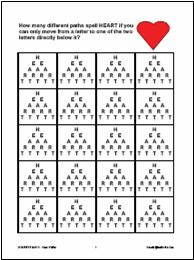
If students enjoyed the Pascal snow activities, then they'll also enjoy this Valentine's version of Pascal paths. Heart Paths challenges students to find all the different paths that spell HEART if they can only move from a letter to one of the two letters directly below it.
The number of possible paths is linked to Pascal's Triangle and older students will be amazed at how this mathematical pattern can be used to help them identify all of the paths. A recording sheet is included in the packet so that students may easily record paths and identify duplicates.
Download the Heart Paths activity which includes the problem, directions, recording sheet and answer key.
Suggestions for Classroom Use:
If students enjoyed the Pascal snow activities, then they'll also enjoy this Valentine's version of Pascal paths. Heart Paths challenges students to find all the different paths that spell HEART if they can only move from a letter to one of the two letters directly below it.
The number of possible paths is linked to Pascal's Triangle and older students will be amazed at how this mathematical pattern can be used to help them identify all of the paths. A recording sheet is included in the packet so that students may easily record paths and identify duplicates.
Download the Heart Paths activity which includes the problem, directions, recording sheet and answer key.
Suggestions for Classroom Use:
- Make an overhead of the Heart Paths problem or use the PDF on a SmartBoard for presentation.
- Demonstrate a legitimate path moving from a letter to one of the two letters directly below it.
- Demonstrate an illegitimate path by moving from a letter to another letter not directly below it.
- Do not tell students how many paths there are. Students need to develop confidence in their own ability to capture all of the paths.
- Use an overhead of the Heart Paths recording sheet (or the PDF file on a SmartBoard for class discussion. Have students come to the overhead to draw possible paths.
- Follow up with a discussion of systematic counting. If students did not use a systemized approach to this problem, demonstrate finding all of the possible paths for the first E, then move to the second E, etc. NOTE: The answer key included in this activity follows a systematic counting system. Systematic counting is an important concept in discrete math and very applicable to computer programming. For students, it is a logical approach that almost guarantees that they will consider every option, so it is a strong strategy to add to their problem solving repertoire.
Monday, January 24, 2011
Pascal Paths
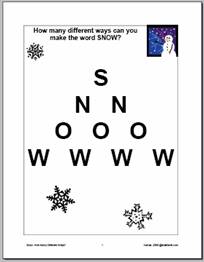
How Many Ways Can You Make Snow? encourages students to apply the patterns in Pascal's Triangle. A teacher instructional plan with mathematical background, answer and challenge is included to explain how to present this problem. A recording sheet was also included as part of the teacher packet so that students are able to record all different solutions in a "systematic" way, which is a goal of discrete mathematics.
Extension:
Extend this lesson using the word winter to form Pascal paths. How many possible different paths are there for this word? How does it relate to Pascal's Triangle?
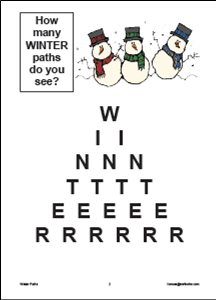
How Many Winter Paths involves systematic counting of the different Pascal paths in this arrangement of the word WINTER. Students will be challenged to relate this activity to Pascal's triangle as they analyze their solutions to see if they have found all of the ways to reach each R in the bottom row. A teacher instructional plan with mathematical background, answer and this challenge is included to explain how to present the problem. The recording sheet encourages students to trace one path in each frame, making it easy to see if students use a systematic counting approach to solving the problem.
- Download How many different ways can you make the word SNOW? problem, recording sheet and answer key.
Extension:
Extend this lesson using the word winter to form Pascal paths. How many possible different paths are there for this word? How does it relate to Pascal's Triangle?
How Many Winter Paths involves systematic counting of the different Pascal paths in this arrangement of the word WINTER. Students will be challenged to relate this activity to Pascal's triangle as they analyze their solutions to see if they have found all of the ways to reach each R in the bottom row. A teacher instructional plan with mathematical background, answer and this challenge is included to explain how to present the problem. The recording sheet encourages students to trace one path in each frame, making it easy to see if students use a systematic counting approach to solving the problem.
- Download How many winter paths do you see? problem, recording sheet and Pascal's link. This PDF also contains instructional suggestions for presenting this problem to students.
Labels:
discrete math,
Pascal,
Pascal's Triangle,
pattern,
snow,
systematic counting
Tuesday, October 12, 2010
Pumpkin Problem Solving
Take advantage of the seasonal preoccupation with pumpkins to include some problem solving activities. These seasonal activities include the student handout and a detailed possible solution, both in PDF format for easy downloading and printing.
- Pascal's Pumpkins is an activity from the Rutger's Discrete Math collection, revised by Mathwire, that challenges students to analyze the patterns in order to complete the array. The file contains the student handout as well as an explanation of the different patterns students may find and the solution.
- Pumpkin Picking challenges students to solve a pattern problem. The solution provided details how students might use a table to organize the data and easily identify the correct answer to this problem.
- Pumpkin Farm is a sneaky way to get students to analyze the meaning of remainders in long division. Students must figure out which character will be the 100th to be printed on a neon signboard. The file contains the student handout as well as a detailed possible solution.
- Jack-o-Lantern Combinations challenges students to figure out how many different pumpkins may be made, given the assortment of eyes, noses and mouths. This problem provides an opportunity to expose students to the concept of orderly counting where they exhaust all possibilities for one component before moving to the next, so that they exhaust all possibilities without duplication.
Friday, July 9, 2010
Heads and Tails Investigation
Explore the probability of a one-coin toss using the Heads and Tails Game. This is an easy game for young learners. All you need to play is the Heads and Tails gameboard, two coins for markers and another coin to flip. Use a coin toss to decide who will be heads and who will be tails. Then the fun begins!
PLAYING THE GAME:
Both players place their marker coins on the star on the snake. The player who is HEADS flips the coin first. If the flip is HEADS, the player moves his/her marker one space toward the head. If the flip is TAILS, the player doesn't move.
Next, the TAILS player, flips the coin, moves one space if it lands on TAILS, stays put if it comes up HEADS.
Play continues switching back and forth until one of the players' markers reaches the head of tail of the snake to win the game.
DISCUSSION:
Do both players have an equal chance of winning? Try keeping a record of several games to see if HEADS and TAILS really both win.
Does it matter who goes first? Sometimes let HEADS go first; other times, let TAILS go first.
Use a simple tally sheet to record whether HEADS or TAILS wins each game.
VARIATION:
EXTENDED PLAY OPTION: The HEADS player tosses the coin. If it comes up HEADS, the player moves the coin one space toward the head and tosses again. If it comes up TAILS, the player stops and does not move. The TAILS player now tosses the coin. If the toss comes up TAILS, the player moves the coin one space toward the tail and tosses again. The player continues as long as the toss comes up TAILS. The game continues until a player's marker reaches the HEAD or TAIL of the snake.
DISCUSSION:
Do both players still have an equal chance of winning?
Does the game go faster this way? Explain.
What was the longest move either HEADS or TAILS got on one turn?
MODIFICATIONS:
If young players have trouble tossing the coin, use a small container and let them drop the coin into the container.
OR place the coin in a small see-through container such as a clear plastic jar with lid. Players then simply shake the jar and place it down on the table on its lid. It's easy to see whether it landed on HEADS or TAILS without opening the jar.
Buy larger coins at the dollar store. Remember that these are not the same weight as real coins and any imperfections may affect the outcome of the games. This could prove an interesting investigation for older players. Are some coins HEADS-winning coins and others TAILS-winning coins or are they all fairly equal?
Labels:
coin,
discrete math,
game,
heads,
probability,
tails,
toss
Friday, January 29, 2010
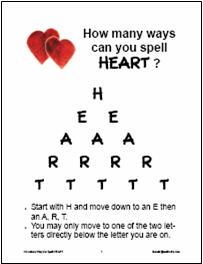
How many ways can you spell HEART?
Heart Paths
Students will enjoy this discrete math activity that challenges them to find all of the possible ways to spell heart. Each path starts on the H and moves down to an E, then an A, then an R, and finally a T. You may only move to one of the two letters directly below the letter you are on.
This activity is directly related to Pascal's Triangle, so it would be beneficial if students have previous experience with this famous pattern. Try Pascal's Hearts which challenges students to try to figure out how to fill in the missing rows. The downloadable file contains a notated solution which teachers may use to lead a class discussion of the solution and any patterns students can find in Pascal's Triangle.
The downloadable Heart Paths file contains a student recording sheet so that students can record their paths in an orderly fashion. This enables students to check that they have not duplicated a previous path. Classroom teachers might make a transparency of this handout to be used on the overhead. This way different students can draw paths as the class discusses the possible paths.
Be sure to check out the Mathwire Discrete Math collection for additional discrete math Pascal's path activities. The SNOW activity download includes a teacher step-by-step orderly solution that relates the rows to the rows of Pascal's Triangle. This same process is easily extended to the 5-letter HEART paths.
Students will enjoy this discrete math activity that challenges them to find all of the possible ways to spell heart. Each path starts on the H and moves down to an E, then an A, then an R, and finally a T. You may only move to one of the two letters directly below the letter you are on.
This activity is directly related to Pascal's Triangle, so it would be beneficial if students have previous experience with this famous pattern. Try Pascal's Hearts which challenges students to try to figure out how to fill in the missing rows. The downloadable file contains a notated solution which teachers may use to lead a class discussion of the solution and any patterns students can find in Pascal's Triangle.
The downloadable Heart Paths file contains a student recording sheet so that students can record their paths in an orderly fashion. This enables students to check that they have not duplicated a previous path. Classroom teachers might make a transparency of this handout to be used on the overhead. This way different students can draw paths as the class discusses the possible paths.
Be sure to check out the Mathwire Discrete Math collection for additional discrete math Pascal's path activities. The SNOW activity download includes a teacher step-by-step orderly solution that relates the rows to the rows of Pascal's Triangle. This same process is easily extended to the 5-letter HEART paths.
Labels:
discrete math,
heart,
Pascal,
Pascal's Triangle,
paths,
patterns,
recording sheet,
Valentine's Day
Friday, December 18, 2009
12 Days of Christmas
Investigate the math behind this holiday gifting by working through DIMACS The Twelve Days of Christmas and Pascal's Triangle. Students who struggled to figure out the total number of gifts received will be astounded to discover that the patterns in Pascal's triangle may be used for an easy solution.
Students might also enjoy singing 12 Days of Math, a math teacher's parody of the famous carol.
Print out pictures of the 12 Days Gifts for students to color and/or use as props when singing the song and discussing solutions to the problem of total gifts given in this holiday song.
Thursday, October 15, 2009
Candy Bingo Cards
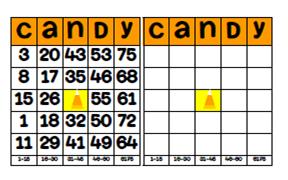
Bingo is a great game that provides number recognition practice for pre-kindergarten through first grade students. This set of bingo cards includes 10 different bingo cards and a set of blank cards teachers may use to have students create their own winning cards. The range of numbers they may use for each column is posted at the bottom of each column. This is another terrific skill as students must choose appropriate numbers that fall within each range, including the endpoints in this case.
Download the Candy Bingo Cards for a great seasonal math activity. The cards work for the entire fall season. Teachers may use unit cubes, bingo markers or candy corn for the bingo pieces. These cards work equally well for family get-togethers with children!
Labels:
bingo,
candy corn,
discrete math,
game,
number recognition,
seasonal
Tuesday, October 13, 2009
Pascal's Pumpkins
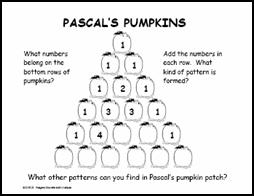
Pascal's Pumpkins encourages students to look for patterns in Pascal's Triangle. The handout develops awareness of this important mathematical pattern through this timely seasonal activity. Students who take higher math courses will meet Pascal again in many different applications, including probability. This handout is an outgrowth of the Rutgers Universiy Discrete Math Institute.
Download Pascal's Pumpkins. The PDF file contains the student handout and a detailed explanation of the different patterns students might find. Be sure to make an overhead copy of the pattern so that students are easily able to point out patterns and explain the pattern that they see as they fill in the empty pumpkins.
Extend the activity by asking students to draw and label the numbers in the 7th, 8th, etc. row. How does identifying the patterns help them complete this task more easily?
Labels:
discrete math,
fall,
Halloween,
Pacsal,
pattern,
pumpkin math,
seasonal math activities
Subscribe to:
Posts (Atom)