Showing posts with label recording sheet. Show all posts

Thursday, July 15, 2010

The Game of Pig

Pig is one of my favorite probability games.  I have played the game with kindergarten through college level students and used it in teacher training sessions.  Everyone LOVES the game and it's fun to watch who plays it safe and who's the risk-taker.  


In my own classroom experience, I have found that this is best introduced as a class activity. Students collect points for each toss of the die unless a ONE is tossed, which means they lose all of the points they have collected in the round. To prevent losing their points, students may elect to stop at any point in the game before a ONE is tossed and they get to keep the points they collected but get no further points. Students love the game and begin to appreciate that theoretical probability and experimental probability are often quite different! 

I devised a method that uses only one die tossed by the teacher, so this is a great transition activity that quiets a class as they strain to hear and record the results of the die toss AND decide if they will stop or continue to play.   It's a win-win because students feel that they're playing, but they're actually learning a lot about the probability of a one-die toss.

  • Download Pig directions.
  • Download Pig template or Pig Tally template, and place in a sheet protector to record die tosses.  Students may use dry erase markers for a reusable recording sheet.  The Pig Tally template requires students to use tally marks to record each toss of the die.  This recording sheet is a very visual presentation of the results and proves extremely useful when students devise winning strategies, as described below.
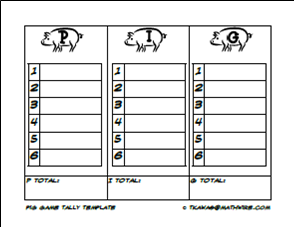
Results:  Younger students may use calculators to total each column.  Older students should use mental math to find the sum of the die tosses.  Students should write the total of all 3 columns in the upper right hand corner of the template and circle it.

Extending the Data Collection & Analysis:
  • Ask pairs or small groups of students to talk about the game and come up with a winning strategy.  For example, some groups decide to stop once they have 20 points.  Another group decides to stop when they get 3 of any number.
  • Have each group share their winning strategy and explain why they think it is a winner.
  • Play the game again.  Groups MUST play according to their winning strategy.
  • Discuss the results and allow groups to refine their strategies, if desired, before playing 1-2 more times.
  • Finally, ask students to write about what they learned from this game.  Is there really a winning strategy that works all the time?  Explain your thinking.

Friday, January 29, 2010

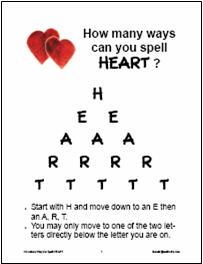
How many ways can you spell HEART?

Heart Paths

Students will enjoy this discrete math activity that challenges them to find all of the possible ways to spell heart.  Each path starts on the H and moves down to an E, then an A, then an R, and finally a T.  You may only move to one of the two letters directly below the letter you are on. 

This activity is directly related to Pascal's Triangle, so it would be beneficial if students have previous experience with this famous pattern.  Try Pascal's Hearts which challenges students to try to figure out how to fill in the missing rows.  The downloadable file contains a notated solution which teachers may use to lead a class discussion of the solution and any patterns students can find in Pascal's Triangle. 

The downloadable Heart Paths file contains a student recording sheet so that students can record their paths in an orderly fashion.  This enables students to check that they have not duplicated a previous path.  Classroom teachers might make a transparency of this handout to be used on the overhead.  This way different students can draw paths as the class discusses the possible paths.

Be sure to check out the Mathwire Discrete Math collection for additional discrete math Pascal's path activities.  The SNOW activity download includes a teacher step-by-step orderly solution that relates the rows to the rows of Pascal's Triangle. This same process is easily extended to the 5-letter HEART paths.