Showing posts with label Pascal's Triangle. Show all posts

Friday, October 28, 2011

Pascal's Ghosts

How Many Ghosts Do You See?


This activity encourages students to apply the patterns in Pascal's Triangle.  A teacher instructional plan with mathematical background, answer and challenge is included to explain how to present this problem, which is also an outgrowth of the Rutgers Discrete Math Institute.  


A recording sheet is also included as part of the teacher packet so that students are able to record all different solutions using a systematic counting method, which is a goal of discrete mathematics.  


Download Pascal's Ghosts problem, instructional plan, student recording sheet and answer key.


Be sure to check out Pascal's Pumpkins in an earlier post.  This is an easier introduction to the patterns in Pascal's triangle.


Tuesday, October 11, 2011

Pascal's Pumpkins

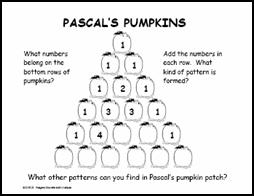
Pascal's Pumpkins   encourages students to look for patterns in Pascal's Triangle.   The handout develops awareness of this important mathematical pattern through a timely seasonal activity.

Students who take higher math courses will meet Pascal again in many different applications, including probability.   This handout is an outgrowth of the Rutgers Discrete Math Institute.

Download Pascal's Pumpkins handout and solution.

Thursday, March 17, 2011

Shamrock Paths

Shamrock Paths challenges students to use Pascal's Triangle to figure out how many different ways there are to spell Shamrock. Included in the PDF file are an explanation of how this problem relates to Pascal's Triangle and the numerical solution to the challenge. 

Download the Shamrock Paths student handout, explanation, and the solution.

Monday, January 31, 2011

Valentine Problem Solving: Heart Paths

Heart Paths

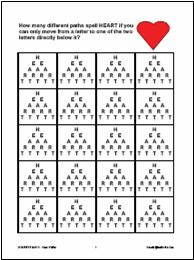
If students enjoyed the Pascal snow activities, then they'll also enjoy this Valentine's version of Pascal paths.  Heart Paths challenges students to find all the different paths that spell HEART if they can only move from a letter to one of the two letters directly below it. 

The number of possible paths is linked to Pascal's Triangle and older students will be amazed at how this mathematical pattern can be used to help them identify all of the paths.  A recording sheet is included in the packet so that students may easily record paths and identify duplicates.


Download the Heart Paths activity which includes the problem, directions, recording sheet and answer key.


Suggestions for Classroom Use:
  • Make an overhead of the Heart Paths problem or use the PDF on a SmartBoard for presentation.  
  • Demonstrate a legitimate path moving from a letter to one of the two letters directly below it.
  • Demonstrate an illegitimate path by moving from a letter to another letter not directly below it.
  • Do not tell students how many paths there are.  Students need to develop confidence in their own ability to capture all of the paths.
  • Use an overhead of the Heart Paths recording sheet (or the PDF file on a SmartBoard for class discussion.  Have students come to the overhead to draw possible paths.
  • Follow up with a discussion of systematic counting.  If students did not use a systemized approach to this problem, demonstrate finding all of the possible paths for the first E, then move to the second E, etc.  NOTE:  The answer key included in this activity follows a systematic counting system.  Systematic counting is an important concept in discrete math and very applicable to computer programming.  For students, it is a logical approach that almost guarantees that they will consider every option, so it is a strong strategy to add to their problem solving repertoire.

Monday, January 24, 2011

Pascal Paths

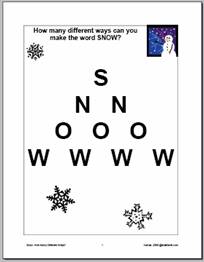
How Many Ways Can You Make Snow? encourages students to apply the patterns in Pascal's Triangle.   A teacher instructional plan with mathematical background, answer and challenge is included to explain how to present this problem.   A recording sheet was also included as part of the teacher packet so that students are able to record all different solutions in a "systematic" way, which is a goal of discrete mathematics. 


Extension:
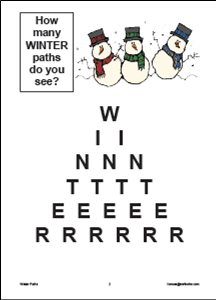
Extend this lesson using the word winter to form Pascal paths.  How many possible different paths are there for this word?  How does it relate to Pascal's Triangle?  

How Many Winter Paths  involves systematic counting of the different Pascal paths in this arrangement of the word WINTER.   Students will be challenged to relate this activity to Pascal's triangle as they analyze their solutions to see if they have found all of the ways to reach each R in the bottom row.   A teacher instructional plan with mathematical background, answer and this challenge is included to explain how to present the problem.   The recording sheet encourages students to trace one path in each frame, making it easy to see if students use a systematic counting approach to solving the problem.
  • Download How many winter paths do you see? problem, recording sheet and Pascal's link.  This PDF also contains instructional suggestions for presenting this problem to students.
 Note:  Systematic counting is an important concept in discrete mathematics.  Be sure to model using a systematic approach to finding all of the different paths, as presented in the instructional suggestions for this problem.  Students will benefit from adding this logical and systematic counting approach to their problem-solving repertoire.


Friday, January 14, 2011

Pascal's Penguins

Pascal's Penguins is an effective introductory activity to the well-known mathematical pattern known as Pascal's Triangle. Students must look for patterns in these penguin variations of Pascal's Triangle. The activity challenges students to identify patterns, fill in the missing numbers and write the next line in the pattern. Class discussion should encourage students to share all of the patterns they see in Pascal's Triangle and discuss how these patterns helped them discover the missing numbers. 

Pascal's Penguins - 1 introduces primary students to a small version of Pascal's Triangle in this simple patterning activity.  
Pascal's Penguins - 2 introduces a larger version of Pascal's triangle and encourages students to identify the different patterns within the triangle and use these patterns to fill in the missing penguin numbers. 

Friday, January 29, 2010

How many ways can you spell HEART?

Heart Paths

Students will enjoy this discrete math activity that challenges them to find all of the possible ways to spell heart.  Each path starts on the H and moves down to an E, then an A, then an R, and finally a T.  You may only move to one of the two letters directly below the letter you are on. 

This activity is directly related to Pascal's Triangle, so it would be beneficial if students have previous experience with this famous pattern.  Try Pascal's Hearts which challenges students to try to figure out how to fill in the missing rows.  The downloadable file contains a notated solution which teachers may use to lead a class discussion of the solution and any patterns students can find in Pascal's Triangle. 

The downloadable Heart Paths file contains a student recording sheet so that students can record their paths in an orderly fashion.  This enables students to check that they have not duplicated a previous path.  Classroom teachers might make a transparency of this handout to be used on the overhead.  This way different students can draw paths as the class discusses the possible paths.

Be sure to check out the Mathwire Discrete Math collection for additional discrete math Pascal's path activities.  The SNOW activity download includes a teacher step-by-step orderly solution that relates the rows to the rows of Pascal's Triangle. This same process is easily extended to the 5-letter HEART paths.