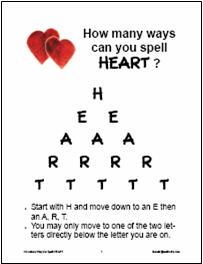
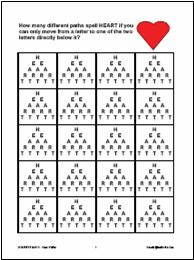
Heart Paths challenges students to find all the different paths that spell HEART if they can only move from a letter to one of the two letters directly below it. Students use the Heart Path worksheet to record each path, making it easy to check for duplicates.
This problem is best solved using systematic counting, an organized approach to solving the problem. While many students might not use this approach independently, it is beneficial for the teacher to spotlight students who successfully used this approach. Or, the teacher might model the approach as students check their own solutions, adding paths they might have missed in a more haphazard approach.
Download the Heart Paths worksheet which includes the problem sheet, worksheet and solution.
How Many Ghosts Do You See?
This activity encourages students to apply the patterns in Pascal's Triangle. A teacher instructional plan with mathematical background, answer and challenge is included to explain how to present this problem, which is also an outgrowth of the Rutgers Discrete Math Institute.
A recording sheet is also included as part of the teacher packet so that students are able to record all different solutions using a systematic counting method, which is a goal of discrete mathematics.
Download Pascal's Ghosts problem, instructional plan, student recording sheet and answer key.
Be sure to check out Pascal's Pumpkins in an earlier post. This is an easier introduction to the patterns in Pascal's triangle.
Valentine's Day Treat
This is a classic combination problem that challenges students to list all of the possible sundaes that can be made if students choose one ice cream and one topping from the cafeteria list. Note that students must choose a topping for this problem, otherwise they are simply buying ice cream which doesn't count as a sundae.
This problem was designed as a simple primary level introduction to combinations and systematic counting. The included possible solution details a simple way to introduce students to this method of counting combinations. Older students might use a tree diagram to find all of the possible combinations.
- Download Valentine's Day Treat which includes the student handout and a possible solution method using a simple listing of the different combinations.
Heart Paths
If students enjoyed the Pascal snow activities, then they'll also enjoy this Valentine's version of Pascal paths. Heart Paths challenges students to find all the different paths that spell HEART if they can only move from a letter to one of the two letters directly below it.
The number of possible paths is linked to Pascal's Triangle and older students will be amazed at how this mathematical pattern can be used to help them identify all of the paths. A recording sheet is included in the packet so that students may easily record paths and identify duplicates.
Download the Heart Paths activity which includes the problem, directions, recording sheet and answer key.
Suggestions for Classroom Use:
- Make an overhead of the Heart Paths problem or use the PDF on a SmartBoard for presentation.
- Demonstrate a legitimate path moving from a letter to one of the two letters directly below it.
- Demonstrate an illegitimate path by moving from a letter to another letter not directly below it.
- Do not tell students how many paths there are. Students need to develop confidence in their own ability to capture all of the paths.
- Use an overhead of the Heart Paths recording sheet (or the PDF file on a SmartBoard for class discussion. Have students come to the overhead to draw possible paths.
- Follow up with a discussion of systematic counting. If students did not use a systemized approach to this problem, demonstrate finding all of the possible paths for the first E, then move to the second E, etc. NOTE: The answer key included in this activity follows a systematic counting system. Systematic counting is an important concept in discrete math and very applicable to computer programming. For students, it is a logical approach that almost guarantees that they will consider every option, so it is a strong strategy to add to their problem solving repertoire.
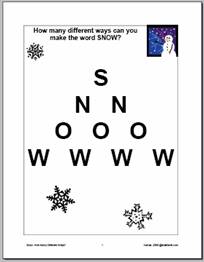
How Many Ways Can You Make Snow? encourages students to apply the patterns in Pascal's Triangle. A teacher instructional plan with mathematical background, answer and challenge is included to explain how to present this problem. A recording sheet was also included as part of the teacher packet so that students are able to record all different solutions in a "systematic" way, which is a goal of discrete mathematics.
Extension:
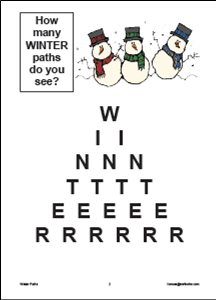
Extend this lesson using the word winter to form Pascal paths. How many possible different paths are there for this word? How does it relate to Pascal's Triangle?
How Many Winter Paths involves systematic counting of the different Pascal paths in this arrangement of the word WINTER. Students will be challenged to relate this activity to Pascal's triangle as they analyze their solutions to see if they have found all of the ways to reach each R in the bottom row. A teacher instructional plan with mathematical background, answer and this challenge is included to explain how to present the problem. The recording sheet encourages students to trace one path in each frame, making it easy to see if students use a systematic counting approach to solving the problem.
- Download How many winter paths do you see? problem, recording sheet and Pascal's link. This PDF also contains instructional suggestions for presenting this problem to students.
Note: Systematic counting is an important concept in discrete mathematics. Be sure to model using a systematic approach to finding all of the different paths, as presented in the instructional suggestions for this problem. Students will benefit from adding this logical and systematic counting approach to their problem-solving repertoire.