Showing posts with label dice. Show all posts

Tuesday, November 29, 2011

Dice in the Classroom

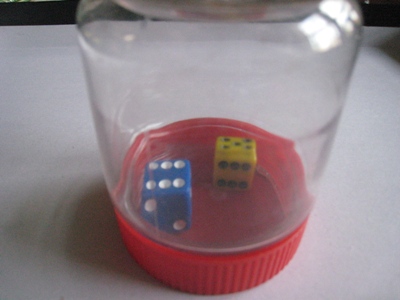
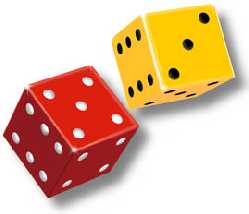
There are so many effective math games and data investigations that involve tossing dice.  One way to help young students toss dice is to place the dice in a clear jar.  Students simply shake the jar, place it down on its lid, and read the dice toss.  Teachers may place 1-4 dice in the jar and they're ready to go.  HINT:  This also works for coin tosses!


Some teachers prefer to use the small trays in which vegetables and fruits are sometimes packed or small boxes or box lids.  The sides stop the dice from rolling off the student desk.  If noise is a concern in the classroom, place a sheet of craft foam in the bottom of the tray and the dice tosses will be silent.


Now check out some activities from the Mathwire collections:

Saturday, October 8, 2011

Handful of Pennies

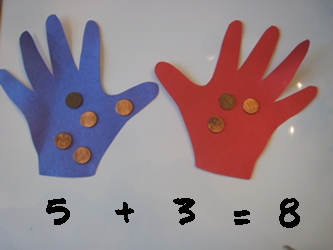
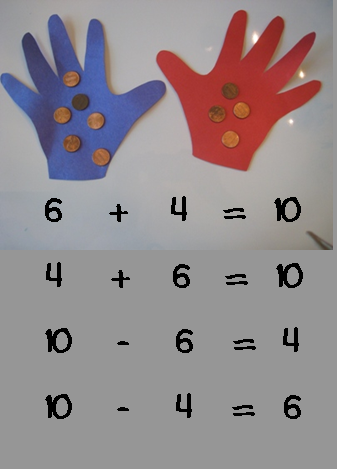
The student rolls a die and places that many pennies in the blue hand.  She rolls the die again and places that many pennies in the red hand.  Next, the student writes a number sentence for the number of pennies in each hand.


Students may work independently on this activity to practice their math facts.  Students enjoy both dice and money so it's a great way to provide practice in basic facts.  Students who need concrete practice may simply count the pennies, then write the corresponding sentence.


MATERIALS:  

  • Students create their own mats by tracing their hands onto a piece of oaktag or card stock.  Students may elect to color the hands blue and red, as pictured.  
  • Insert the mat into a page protector and use dry erase markers for easy cleaning and re-use.
  • Create a blank template for the overhead.

EXTENSIONS:  
  • Ask the student to write the other three number sentences for each number family.
  • Challenge students to complete this activity with 3-4 handfuls of pennies by linking together 2 mats.
  • Have students roll 2 dice instead of one die and place that many pennies on the hand.  Repeat for the other hand.


Monday, April 4, 2011

Free the Animals Game

Who will free their animals first?   Students toss two dice, calculate the difference and free an animal from that number cage.   Younger students will enjoy this animal version of the Release the Prisoners game and learn subtraction facts as well.   Both the 6-sided dice game mat and the 12-sided dice game mat are included with directions. 

  • Download the Free the Animals game directions and game mats for 6-sided dice to practice easier subtraction facts or 12-sided dice to practice harder subtraction facts. 
  • Download the Free the Animals game recording sheet designed so that students can track how many animals each player places in his/her cages and who wins.   Hopefully, students will learn something about probability while mastering subtraction facts.

Saturday, January 22, 2011

Penguin Bowling Game

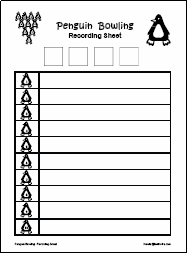
The Penguin Bowling Game was designed to provide mixed basic facts practice. Students toss 4 dice, then use the numbers from the dice throw and any of the four operations (+, -. *, /) to form expressions to knock down penguin pins. They are trying to create expressions that result in answers of each number from 1-10.  Each student uses a recording sheet to write their expressions.  Insert the recording sheet into a plastic sheet protector and use dry erase markers for a renewable option.

Students use a score sheet to record group scores as one does in real bowling games. Remember to model the scoring process, using an overhead of the scoring sheet, if students are not familiar with scoring regular bowling games. Teachers will especially have to model how to score a strike, as students will be strongly motivated to knock down all ten penguins in each round to gain these extra strike points.

This activity is a great do-now for students at the beginning or end of class to provide basic facts practice that students find highly motivating in a game format.  Additionally, students profit from seeing and hearing the expressions their peers created and they are more likely to incorporate similar strategies in future play.

Penguin Bowling Game Materials:

Saturday, September 18, 2010

Clean up the Money Game

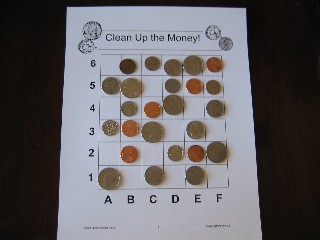
This 2-player game challenges students to toss 2 dice, form a coordinate pair, then collect the coin from that space, if there is one.   First students alternate placing quarters, dimes, nickels and pennies on the gameboard. Then students toss a regular die and a special die (A-B-C-D-E-F) to form the coordinate pair and remove the coin from the matching space.  
Variations of the game are given but students must always find the value of their coins to identify the winner of the game so they get plenty of practice sorting and counting coins. NOTE: Buy wooden cubes at craft stores to create the ABCDEF die or use labels to cover the faces of a regular die.

Download the directions, game mat and recording sheet for the Clean up the Money game.
See more Mathwire Money Games.

Saturday, August 28, 2010

Data Collection: Tossing Two Dice

Students LOVE working with dice, almost forgetting that they're doing math.  While standard probability lessons ask students to calculate the probability of tossing an even number, a sum of 10, etc., students are more highly motivated when they generate their own experimental data.

The Mathwire collection contains many examples of both one-die toss activities and two-dice toss activities.  These data investigations begin with a game but make data collection an integral part of the activity, so that students begin to examine the underlying probability of the game and can use appropriate strategies in future play.

Students will generate their own small set of data, which should be combined with the whole class data for a larger set.  Teachers may ask questions to help students draw conclusions and make generalizations about the probability of dice tosses.

After this initial hands-on data collection and analysis, extend the activity by asking students to use online dice simulators to generate even more data to test their hypotheses and generalizations.  This option allows students to quickly generate large sets of random data.  It is helpful to pair students for this activity:  one student at the computer keyboard and the other student recording the results of each simulated dice toss.  Again, ask students to post their results to a class data collection display (e.g. tally chart, graph, etc.) so that the class is able to analyze the larger sample.

Check out these online dice-toss simulators:
  • Coins & Dice:  A Probability Simulator records the results of each dice toss, making it easy for students to record the result of each dice toss
  • Dice Roll displays the results in a bar graph so that students visually see the results of extended dice tosses
This data collection and data anaylsis approach provides students with hands-on data collection activities that generate real-life data for analysis.  Students then take advantage of technology to simulate the activity, quickly collecting larger sets of random data.  It's the best of both worlds!

Sunday, August 1, 2010

Three Strikes and You're Out!


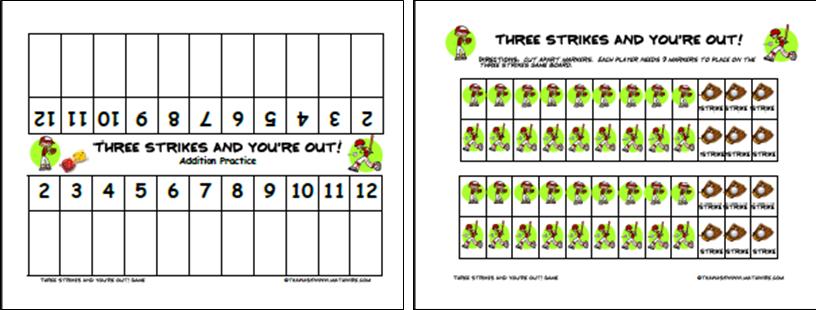
Summer means baseball games so capitalize on this favorite sport with the game Three Strikes and You're Out!  The game was designed to practice addition and subtraction facts while incorporating a basic introduction to probability outcomes. 

Players will enjoy choosing the numbers for their players and their strikes.   As they play the game, they'll learn which numbers are best for placing players and which numbers are best left as strikes, developing a basic understanding of probability.  They'll practice addition or subtraction facts while learning that the dice toss is often unpredictable and random.

The game uses the sum of two dice to practice addition facts, but may easily be adapted to practice subtraction facts by using two 12-sided dice and finding the difference. The game handouts include directions, variations in play and scoring, game boards for both the addition and subtraction games, as well as game pieces that may be used to support the baseball theme.  

Download the directions and gameboards for Three Strikes and You're Out.

Thursday, July 15, 2010

The Game of Pig

Pig is one of my favorite probability games.  I have played the game with kindergarten through college level students and used it in teacher training sessions.  Everyone LOVES the game and it's fun to watch who plays it safe and who's the risk-taker.  


In my own classroom experience, I have found that this is best introduced as a class activity. Students collect points for each toss of the die unless a ONE is tossed, which means they lose all of the points they have collected in the round. To prevent losing their points, students may elect to stop at any point in the game before a ONE is tossed and they get to keep the points they collected but get no further points. Students love the game and begin to appreciate that theoretical probability and experimental probability are often quite different! 

I devised a method that uses only one die tossed by the teacher, so this is a great transition activity that quiets a class as they strain to hear and record the results of the die toss AND decide if they will stop or continue to play.   It's a win-win because students feel that they're playing, but they're actually learning a lot about the probability of a one-die toss.

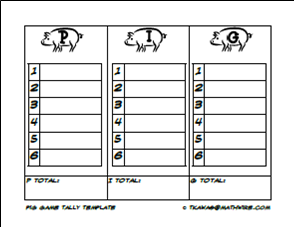
  • Download Pig directions.
  • Download Pig template or Pig Tally template, and place in a sheet protector to record die tosses.  Students may use dry erase markers for a reusable recording sheet.  The Pig Tally template requires students to use tally marks to record each toss of the die.  This recording sheet is a very visual presentation of the results and proves extremely useful when students devise winning strategies, as described below.
Results:  Younger students may use calculators to total each column.  Older students should use mental math to find the sum of the die tosses.  Students should write the total of all 3 columns in the upper right hand corner of the template and circle it.

Extending the Data Collection & Analysis:
  • Ask pairs or small groups of students to talk about the game and come up with a winning strategy.  For example, some groups decide to stop once they have 20 points.  Another group decides to stop when they get 3 of any number.
  • Have each group share their winning strategy and explain why they think it is a winner.
  • Play the game again.  Groups MUST play according to their winning strategy.
  • Discuss the results and allow groups to refine their strategies, if desired, before playing 1-2 more times.
  • Finally, ask students to write about what they learned from this game.  Is there really a winning strategy that works all the time?  Explain your thinking.

Sunday, December 20, 2009

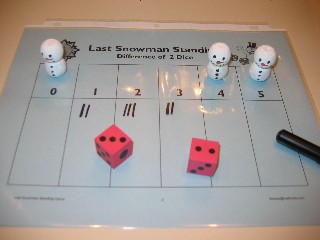
Last Snowman Standing Game

The snowmen face off in this game of addition facts. But beware! A toss of the die may mean the sun melts a snowman. Students practice addition facts as they try to be the last snowman standing because in this game the first person to remove all of his/her snowmen loses the game!


The snowmen pictured above were created with two wooden beads glued together, then painted white, The face was added with sharpie pens. Just be sure to buy the beads that have a flat bottom so that the snowmen will stand. Or, use any manipulative as snowmen.

Download the Last Snowman Standing Game which includes directions and game mats for three different versions of the game:
  • Sum of Two Dice Version to practice addition facts
  • Difference of Two Dice Version to practice subtraction facts
  • One Die Toss for a simplified version to analyze the probability of a die toss

Data Collection: The directions for each version also include directions for data collection and analysis of the outcomes of the games. Be sure to incorporate these activities, if at all possible, as games offer a highly motivational study in probability. Students love to "play games" to collect data. They're also eager to analyze games so that they learn how the game works and what strategies they can use to improve their odds of winning.

Differentiation: This game offers many opportunities to differentiate the activity. First of all, teachers are able to select from three different versions. Secondly, each teacher should differentiate the game analysis to meet the instructional level of his/her students. Most students can handle the questions with teacher guidance. Older students and talented primary students may be challenged to analyze the game and answer the questions in small groups.