Coin Race
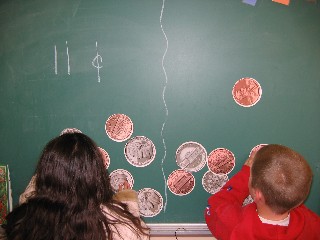
Mrs. Higgins and Ms. Gillespie's first graders at Port Monmouth Road School in Keansburg, NJ, use large magnetized coin cutouts to make the correct money amount. This activity provides a platform for discussing different ways to make the same amount as student pairs often choose different coin combinations. Students at their seats use coins to create combinations as well and record them on whiteboards, if desired.
Many Coins, Many Ways
Challenge students to find all of the different ways to use coins to express the day's date. Students may start this challenge haphazardly, but this activity presents older students the opportunity to learn the value of using an organized approach to solving these types of problems so that they will be confident that they have found all of the possibilities. Teachers might model the use of a chart, for instance, to record combinations. Students should be prompted to talk about the orderly approaches they used.
Showing posts with label coin. Show all posts
Friday, April 1, 2011
Monday, September 20, 2010
Coin Combinations
It is important that students recognize that there are often different combinations of coins for any particular value. Many problem-solving activities incorporate this skill as students search for all of the different ways to make 50 cents, for example.
One teacher uses these large coin cut-outs, available at teacher supply stores, to challenge students to find different combinations for the same value. The students love being at the board, manipulating the large coins, and coming up with different combinations. Students at their seats work with small bags of coins to complete the same task.
Consider adding this station to the daily math routines. Challenge students to find many different coin combinations for the date. Repeated practice in the primary grades would help build flexibility with coin combinations, an important skill in counting coins and making change.
Teachers might use A Quarter from the Tooth Fairy as an introduction to the concept of coin combinations.
In this book, Caren Holtzman [Hello Math Reader, Level 3] recounts in verse how a young boy spends the quarter he got from the Tooth Fairy for his tooth. He first buys a monster for his quarter but then decides it wasn't quite right and returns it, getting 2 dimes and 1 nickel back.
Each time he buys and returns an item, he gets his 25 cents back in a different combination of coins, making this book an excellent introduction to the problem of how many different ways students can make 25 cents.
Challenge: Try to find all of the different ways to make 25 cents with coins. Students may use the Student Worksheet to keep track of all of the different ways.
One teacher uses these large coin cut-outs, available at teacher supply stores, to challenge students to find different combinations for the same value. The students love being at the board, manipulating the large coins, and coming up with different combinations. Students at their seats work with small bags of coins to complete the same task.
Consider adding this station to the daily math routines. Challenge students to find many different coin combinations for the date. Repeated practice in the primary grades would help build flexibility with coin combinations, an important skill in counting coins and making change.
Teachers might use A Quarter from the Tooth Fairy as an introduction to the concept of coin combinations.
In this book, Caren Holtzman [Hello Math Reader, Level 3] recounts in verse how a young boy spends the quarter he got from the Tooth Fairy for his tooth. He first buys a monster for his quarter but then decides it wasn't quite right and returns it, getting 2 dimes and 1 nickel back.
Each time he buys and returns an item, he gets his 25 cents back in a different combination of coins, making this book an excellent introduction to the problem of how many different ways students can make 25 cents.
Challenge: Try to find all of the different ways to make 25 cents with coins. Students may use the Student Worksheet to keep track of all of the different ways.
Labels:
coin,
coin combinations,
coin values,
daily math routines
Sunday, September 19, 2010
Who Has? Coin Cards
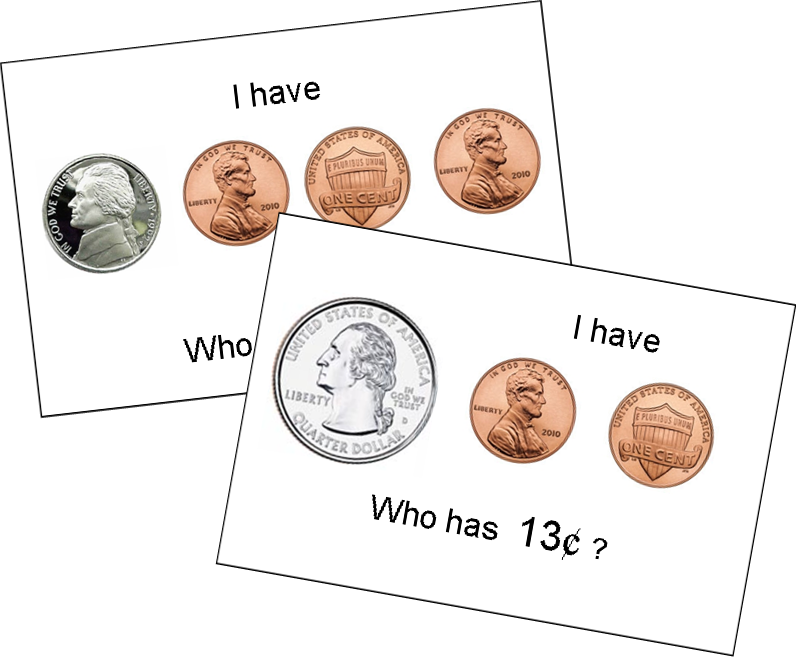
The coin card deck provides practice for students to count coins and determine the amount pictured. Give each student a card and hand out any extras to better students, as the whole deck must be used. Allow students time to figure out the value of the coins on their cards.
Pick a student to start the game. The student reads the coins on his/her card. Because other students cannot see the coins on the card, it is important for the student to read the coins. For example, the student with the card pictured above would read: I have one quarter and two pennies. Who has 13 cents?
The student with the card that has a value of 13 cents would then answer. I have one dime and three pennies. Who has 32 cents. The game continues until the original student answers the question Who has 27 cents?
Classroom Management Suggestions:
Teachers can easily differentiate the game to accommodate varied ability levels by carefully distributing the cards, giving simpler coin combinations to struggling students so that they may successfully participate.
The game is designed to be an ongoing loop, so teachers may select any student to begin and the play will eventually come back to that student. All cards must be used to complete the loop.
In the beginning, teachers may find it helpful to follow the Who Has? Coin Deck Loop to easily monitor student responses. Teachers might ask the starting student to come to the front of the class to start. This way, it's easy to know when the play comes back to the starter.
Once students are proficient at this deck, start timing the class performance. Record the time on the board and challenge students to better their time the next day.The beauty of the Who Has? card decks is that students mentally check everyone's response, performing 20 calculations in the course of the game. Students enjoy the game more than completing a similar worksheet and they are strongly motivated to participate and give the correct answer in order to better the class time.
Download the Who Has? Coin Deck which may be printed onto 2x4 inch labels to affix to index cards to create an easy deck. Teachers may also print the cards on card stock and cut them apart to create a smaller deck.
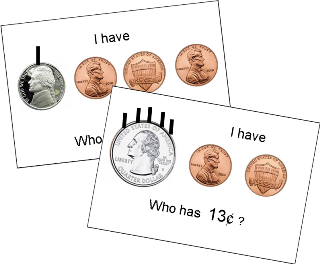
If students are currently using coin antennas to determine the value of coin combinations, Mathwire has a deck for them. Download the Who Has? Coin Deck with Antennas to use with young learners. The game is played in the same way. The antennas are added as an appropriate modification for struggling learners. This deck is exactly the same sequence as the regular deck, so teachers could choose to insert the coin antenna cards only for struggling students.
Mathwire Who Has? Collection: Check out all of the card decks in the Mathwire Who Has? collection which includes addition, subtraction, multiplication facts, geometry, doubles, etc. The web page also details classroom management suggestions.
Small Group Play: Place extra decks in the math center. Allow 2-4 students to play the game in pairs or small groups. Students deal out the cards and place them face up in front of them on the table. The person to the left of the dealer picks any card to begin. He/she reads that card and then turns it over. The student with the correct answer reads his/her card and then turns it over. Play continues until all cards are turned over. The person who turns over all cards first is the dealer for the next round.
Labels:
coin,
coin antennas,
coin values,
counting coins,
Who Has
Friday, July 9, 2010
Heads and Tails Investigation
Explore the probability of a one-coin toss using the Heads and Tails Game. This is an easy game for young learners. All you need to play is the Heads and Tails gameboard, two coins for markers and another coin to flip. Use a coin toss to decide who will be heads and who will be tails. Then the fun begins!
PLAYING THE GAME:
Both players place their marker coins on the star on the snake. The player who is HEADS flips the coin first. If the flip is HEADS, the player moves his/her marker one space toward the head. If the flip is TAILS, the player doesn't move.
Next, the TAILS player, flips the coin, moves one space if it lands on TAILS, stays put if it comes up HEADS.
Play continues switching back and forth until one of the players' markers reaches the head of tail of the snake to win the game.
DISCUSSION:
Do both players have an equal chance of winning? Try keeping a record of several games to see if HEADS and TAILS really both win.
Does it matter who goes first? Sometimes let HEADS go first; other times, let TAILS go first.
Use a simple tally sheet to record whether HEADS or TAILS wins each game.
VARIATION:
EXTENDED PLAY OPTION: The HEADS player tosses the coin. If it comes up HEADS, the player moves the coin one space toward the head and tosses again. If it comes up TAILS, the player stops and does not move. The TAILS player now tosses the coin. If the toss comes up TAILS, the player moves the coin one space toward the tail and tosses again. The player continues as long as the toss comes up TAILS. The game continues until a player's marker reaches the HEAD or TAIL of the snake.
DISCUSSION:
Do both players still have an equal chance of winning?
Does the game go faster this way? Explain.
What was the longest move either HEADS or TAILS got on one turn?
MODIFICATIONS:
If young players have trouble tossing the coin, use a small container and let them drop the coin into the container.
OR place the coin in a small see-through container such as a clear plastic jar with lid. Players then simply shake the jar and place it down on the table on its lid. It's easy to see whether it landed on HEADS or TAILS without opening the jar.
Buy larger coins at the dollar store. Remember that these are not the same weight as real coins and any imperfections may affect the outcome of the games. This could prove an interesting investigation for older players. Are some coins HEADS-winning coins and others TAILS-winning coins or are they all fairly equal?
Labels:
coin,
discrete math,
game,
heads,
probability,
tails,
toss
Subscribe to:
Comments (Atom)