Showing posts with label multiplication facts. Show all posts

Tuesday, February 28, 2012

Baseball Multiplication Game

Teachers familiar with the Everyday Math Program are familiar with the Baseball Multiplication Game played to help students master basic multiplication facts.  Players toss two dice, multiply the numbers, then enter the product to score.  According to the table, that product earns a single, double, triple, home run or an out.  Students will enjoy playing against the computer and practice multiplication facts at the same time.


Try Baseball Multiplication online at the Everyday Math Games Site.

Thursday, February 23, 2012

Lattice Multiplication

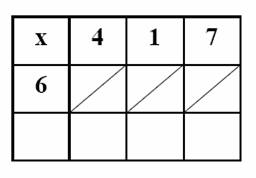
This algorithm works well for students who are developing multiplication fact fluency. Students may begin using a template to solve multiplication problems, but they quickly learn to draw their own lattice matrix to solve problems. Students love the method and it is very successful with both whole numbers and decimals. Teach students this multiplication algorithm as one of many different algorithms they may elect to use.  Students will very quickly learn to multiply large numbers, using basic multiplication facts and addition/regrouping skills.


Procedure:
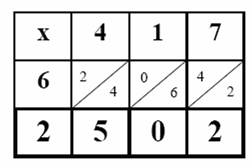
  • Student writes the problem in the grid (e.g. 6 x 417).
  • Student then writes the answer to each single digit multiplication in the appropriate square.
  • The tens digit is placed above the diagonal; the ones digit below the diagonal.
  • When all squares have been completed, the student sums the numbers between each set of diagonals, and writes the sum at the bottom of the grid. NOTE: If the sum is greater than 10, regroup the ten to the next diagonal to the left.
  • The student can now simply read the answer from left to right and insert commas, as appropriate.
For a complete overview of this method, see Cool Math's explanation of Lattice Multiplication to view the step-by-step procedure.  Take a cue from the site's explanation and use colored markers when introducing this algorithm to students on the overhead or whiteboard.  

Practice:
Templates:   Three different templates are included for Lattice Multiplications.   Templates are designed to be used in sheet protectors.   This strategy allows students to use dry-erase markers and re-use the same paper for many multiplication problems.

Thursday, March 24, 2011

Who Has? Decks: Multiplication Facts


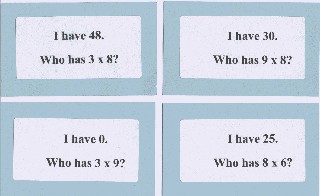
Once students have developed conceptual understanding of the basic operations they need to develop fluency with the facts.   One quick way to include daily practice and motivate students to master these basic facts is through the use of the Who Has? card decks.   These decks can be created for virtually any topic and frequent use as both a whole class practice or as a center activity for partners or small groups will provide facts practice in a highly-motivating format.


Classroom Management Strategies

There are several strategies that have proven successful when implementing this activity:
  • Distributing Cards:   Distribute one card to each student, then distribute the extras to strong students in the beginning and to random students as the class becomes more familiar with the deck.
  • Class Play:   As you distribute the cards, encourage students to begin thinking about what the question for their card might be so that they are prepared to answer.   When all cards are distributed, select the "0" card or any student to begin.   Play continues until the game comes back to the original card.   That student answers and then says "stop" to signal the end of the game.
  • Timed Play:   Consider using a stopwatch to time the class game.   Record the time on the board so that students try each game to beat their current best time.   This practice encourages students to stay attentive and prompts students to practice basic facts so that the class time improves. 
  • Calling Out Answers:Discourage this practice by adding 5 seconds onto the class time whenever you hear an answer from someone who does not hold the card.   Use the same penalty for students who express vocal displeasure with delays by other students.
  • Partner or Small-Group Play:  
    • One student deals out the cards to all players.
    • Players arrange the cards face-up in front of them.   Students will find that arranging the cards in order from least to greatest will help them locate cards quickly.
    • Play begins with the "0" card or any card held by the player to the dealer's left.
    • Play continues as in the class game. Whoever has the card that answers the question reads that answer and then reads the question on that card.
    • Students turn over the cards after reading them.
    • The first person to turn over all his/her cards, wins the game. [Note: this is completely random but don't tell the students!]
    • Shuffle the cards and repeat the game.
The current record for the multiplication deck was held by a fourth grade class in New Jersey who completed the deck in 59 seconds. 
 
Mrs. Leanne Cherosky's 5th grade class at Buffalo Elementary just e-mailed that they broke the record with a time of :56.593.  Congratulations, 5th graders!!!  

If your class beats this record, be sure to leave a comment on this post with grade level, school and the time.

Wednesday, October 13, 2010

Calculation Nation

NCTM's Illuminations site includes Calculation Nation.  Students may play the games to challenge themselves, playing against the computer, or they may challenge another online player. 

The games practice multiplication facts, factors, prime numbers, area, perimeter and other upper elementary through middle school concepts and skills.  All games add an element of strategy so that students are prompted to try several possible moves before selecting the best move that garners the most points.  Students won't realize they're really doing math as they PLAY these games and they'll keep playing to try to improve their scores and beat the computer or their online opponent.

Add this free resource to your online sites and encourage students to practice regularly.  They may enjoy playing each other, parents, older siblings or students from other schools.