Showing posts with label games. Show all posts

Tuesday, April 26, 2011

Fractions: Spin to Win Game

It is important that students develop numerical sense in fractions.  One excellent activity is sorting fractions as close to 0, close to 1/2, close to 1.  This activity forces students to think about fractions in a whole different way and enriches student understanding.
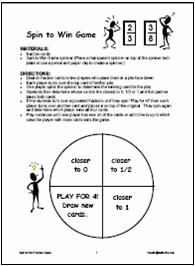
The Spin to Win Game was developed to provide fun practice in this skill.  Students play in pairs. Each student draws a card from the fraction deck. One student spins the spinner. If the spinner lands on "closer to 0" then the student whose fraction is closer to 0 wins both cards. The same holds true for "closer to 1/2" or "closer to 0." If the students turn over equivalent fractions, they pick another card and spin to win all 4 cards. 

Materials:

Saturday, December 18, 2010

Gingerbread Man Math Activities

Check out Mathwire's Gingerbread Man Math collection for timely math gingerbread activities to accompany this seasonal unit.  The collection includes activities to develop measurement, probability, symmetry, problem solving, games and literature links to popular gingerbread books.

Older students will practice coordinate graphing skills as they play Catch the Gingerbread Man, a Battleship-type game where students try to capture their opponent's gingerbread men.


Younger students will enjoy the Run, Gingerbread Man, Run! game which comes with a colored spinner, gameboard and directions for small group play.  Students will practice simple counting skills as they try to be the first to move through the colored board.

Students may use a copy of the gameboard to analyze the results of winners:
  • Did the red, yellow, blue or green gingerbread man win more often?
  • Does each color have an equal chance of winning?  Explain your thinking

Problem solving activities involve combinations.  Gingerbread Bake Sale challenges students to figure out if Ruby can make each of the 12 gingerbread cookies on a cookie sheet different, given the possible eyes and noses.  Gingerbread Man Combinations is a harder version of this problem, with more choices to challenge older students.  Gingerbread Man Chain requires students to use measurement skills to figure out how many gingerbread men will be needed to create borders at the top and bottom of a bulletin board.

Wednesday, October 13, 2010

Calculation Nation

NCTM's Illuminations site includes Calculation Nation.  Students may play the games to challenge themselves, playing against the computer, or they may challenge another online player. 

The games practice multiplication facts, factors, prime numbers, area, perimeter and other upper elementary through middle school concepts and skills.  All games add an element of strategy so that students are prompted to try several possible moves before selecting the best move that garners the most points.  Students won't realize they're really doing math as they PLAY these games and they'll keep playing to try to improve their scores and beat the computer or their online opponent.

Add this free resource to your online sites and encourage students to practice regularly.  They may enjoy playing each other, parents, older siblings or students from other schools.

Sunday, December 6, 2009

Math Activity Themes: Gingerbread Math


Gingerbread men and gingerbread houses enjoy special popularity around the holidays, but many of these gingerbread activities are timeless and complement literature titles that teachers use at the beginning of school or after the holidays. It's very easy to incorporate mathematics into a study of gingerbread men, and students will enjoy the data collection activities and games while learning math skills and deepening their understanding of important mathematical concepts.


Look through these Gingerbread Man Math activities and add some to your repertoire. Consider broadening the gingerbread math to include measurement, games and problem solving this year. 

Sunday, August 9, 2009

Contig and Contig Jr. Games


Contig Game

The Contig Game is one of the best games for practicing basic facts and one of my personal favorites. I have found that both students and teachers quickly become engrossed in the game. It is rewarding to watch students mentally rehearse many different options in search of the best move! Students also learn from each other as they watch partners combine numbers and operations, strategizing aloud to create the perfect move that captures the most points. It is a rich game that allows for differentiation as students begin play at their own entry level of comfort yet accommodates growth as students become more proficient at basic facts and operations.

In the Contig Game, students toss three dice. They use those three numbers and any operations (*,-,*,/) to form a number on the game mat. Players earn an extra point for each covered number their new number touches, so students quickly learn to search for the best move that will yield the maximum possible points. The instructional benefit of the game is that students try many different combinations in search of that best move. Students with solid “fact power” definitely have the edge in this game!

Check out the Mathwire version of Contig to download the directions and game board in PDF format.


NEW: Contig Jr. Game

Now younger students can also practice their addition and subtraction facts with the new Mathwire junior version of the game. The new Mathwire Contig Jr. game board is obviously different and provides lots of options for students to mark their answers. Scoring is similar to the regular Contig game, in that students earn more points if they can make an answer that lies next to X’s already on the board. The game may also be played in a very simple mode, where students simply use the dice numbers and addition and/or subtraction to make a number that is open on the game board. If they can’t make a number that’s still free, they lose their turn, and the other player goes.

Check out the Mathwire version of the new Contig Jr. game to download the directions and game board.


Implementation suggestions:
· Place the game board in a sheet protector and let students mark their numbers with dry erase markers. They may also keep score in the margins of the game board so that everything is all in one place. Alternately, use manipulatives to cover the numbers.
· Group students homogeneously to play this game so that better students are challenged by equally competent players. Likewise, students who are still mastering basic facts have an even playing field when matched with similar ability students. This should encourage all students to master basic facts in order to capture more points and win the game. This grouping also provides the necessary pacing (faster or slower) to match student needs.
· Limit play time to 5 or 10 minutes, if needed. The winner is the player with the most points at the end of this time period.
· Place the game in the math center and allow students to play when they have finished their work, during indoor playground time, and during other identified times.
· After lots of experience playing the game, organize a class play-off where the winning player advances to the next round to play another winning player, etc. Continue rounds until only one player is left to be crowned Class Contig Champion.

Saturday, August 8, 2009

Welcome to the Mathwire Blog: New Games

Welcome to the new Mathwire Blog. Each post will feature the latest addition to the Mathwire site , a new twist on a Mathwire classic activity or an internet resource that supports elementary math learning. The Mathwire site features classroom-ready, Standards-based math activities for elementary teachers and students.

Check back often as new activities are featured on the site as well as this blog. Please let us know if you try the activity in your classroom and how you might have adapted it to best meet the varied needs of learners in your class.

New Games on Mathwire
The beginning of the new school year is always a great time to brush up on basic facts mastery. Be sure to check out the new Three Strikes And You're Out Game which provides practice in addition or subtraction facts. You can download the directions, game board and game pieces in PDF format on Mathwire.


While you're there, check out the new M&M Probability Game Pieces which were created to go with the M&M Probability Game, at the request of some Mathwire.com users. You'll find links for the game directions, recording sheets, and game pieces. There are also pictures of the game being played so that you can see how to create the sentence strip game board complete with the M&M game pieces. Check out these resources and download the PDF files on Mathwire.

Math games are a great way to provide basic facts practice. Students feel that they are playing, but they're really practicing their basic facts over and over, trying to make the best move to win the game. It's a win-win!