Showing posts with label Contig Jr.. Show all posts

Wednesday, April 20, 2011

Developing Number Sense

Students in Everyday Math classes play a game called Name That Number.  Make It Count is a very similar online game.  Students are dealt number cards, given operations and a target number.  The students must use only those cards (all or some) and the given operations to produce the target number.  They click on Submit to check their solution and get immediate feedback.  If the student is stumped by a particular combination of cards, they may click on See Answer to view a possible solution

These games provide practice of basic facts.  The real beauty is that students rehearse many different options in the search for one successful combination, developing number sense.  There are often several possible solutions, so students believe they will be successful, motivating them to search for a solution when one is not initially evident.

After a class presentation of the game, students often benefit from playing as pairs, generating mathematical discussion and debate in the search for a solution.  This online game might also be added to Parent Resources as students may play for free at home.


The Make the Number template may be downloaded and used in class as a warm-up or Do Now! activity.  For renewable use, students insert the template into a clear sheet protector and use dry erase markers to write in the target number and the number cards.  They use the white space to write down and check possible solutions.

NOTE:  Teachers may opt to make an overhead of this template so that students are able to record different solutions they find.  If the overhead is also inserted into a sheet protector, students may use dry erase markers to record their solutions.  The sheet protector is easy to clean and the overhead may be kept in a teacher binder for easy retrieval as needed.
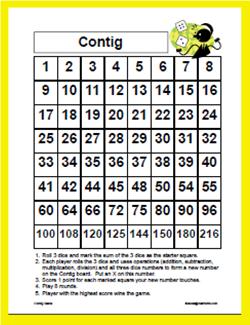

Extension:  The Contig game is a natural extension of this activity and it develops number sense as students search for the best possible solution that will win them the most points.  Students should know multiplication and division facts, but older students are easily challenged by this game.  Try it!


In the Contig Game students toss three dice.   They use those three numbers and any operations to form a number on the game mat.   Players earn an extra point for each covered number the new number touches, so students quickly learn to search for the best move that will yield the maximum possible points.   The instructional benefit of the game is that students try many different combinations in search of that best move. 
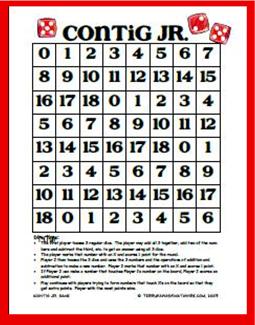


Contig Jr. is designed to provide that same format for younger students who need to develop mastery of addition and subtraction facts. 

Suggestions:   
  • Introduce these games to students and provide students time for supervised play.  
  • Make the games available in the math center for use during center time or indoor recess or game day. 
  • Insert the game mats into clear sheet protectors and use dry erase markers for renewable play. 
  • Home Connection:  Send a copy of the game mat home for students to teach parents and play at home for additional practice.

Sunday, August 9, 2009

Contig and Contig Jr. Games


Contig Game

The Contig Game is one of the best games for practicing basic facts and one of my personal favorites. I have found that both students and teachers quickly become engrossed in the game. It is rewarding to watch students mentally rehearse many different options in search of the best move! Students also learn from each other as they watch partners combine numbers and operations, strategizing aloud to create the perfect move that captures the most points. It is a rich game that allows for differentiation as students begin play at their own entry level of comfort yet accommodates growth as students become more proficient at basic facts and operations.

In the Contig Game, students toss three dice. They use those three numbers and any operations (*,-,*,/) to form a number on the game mat. Players earn an extra point for each covered number their new number touches, so students quickly learn to search for the best move that will yield the maximum possible points. The instructional benefit of the game is that students try many different combinations in search of that best move. Students with solid “fact power” definitely have the edge in this game!

Check out the Mathwire version of Contig to download the directions and game board in PDF format.


NEW: Contig Jr. Game

Now younger students can also practice their addition and subtraction facts with the new Mathwire junior version of the game. The new Mathwire Contig Jr. game board is obviously different and provides lots of options for students to mark their answers. Scoring is similar to the regular Contig game, in that students earn more points if they can make an answer that lies next to X’s already on the board. The game may also be played in a very simple mode, where students simply use the dice numbers and addition and/or subtraction to make a number that is open on the game board. If they can’t make a number that’s still free, they lose their turn, and the other player goes.

Check out the Mathwire version of the new Contig Jr. game to download the directions and game board.


Implementation suggestions:
· Place the game board in a sheet protector and let students mark their numbers with dry erase markers. They may also keep score in the margins of the game board so that everything is all in one place. Alternately, use manipulatives to cover the numbers.
· Group students homogeneously to play this game so that better students are challenged by equally competent players. Likewise, students who are still mastering basic facts have an even playing field when matched with similar ability students. This should encourage all students to master basic facts in order to capture more points and win the game. This grouping also provides the necessary pacing (faster or slower) to match student needs.
· Limit play time to 5 or 10 minutes, if needed. The winner is the player with the most points at the end of this time period.
· Place the game in the math center and allow students to play when they have finished their work, during indoor playground time, and during other identified times.
· After lots of experience playing the game, organize a class play-off where the winning player advances to the next round to play another winning player, etc. Continue rounds until only one player is left to be crowned Class Contig Champion.