Showing posts with label math game. Show all posts

Monday, May 16, 2011

Tally Ho! Game

This game was created to help kindergarten students learn to use tally marks to count.  The game mat was specially designed to support young learners who must master the skill of tally counting.  

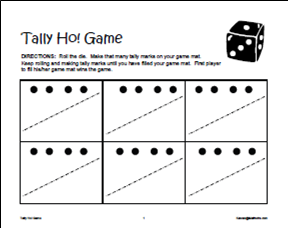
Tally marks are made in groups of five (four upright and the fifth goes across the four) for easy counting.  The game mat has four dots to prompt students to mark four upright tallies.  Then the dotted line prompts students to close the gate by drawing the fifth tally across the group of four,  Finally, each group of five is in its own box.

Now, students practice making tally marks in a game format.  They roll a die and add that many tally marks to their game mat.  For ease of use, place the Tally Ho! game mat in a sheet protector and use dry erase pens to make the tally marks.  They are easily erased to play again.


Differentiation:  Use this dot and dashed line approach as an accommodation for students having difficulty making tally marks correctly in groups of five in classroom activities. 

Friday, May 13, 2011

Counting Game: Car Race

In the counting game, Car Race, students toss a die and move cars that many spaces.   First player to cross the finish line wins the game.   This is a simple counting game that reinforces counting 1-6 spaces and one-to-one correspondence.

  • Download the directions, game mat and center icons for Car Race.  
  • The game mat is printed in 3 sections which should be taped together.
  • Students enjoy using small cars as their game pieces.
  • NOTE:  This game was developed by a Monmouth University student for the Probability Fair.

Sunday, January 16, 2011

Penguin Math Games

Capture the Penguins Game uses the outcome of two-dice toss to form a coordinate pair. Students toss two dice (one regular and one A-F) in this fun game that introduces students to coordinate graphing in the spaces.   Students form a coordinate pair based on the dice toss and capture a penguin, if possible.   Students use the accompanying recording sheet to keep score during the game. 
  • A-F Dice: Create A-F dice using plain dice or purchase small wooden cubes at a craft store to make the dice.  
  • Penguin Pieces: Penguins pictured to the right were created by painting wooden clothespins and doll stands, both readily available at craft stores. 
Download Capture the Penguins game mat, instructions and student recording sheet. 


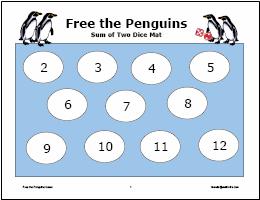
Free the Penguins Game:  The penguins are stuck on the ice floes. Only a roll of the die can free them to search for food in the ocean. Students will practice addition or subtraction facts as they try to be the first to free their penguins. Use mats with clothespin penguins for the most fun! 

These games are not only an excellent opportunity to practice basic facts but they allow students to collect data and reflect on the probability inherent in the game. Suggestions are included with this game for students to keep tallies of all dice tosses, organize the class data in a line plot, and then analyze the data for patterns and trends. 

Download Free the Penguins game mat, instructions and suggestions for data collection.


Wednesday, December 16, 2009

Capture the Penguin Game


Students toss two dice (one regular and one A-F) in this fun game that introduces students to coordinate graphing in the spaces. Students form a coordinate pair based on the dice toss and capture a penguin, if possible. If the space holds a penguin, they capture the penguin for quick points. Create A-F dice using plain dice or purchase small wooden cubes at a craft store to make the dice.

The penguins shown in the picture were created by painting clothespins and clothespin stands, found at craft stores.

Download the Capture the Penguin Game, a PDF which includes directions, game mat, penguin markers and a recording sheet.

Wednesday, December 2, 2009

Gingerbread Math Games


Counting Game:  Run, Gingerbread Man, Run

This game was designed to introduce students to the randomness of spinners and dice. Each color gingerbread man starts at the same place and has the same chance of winning by crossing the finish line, but does it work out that way? Students will enjoy playing the game AND use a clothespin graph [see sample on right] to collect some useful data on the winners.


Once students have collected class data from playing many games, they will come together to analyze the clothespin graph results. Students will be asked to discuss whether or not they think the game is fair for all of the gingerbread men and explain their reasoning.

Download the Run, Gingerbread, Run game so that students can get started playing and collecting data. The pdf file contains the spinner, gameboard, clothespin graph icons, and an optional tally sheet. 


Coordinate Graphing Game:  Catch the Gingerbread Men

For this game, students toss two dice (one regular and one marked A-B-C-D-E-F), form an ordered pair (e.g. B5), then remove the gingerbread man from that space, if there is one. Play continues until the timer rings or until one player has caught 10 gingerbread men. Students love playing the game and they get to practice their coordinate graphing skills in the process.


Coordinate Pairs: This seasonal version of the classic Battleship game provides practice in forming coordinate pairs, identifying the x-coordinate (A-F), then the y-coordinate (1-6) so that spaces are identified as C3 or E6. Hopefully, lots of practice will help students transition to the algebraic ordered pairs (x,y) where x and y are both numbers. Just be certain to reinforce the notion that the x-coordinate (across) comes before the y-coordinate (up or down). The alphabetical cues (across comes before up or down) help some students remember the order.


Download Catch the Gingerbread Men game mat, game pieces and directions for playing the game.

Saturday, October 10, 2009

Grab the Candy Corn Game


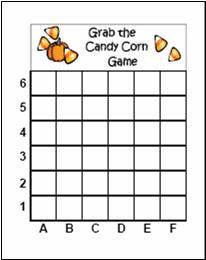
This game was designed to provide practice in coordinate pairs. Students place candy corn on the game board, then toss two dice to make an ordered pair. The player removes a candy if there is one on the space and then the other player takes a turn. Teachers may use real candy corn or the candy corn game pieces provided with the gameboard.

View and download the Halloween/Thanksgiving version of the Grab the Candy Corn Game. This PDF document includes the game board, optional game pieces, directions and a recording sheet.

Also check out the Grab the Candy:  M and M Version for an additional resource to use with students during the holiday season.  The PDF document includes the game board, optional game pieces, directions and a recording sheet.