Showing posts with label Thanksgiving. Show all posts

Friday, November 18, 2011

Thanksgiving Probability


How about a little probability for Thanksgiving?  This handout is a simple review of probability using the letters in Thanksgiving.  Students must explain their answers to provide practice in writing and explaining their thinking.  There is a challenge question that might be thought about and explained in different ways, so it's always interesting to see which route students choose to use.

Thursday, November 17, 2011

Turkeys and Cows


In honor of Thanksgiving, here is a turkey and cow problem, an adaptation of the familiar chicken and cows problems.  In these problems, students are given the number of heads and the number of legs and must figure out how many chickens and cows there are.  Central to the solution of these types of problems is the fact that chickens have two legs and cows have four legs.

The following method is a simple pictorial way to solve these types of problems.  Very young first and second graders have used this method to successfully tackle these problems, itching for more challenges.

PROBLEM:  Farmer Brown counted the turkeys and cows in his barnyard.
  • There were 5 heads.
  • There were 14 legs.
How many turkeys and how many cows were in Farmer Brown's barnyard?

First, the students concentrate on the number of heads.  In this case there were 5 heads, so the students draw 5 circles to represent the heads.


Second, the students give each head 2 legs to make them turkeys.


Now the student checks the number of heads and legs he has drawn.  The student has 5 heads (correct) and 10 legs (not enough).  Farmer Brown saw 14 legs, so the student needs to add 4 more legs.  He must add 2 legs at a time because a cow has 4 legs.


Again, the student counts and checks his drawing.  He has 5 heads (correct) and 14 legs (correct), so he now labels each drawing either T (turkey) or C (cow).


It is now easy to see that the solution to this problem is that Farmer Brown had 3 turkeys and 2 cows in his barnyard.

Teachers should model this method with students.  It might be very helpful to model this solution on chart paper or chalkboard, so that students may refer back to this model as they solve problems on their own.  Next, let pairs of students work together to solve another problem.  After that, students may work individually or as pairs to solve additional problems involving turkeys and cows.

Download Mathwire's Turkeys and Cows problem set.

CHALLENGE:  Students may be challenged to create their own turkey and cow problems for their classmates to solve.   Each problem should also have a solution attached for easy checking.


Thursday, November 18, 2010

Turkey Glyph


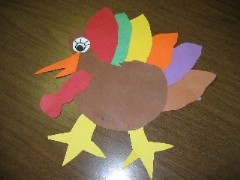
Students in Mrs. Bestle's class in Keansburg, NJ, created turkey glyphs that tell a story about how they celebrate Thanksgiving and what foods they like to eat on that special day.  It's great to have students create the legend(key) for what different parts of the turkey glyph mean (e.g. like white or dark meat, eat home or away, like gravy, feather colors for different vegetables, etc.)


Glyphs are a great visual display of data and may be used to create a seasonal bulletin board of student work.  Be sure to use the display for some data analysis activities. 
  • Will more people in this class eat at home or away for Thanksgiving?
  • Do more people in this class like corn or potatoes
  • How many people in this class like yams?


Developing the legend(key) with students allows teachers to customize the activity to fit individual classes.  Creating a legend for a glyph is a higher-order thinking skill that develops critical thinking skills. 
 
See turkey glyph for one teacher's legend and lesson plan for this activity.

Saturday, October 10, 2009

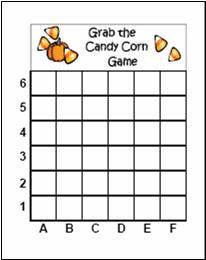
Grab the Candy Corn Game


This game was designed to provide practice in coordinate pairs. Students place candy corn on the game board, then toss two dice to make an ordered pair. The player removes a candy if there is one on the space and then the other player takes a turn. Teachers may use real candy corn or the candy corn game pieces provided with the gameboard.

View and download the Halloween/Thanksgiving version of the Grab the Candy Corn Game. This PDF document includes the game board, optional game pieces, directions and a recording sheet.

Also check out the Grab the Candy:  M and M Version for an additional resource to use with students during the holiday season.  The PDF document includes the game board, optional game pieces, directions and a recording sheet.