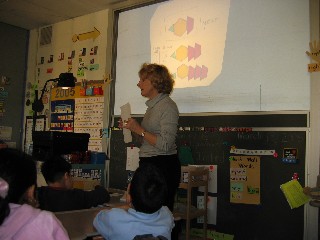
Introduce elementary students to the concept of functions by investigating growing patterns. Visual patterns formed with manipulatives are especially effective for elementary students and allow them to concretely build understanding as they first reproduce, then extend the pattern to the next couple of stages. Finally, students explain the pattern in words and try to write a rule that works for any stage.
See Mathwire's Investigating Growing Patterns for specific suggestions on using these patterns to help elementary students develop a concept of functions. The article includes activities with handouts that teachers can use to introduce this topic to elementary students. A Function Scrapbook of function ideas is included and examples of function problems created by elementary students will be added as they are completed. Literature connections and web links to relevant sites on the internet are also included in the article.
Use the book Two of Everything to  introduce students to the doubling pattern. Students will enjoy the story and predict what will happen each time something is put into the magic pot.
Make the math connection even more concrete by using a pot and linking cubes to illustrate the story. Students may use a Magic Pot Workmat to record the input and output, then write a rule.
Extension: Extend the activity by using the magic pot and simple rules to create data sets. Students should guess the rule by giving an input number and telling the output that would result. By not stating the rule, students provide more time for other class members to generalize the rule. Each guess simply provides another data set for students to enter in their table.
Enrichment: After reading Two of Everything, challenge students to solve NCTM's 5 Coins problem: Would you rather have 1000 coins or 5 coins and a Magic Doubling Pot that works 10 times? Students might work in pairs and use in/out charts to record their solutions.
introduce students to the doubling pattern. Students will enjoy the story and predict what will happen each time something is put into the magic pot.
Make the math connection even more concrete by using a pot and linking cubes to illustrate the story. Students may use a Magic Pot Workmat to record the input and output, then write a rule.
Extension: Extend the activity by using the magic pot and simple rules to create data sets. Students should guess the rule by giving an input number and telling the output that would result. By not stating the rule, students provide more time for other class members to generalize the rule. Each guess simply provides another data set for students to enter in their table.
Enrichment: After reading Two of Everything, challenge students to solve NCTM's 5 Coins problem: Would you rather have 1000 coins or 5 coins and a Magic Doubling Pot that works 10 times? Students might work in pairs and use in/out charts to record their solutions.