
Students need many concrete experiences with fractions to develop a deep understanding of the three models of fractions: area, linear and set models. Teachers need to address all three models in well-designed instructional activities so that students develop a rich concept of fractions that they can use to make sense of numbers, operations, measurement and probability.
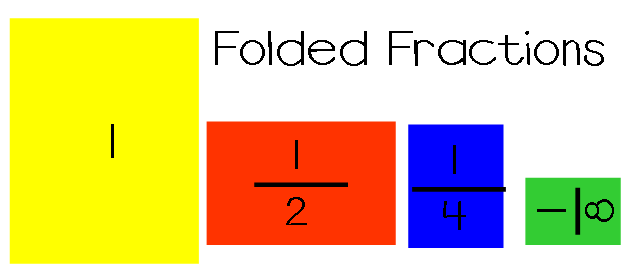
Folded Fractions: For this area model, students use 4 pieces of construction paper to create this set of fraction manipulatives. Students fold the paper following instructions, unfolding to easily see how many pieces are now in the whole. After marking each piece with the correct fraction part, students cut apart the fractional pieces.
This model is easily created from classroom materials and students should keep their sets in their desks. Students may use the fraction pieces during instruction, in problem solving or to play games. By using the yellow "1" or "whole" mat, students may easily combine different fractional pieces to create a whole, etc., placing pieces on top of the yellow mat to see different ways of making a whole.
- Download directions for making Folded Fractions.
Other Area Models
Students divide shapes into the appropriate number of equal sections given by the denominator, then shade in the appropriate number of sections, given by the numerator to create a picture of the fraction. Equivalent fractions are also developed using this area model. Teachers may also use any of these manipulatives to develop the area model:
- pattern blocks
- circular fraction regions
- pizzas
- geoboards
- spinners


