Showing posts with label coins. Show all posts

Sunday, October 9, 2011

Heads & Tails Game

The Heads & Tails Game was designed to introduce young students to the probability of a single coin toss.  By playing the game and adding results to a class tally, students will learn that the outcomes of heads and tails are equally likely.


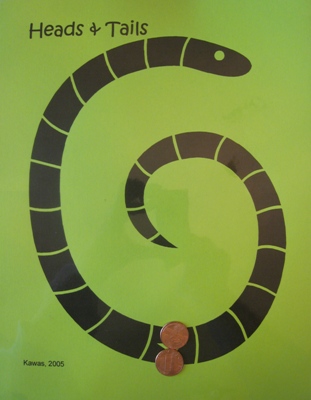
To start the game, each player places a penny on the star of the snake.  The heads player places the penny heads side up.  The tails player places the penny tails side up.


The heads player tosses a coin.  If it is heads, he moves the penny one space toward the head of the snake.  If it is tails, he does not move but the tails player moves her coin one space toward the tail.


Next, the tails player tosses a coin.  If it is tails, she moves her penny one space toward the tail of the snake.  If it is heads, she does not move but the heads player moves his penny one space toward the head of the snake.
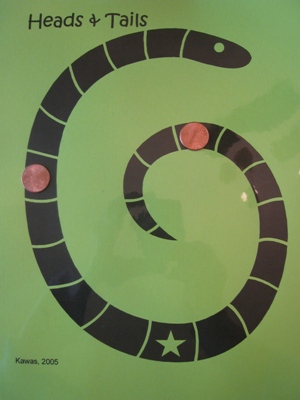

Play continues back and forth until one of the players reaches either the head or the tail of the snake, thereby winning the game.


The players post their results on the classroom tally, adding to the Heads Won or Tails Won count.  Players should play several games, if possible, to create a large sample which more closely approximates the actual probability.


Download the Heads & Tails game mat.


Monday, March 28, 2011

Mathwire Who Has? Deck Collection

Several decks are available on Mathwire for downloading as PDFs.   All decks are 30 cards so that there are enough cards for most classes.   In fact, some students will probably need to have two cards to use the complete deck.   The decks are designed to print onto 2x4 inch labels (10 to a page).   These can then be affixed to index cards to create each deck.   If labels are not available, simply cut and paste the printout to create card decks. 
  
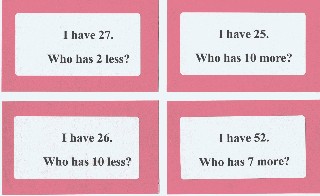
More or Less Deck:   this deck was developed to help students develop mental math proficiency.  Students will learn to mentally add or subtract a one-digit number or a multiple of  10.  Regular practice helps students develop proficiency in mental addition and subtraction.


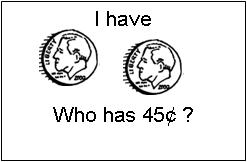
Coins Deck:  Two decks are available for this series. 

  • Coin Deck uses clip art of actual coins on each card.  Students answer the question Who has 40 cents?  by stating I have 4 dimes, reading the coins on their cards to correctly answer the question.  Note that this 20-card version uses both heads and tails of coins.
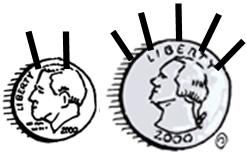
  • Coin Deck with Antennas is the same deck as above, but antennas have been added to coins for an easy coin-counting modification for struggling learners.  Read more about the coin antenna strategy in Mathwire's Money Activities & Strategies collection.


Doubles Deck

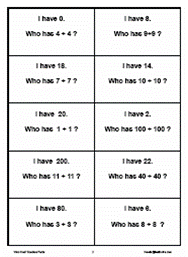
This doubles deck was developed to provide practice in doubles facts.  This 20-card deck is straightforward practice of these important facts.  Regular practice helps students develop mastery of doubles.


 Base Ten Deck

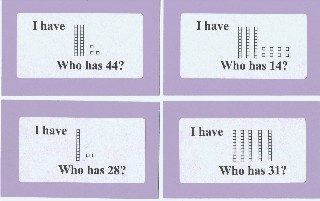
The Base Ten deck provides practice in recognizing numbers pictured in base ten block representation. 


Mathwire Who Has? Collection

These are a few samples from the Mathwire collection.  See Who Has? Activities to read more about using these decks in the classroom and to download additional decks for fractions, geometry, etc. 

Thursday, September 16, 2010

Using Antennas to Count Coins


Students draw antennas on coin pictures to represent the value. Each antenna is worth 5 cents. This means a dime has two antennas, a nickel has one antenna, a penny has no antennas, etc. This strategy capitalizes on students' strength in counting by fives. They simply point to each antenna as they count by 5s, then count on by ones to include any pennies.

This method is also efficient because students do not need to sort and reaarange coins; they simply draw antennas on coins in the order given. This method is especially effective for K-2 regular and special ed. students who will eventually outgrow the need for antennas. NOTE: some teachers call the antennas "hairs" and talk about the penny as "bald" because it has no hair. Whatever works for you and your students is the best strategy.


See more Mathwire Money Activities & Strategies including money games.

Wednesday, September 15, 2010

Using the Hundred Board to Count Money

Hundred Chart: students who confidently use the hundred chart and its patterns to solve problems can utilize this tool to work with coins: 


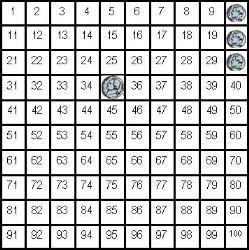
Counting coins: Use a hundred chart to help students count coins.   Have students place coins on the correct number.   For instance, given 3 dimes and 1 nickel, students would place dimes on 10, 20, 30 and the nickel on 35. The last coin tells students how much money they have altogether.   This method is effective for having students figure out which coins to use to pay for an item.

Making change for a dollar: Place a counter on the price of the object.   Place pennies on each square to get to the nearest multiple of 5.   Use nickels, dimes or quarters to get to $1.00.   Students should begin with whatever combination of coins they wish then work toward using the least number of coins as they become more proficient at making change.