Showing posts with label count by fives. Show all posts

Friday, April 15, 2011

Math-Literature Connection: Ladybugs

The Grouchy Ladybug
by Eric Carle


 Ladybug on the Move
by Richard Fowler

  • See NCTM Illumination's Ladybug Lengths unit that helps students develop the concept of measurement through the use of nonstandard units including a ladybug tape that may be downloaded from the site.
  • Let students play with the Hiding Ladybug applet to practice measurement skills.
  • Ladybug Leaf is another online version of this applet game that requires students to estimate distances in a Logo-like environment. 

Lots of Ladybugs
by Michael Dahl


This book was designed to provide practice in counting by fives, offering yet another way to include math in a ladybug unit.  Each page adds five more spots to count until you reach 50.


NOTE:  The worksheet is designed as a companion to the Lots of Ladybugs book.  
  • Worksheet 1 has all numbers in a traceable font.
  • Worksheet 2 has some missing numbers.  Printed numbers are in traceable font. 
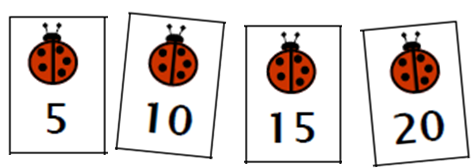
 Ladybug Scramble

The ladybug cards are all scrambled and students must put them in the correct order.  This deck is designed to be printed on card stock, cut apart and stored in plastic bags for use in a math center.
Differentiation:  This activity is easily differentiated by varying the number of cards given to students to accommodate the varied learning levels in the class.  Consider creating A, B, C sets in baggies that contain different number of cards.  Students may move to the harder level once they have mastered the first set.

Friday, March 18, 2011

Scrambled Eggs Game

Successfully skip counting by 5s is an important mathematical foundation for the 5 times table, for counting nickels, for rounding numbers, etc. Counting by 5s and counting by 10s are often the first rote skip counting a student learns. While some students will naturally learn the count through classroom activities, other students will need deliberate intervention to master this sequence. 

 Scrambled Eggs Game

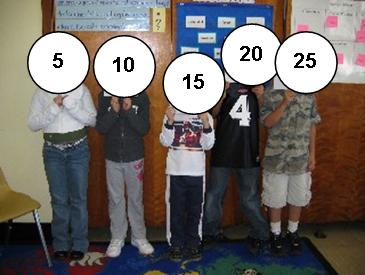
Distribute large cards with multiples of 5 to students. Ask students to quietly assemble themselves in correct order, holding the card in front of them. Time the class in this activity, if this motivates your class to master the sequence. 

NOTE: Cheap, white paper plates work well for this activity. Write large numbers with a black sharpie pen.  Paper plates stack easily for storage and also hold up well through repeated use. 

Partner Game: Each partner shuffles a set of count by five cards and turns them face down.  On the word "GO!" each partner turns over the first card and places it roughly before him/her.  Each student turns over one card at a time, ordering the cards before him/her until all cards are in correct order.  First student to correctly order the sequence of cards wins the game.  
  • Download Count by 5 Cards for individual student use. Copy on card stock, cut apart, and place in baggies for partner game use.

Thursday, September 16, 2010

Using Antennas to Count Coins


Students draw antennas on coin pictures to represent the value. Each antenna is worth 5 cents. This means a dime has two antennas, a nickel has one antenna, a penny has no antennas, etc. This strategy capitalizes on students' strength in counting by fives. They simply point to each antenna as they count by 5s, then count on by ones to include any pennies.

This method is also efficient because students do not need to sort and reaarange coins; they simply draw antennas on coins in the order given. This method is especially effective for K-2 regular and special ed. students who will eventually outgrow the need for antennas. NOTE: some teachers call the antennas "hairs" and talk about the penny as "bald" because it has no hair. Whatever works for you and your students is the best strategy.


See more Mathwire Money Activities & Strategies including money games.