Showing posts with label fair. Show all posts

Friday, December 2, 2011

Counting Game: Run, Gingerbread Men, Run!


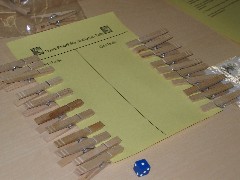
This game was designed to introduce students to the randomness of spinners and dice. Each color gingerbread man starts at the same place and has the same chance of winning by crossing the finish line, but does it work out that way? Students will enjoy playing the game AND use a clothespin graph [see sample on right] to collect some useful data on the winners.

Once students have collected class data from playing many games, they will come together to analyze the clothespin graph results. Students will be asked to discuss whether or not they think the game is fair for all of the gingerbread men and explain their reasoning.

Download the Run, Gingerbread Men, Run! game so that students can get started playing and collecting data. The pdf file contains the spinner, gameboard, clothespin graph icons, and an optional tally sheet.


Wednesday, April 13, 2011

Ladybug Game


The Ladybug, Fly Away Home! game uses a one-die toss to move that numbered ladybug one space closer to her home. Students add their results to the Class Recording sheet by adding a tally mark for the winning ladybug. Class discussion focuses on the fairness of the game by asking if each ladybug has an equal chance to win? PDF file includes directions, game mat, recording sheet and math center icons

Wednesday, February 23, 2011

Heads & Tails Data Collection

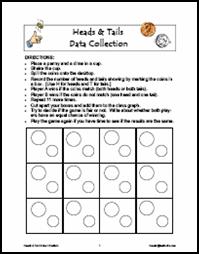
In this activity, students toss a penny and a dime and record whether the outcome is HH, TT, or HT and which coin is heads or tails.   Students cut apart their results and add them to the class results to create a class pictograph which can be analyzed and compared to the expected outcomes.   Students analyze the results to determine if the game is fair or unfair. 

It is important to use two different coins so that students see that the coins matching (HH or TT) and the coins not matching (HT or TH) are equally likely outcomes. Students often respond initially that the game is unfair because the player who wins when the coins match has two chances to win while the other player only has one chance. Using two different coins and recording the results of both coins helps students dispel this initial misconception as they analyze the graph results and create a tree diagram for the event. 

Download Heads & Tails Data Collection which includes the student recording sheet and directions for creating a class graph.

Tuesday, February 22, 2011

Clothespin Graph

Write each student's name on a clothespin. A piece of foam core board or laminated oak tag makes a great two-choice (Yes/No) graph board. Students simply affix the clothespin to the correct side to indicate their response. Students can easily "see" the results and count to verify the outcome.
  • Use this method to record the results of informal classroom surveys:
    • Literature: Which character do you like best? What do you think the character will do next? Which version of the story do you prefer?
    • Daily Routines: Are you buying lunch or did you bring lunch? Present or Absent?
  • Ask students to report the results of who won two-player games so that the class can analyze the fairness of the games. 
Suggested Use:  Use a clothespin graph to record the results of students playing the Heads & Tails Game.  

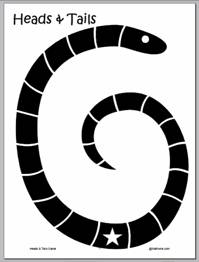
In this game, each student places a penny on the star.  One student is heads and the other student is tails.   Students should place their pennies with the appropriate side up.

The heads student tosses a penny and moves a space toward the head if the outcome is heads.  If the outcome is tails, the student does not move.  Play repeats with the tails student, who moves only if his/her toss is tails, moving toward the tail of the snake.  The first player to read the head or the tail of the snake wins.  The winning player should add a clothespin to the graph to record the win as heads or tails.

Class discussion should focus on analyzing the data to determine if the game is fair or not.   Directions and gameboard are included in the download.   This game was developed by a Monmouth University student for the Probability Fair. 


Download the Heads & Tails Game which includes the game mat, directions and icons for centers work boards.  This game is an excellent addition to a classroom math center, as students may play with a partner and record the results for class discussion at a later time.