Friday, January 29, 2010

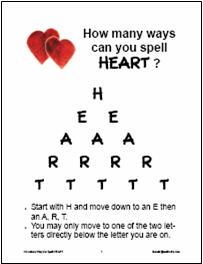
How many ways can you spell HEART?

Heart Paths

Students will enjoy this discrete math activity that challenges them to find all of the possible ways to spell heart.  Each path starts on the H and moves down to an E, then an A, then an R, and finally a T.  You may only move to one of the two letters directly below the letter you are on. 

This activity is directly related to Pascal's Triangle, so it would be beneficial if students have previous experience with this famous pattern.  Try Pascal's Hearts which challenges students to try to figure out how to fill in the missing rows.  The downloadable file contains a notated solution which teachers may use to lead a class discussion of the solution and any patterns students can find in Pascal's Triangle. 

The downloadable Heart Paths file contains a student recording sheet so that students can record their paths in an orderly fashion.  This enables students to check that they have not duplicated a previous path.  Classroom teachers might make a transparency of this handout to be used on the overhead.  This way different students can draw paths as the class discusses the possible paths.

Be sure to check out the Mathwire Discrete Math collection for additional discrete math Pascal's path activities.  The SNOW activity download includes a teacher step-by-step orderly solution that relates the rows to the rows of Pascal's Triangle. This same process is easily extended to the 5-letter HEART paths.

Wednesday, January 27, 2010

U.S. Census Activities

Students will implement data analysis skills as they tackle U.S. Census Data. Check out these resources for suggested student activities:

Saturday, January 9, 2010

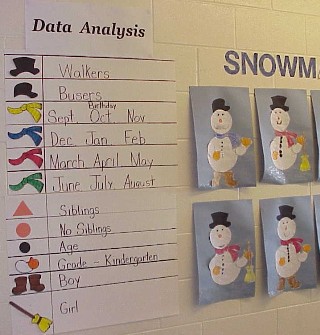
Snowman Glyph


Students will enjoy creating snowman glyphs to picture data about themselves.  Adapt the legend to fit your particular class and/or location.  As students become accustomed to creating glyphs, it's easy to adapt holiday craft projects to become glyphs.  Teachers like to involve students in designing the legend for these projects which requires higher-order thinking skills as they analyze what would be important data to know and how best to picture it in the particular glyph.

Display completed glyphs on a class bulletin board and challenge students to analyze the class data by asking pertinent questions:
  • Do more people in this class ride the bus or walk to school?
  • Do most people in the class have siblings?
  • What set of months have the least birthdays for this class?
  • Do you think these results will be the same for Mrs. ________'s class?  Why or why not?
See more Mathwire Snowman Math Activities.

Sunday, December 20, 2009

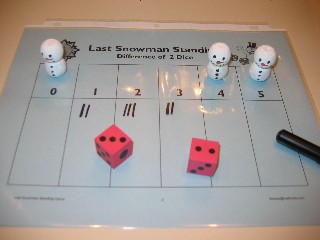
Last Snowman Standing Game

The snowmen face off in this game of addition facts. But beware! A toss of the die may mean the sun melts a snowman. Students practice addition facts as they try to be the last snowman standing because in this game the first person to remove all of his/her snowmen loses the game!


The snowmen pictured above were created with two wooden beads glued together, then painted white, The face was added with sharpie pens. Just be sure to buy the beads that have a flat bottom so that the snowmen will stand. Or, use any manipulative as snowmen.

Download the Last Snowman Standing Game which includes directions and game mats for three different versions of the game:
  • Sum of Two Dice Version to practice addition facts
  • Difference of Two Dice Version to practice subtraction facts
  • One Die Toss for a simplified version to analyze the probability of a die toss

Data Collection: The directions for each version also include directions for data collection and analysis of the outcomes of the games. Be sure to incorporate these activities, if at all possible, as games offer a highly motivational study in probability. Students love to "play games" to collect data. They're also eager to analyze games so that they learn how the game works and what strategies they can use to improve their odds of winning.

Differentiation: This game offers many opportunities to differentiate the activity. First of all, teachers are able to select from three different versions. Secondly, each teacher should differentiate the game analysis to meet the instructional level of his/her students. Most students can handle the questions with teacher guidance. Older students and talented primary students may be challenged to analyze the game and answer the questions in small groups.