Wednesday, January 19, 2011

The M&M Game

M and M Game: 2-dice Version 
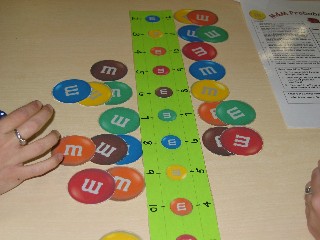
Students place M&M markers on the numbers 2-12.   Students may place one M&M marker on each number or place several on some numbers and leave other numbers blank.   Next, students toss two 6-sided dice, find the sum, and remove an M&M marker from that number, if there is still one.   The first player to remove all markers wins the game. 

This game helps students develop an understanding of the probability of a two-dice throw.  As students play the game, they practice addition facts, but they also learn that some sums are tossed more frequently than others.  This hands-on experience is then solidified with a discussion of all of the possible outcomes, creating a chart to visually capture the data.

Next, students play the game again with this mathematical knowledge and discuss how this information impacts the placement of M&Ms.  Couple this game-playing with class data collection and students may then compare theoretical and experimental probability of a larger sample.

This is just one example of how a simple game may be used as a data collection activity to develop student understanding of theoretical and experimental probability concepts.  Some teachers question the use of games in the classroom pressed for time.  In my experience, this rich use of games to practice basic facts AND as a data collection activity is time well-spent and students respond positively to both the practice and the discussion of these hands-on, fun experiences.

NOTE:  This game, created by Susie Siegel as a grad school project, uses a sentence strip as the number line.  The M&M pieces were created using PowerPoint.  Teachers may choose to laminate the pieces for use in a classroom math center.


MATERIALS:
  • Download Ms. Siegel's M&M Game directions and recording sheet.
  • Download a picture, alternate recording sheet and directions for using that recording sheet.  NOTE:  This recording sheet was designed to fit into a sheet protector so that students may use dry erase markers to play and record data.  This option may be used without the M&M game pieces.
  • Download the 2-dice toss recording sheet for a discussion of the theoretical probability of tossing two dice.  Students write one outcome that produces that sum in each box to create a visual display.   NOTE:  use different colored dice for this activity so that students are able to see that tossing 4 on the red die and 3 on the blue die is different from tossing 3 on the red die and 4 on the blue die.  Both must be counted as outcomes.  Students might benefit from actually using two different color markers to record these outcomes as well.
  • Download M&M pieces for use in playing the game.

Sunday, January 16, 2011

Penguin Math Games

Capture the Penguins Game uses the outcome of two-dice toss to form a coordinate pair. Students toss two dice (one regular and one A-F) in this fun game that introduces students to coordinate graphing in the spaces.   Students form a coordinate pair based on the dice toss and capture a penguin, if possible.   Students use the accompanying recording sheet to keep score during the game. 
  • A-F Dice: Create A-F dice using plain dice or purchase small wooden cubes at a craft store to make the dice.  
  • Penguin Pieces: Penguins pictured to the right were created by painting wooden clothespins and doll stands, both readily available at craft stores. 
Download Capture the Penguins game mat, instructions and student recording sheet. 


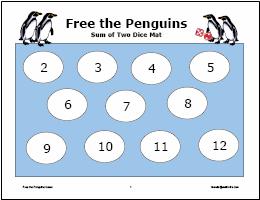
Free the Penguins Game:  The penguins are stuck on the ice floes. Only a roll of the die can free them to search for food in the ocean. Students will practice addition or subtraction facts as they try to be the first to free their penguins. Use mats with clothespin penguins for the most fun! 

These games are not only an excellent opportunity to practice basic facts but they allow students to collect data and reflect on the probability inherent in the game. Suggestions are included with this game for students to keep tallies of all dice tosses, organize the class data in a line plot, and then analyze the data for patterns and trends. 

Download Free the Penguins game mat, instructions and suggestions for data collection.


Saturday, January 15, 2011

Penguin Math-Literature Connection

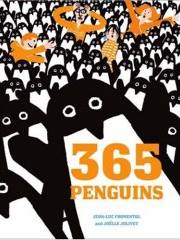
The family in this book receives a penguin in the mail each day and these penguins quickly add up to take over the house and their lives. The book already contains measurement calculations, but the book also lends itself to some problem solving possibilities. After enjoying the book, continue with some of these problem solving activities, created by Mathwire:
  • Students need to apply calendar skills to solve the Penguin Delivery problem.
  • Dad dreams up another crazy arrangement for the penguins in Penguin Formation .
  • See more penguin problems including Penguin Parade and Penguin Puzzler which also feature patterns that would have intrigued Dad.

Friday, January 14, 2011

Pascal's Penguins

Pascal's Penguins is an effective introductory activity to the well-known mathematical pattern known as Pascal's Triangle. Students must look for patterns in these penguin variations of Pascal's Triangle. The activity challenges students to identify patterns, fill in the missing numbers and write the next line in the pattern. Class discussion should encourage students to share all of the patterns they see in Pascal's Triangle and discuss how these patterns helped them discover the missing numbers. 

Pascal's Penguins - 1 introduces primary students to a small version of Pascal's Triangle in this simple patterning activity.  
Pascal's Penguins - 2 introduces a larger version of Pascal's triangle and encourages students to identify the different patterns within the triangle and use these patterns to fill in the missing penguin numbers.