Thursday, September 16, 2010

Using Antennas to Count Coins


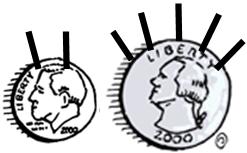
Students draw antennas on coin pictures to represent the value. Each antenna is worth 5 cents. This means a dime has two antennas, a nickel has one antenna, a penny has no antennas, etc. This strategy capitalizes on students' strength in counting by fives. They simply point to each antenna as they count by 5s, then count on by ones to include any pennies.

This method is also efficient because students do not need to sort and reaarange coins; they simply draw antennas on coins in the order given. This method is especially effective for K-2 regular and special ed. students who will eventually outgrow the need for antennas. NOTE: some teachers call the antennas "hairs" and talk about the penny as "bald" because it has no hair. Whatever works for you and your students is the best strategy.


See more Mathwire Money Activities & Strategies including money games.

Wednesday, September 15, 2010

Using the Hundred Board to Count Money

Hundred Chart: students who confidently use the hundred chart and its patterns to solve problems can utilize this tool to work with coins: 


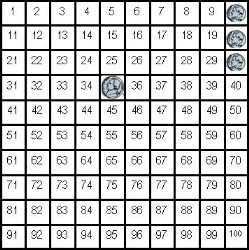
Counting coins: Use a hundred chart to help students count coins.   Have students place coins on the correct number.   For instance, given 3 dimes and 1 nickel, students would place dimes on 10, 20, 30 and the nickel on 35. The last coin tells students how much money they have altogether.   This method is effective for having students figure out which coins to use to pay for an item.

Making change for a dollar: Place a counter on the price of the object.   Place pennies on each square to get to the nearest multiple of 5.   Use nickels, dimes or quarters to get to $1.00.   Students should begin with whatever combination of coins they wish then work toward using the least number of coins as they become more proficient at making change.

Tuesday, September 14, 2010

Hundred Board Puzzles


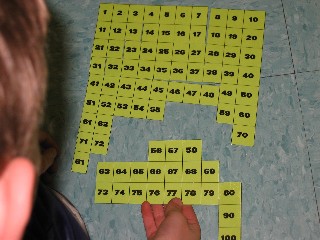
Students learn the patterns in the hundred board by assembling puzzles. Teachers are able to assess student use of patterns in rows and columns by observing the student at work.

Differentiation:  This task is easily differentiated to accommodate the varied levels in a first grade class by changing the number of pieces and the shape of the pieces. Puzzle bags should be sequentially lettered so that students progress through harder versions of the task. Finally, students are asked to create their own puzzles for classmates to solve.

Extension:  Use a 101-200 number grid so that students extend patterns and become more familiar with 3-digit numbers.


Materials: 
  • See Hundred Board Activities on Mathwire to download a hundred board template that may be used to create the hundred board puzzles.
  • Copy the template onto card stock to make the puzzles heavier and easier to assemble.

Friday, September 10, 2010

Math Templates


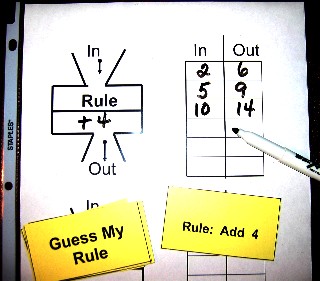
Using math templates during instruction keeps each student actively involved and allows the teacher to informally assess each student's proficiency with the skills and concepts addressed in the day's lesson. Many teachers regularly use whiteboards to have students record answers, write terms, draw pictures, etc. The use of templates in sheet protectors extends this practice and eliminates the time spent drawing diagrams, etc., allowing students more time to demonstrate mathematical proficiency. Teachers who regularly use math templates include planned task items that assess student proficiency. Careful observation of student responses allows teachers to form flexible small groups for additional instruction or enrichment and also better plan for instruction.

The Mathwire Template Library is a collection of generic math templates available in PDF format for easy downloading and printing.  Students insert each template into a clear sheet protector, then use dry erase pens and erasers to extend the life of these templates.