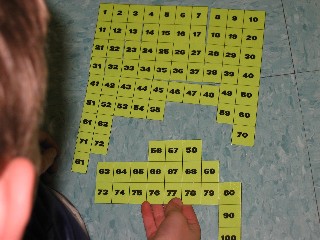
Students learn the patterns in the hundred board by assembling puzzles. Teachers are able to assess student use of patterns in rows and columns by observing the student at work.
This task is easily differentiated to accommodate the varied levels in a first grade class by changing the number of pieces and the shape of the pieces. Puzzle bags should be sequentially lettered so that students progress through harder versions of the task.
Finally, students are asked to create their own puzzles for classmates to solve.
Download a hundred board template to copy onto card stock and then cut apart to create puzzles.
Showing posts with label puzzle. Show all posts
Tuesday, December 13, 2011
Thursday, May 12, 2011
Hundred Board Puzzles
The hundred board or chart holds a prominent place in primary math classrooms. The chart is a visual representation of the patterns in our mathematical system of numbers.
Students are able to learn the patterns in the hundred board by assembling puzzles. Teachers are able to assess student use of patterns in rows and columns by observing the student at work.
Differentiation:
This task is easily differentiated to accommodate the varied levels in a first grade class by changing the number of pieces and the shape of the pieces. Puzzle bags should be sequentially lettered so that students progress through harder versions of the task.
Extensions:
- Have students and their families create their own hundred board puzzles.
- Challenge students to fill in missing numbers on hundred board pieces or whole hundred boards as practice using the patterns in the hundred board.
- Download a hundred board template.
Tuesday, September 14, 2010
Hundred Board Puzzles
Students learn the patterns in the hundred board by assembling puzzles. Teachers are able to assess student use of patterns in rows and columns by observing the student at work.
Differentiation: This task is easily differentiated to accommodate the varied levels in a first grade class by changing the number of pieces and the shape of the pieces. Puzzle bags should be sequentially lettered so that students progress through harder versions of the task. Finally, students are asked to create their own puzzles for classmates to solve.
Extension: Use a 101-200 number grid so that students extend patterns and become more familiar with 3-digit numbers.
Materials:
- See Hundred Board Activities on Mathwire to download a hundred board template that may be used to create the hundred board puzzles.
- Copy the template onto card stock to make the puzzles heavier and easier to assemble.
Subscribe to:
Comments (Atom)