Friday, April 29, 2011

Math-Literature Connection: Give Me Half!

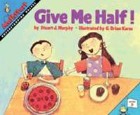
Give Me Half by Stuart J. Murphy 

This book takes a humorous look at splitting things in half. Follow a reading and discussion with this worksheet where students practice splitting shapes (area fraction model) and groups of shapes (set fraction model) into half fairly.


Thursday, April 28, 2011

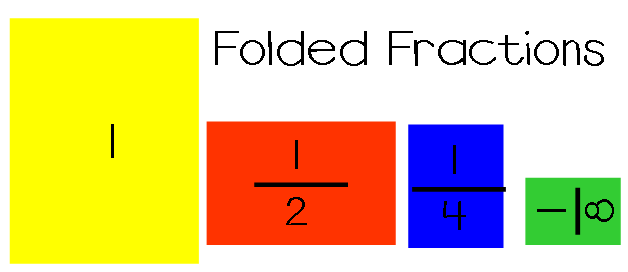
Folded Fractions

Students need many concrete experiences with fractions to develop a deep understanding of the three models of fractions: area, linear and set models. Teachers need to address all three models in well-designed instructional activities so that students develop a rich concept of fractions that they can use to make sense of numbers, operations, measurement and probability. 

Folded Fractions:  For this area model, students use 4 pieces of construction paper to create this set of fraction manipulatives.  Students fold the paper following instructions, unfolding to easily see how many pieces are now in the whole.  After marking each piece with the correct fraction part, students cut apart the fractional pieces.

This model is easily created from classroom materials and students should keep their sets in their desks.  Students may use the fraction pieces during instruction, in problem solving or to play games.   By using the yellow "1" or "whole" mat, students may easily combine different fractional pieces to create a whole, etc., placing pieces on top of the yellow mat to see different ways of making a whole.

Other Area Models
Students divide shapes into the appropriate number of equal sections given by the denominator, then shade in the appropriate number of sections, given by the numerator to create a picture of the fraction. Equivalent fractions are also developed using this area model. Teachers may also use any of these manipulatives to develop the area model: 
  • pattern blocks
  • circular fraction regions
  • pizzas
  • geoboards
  • spinners

Wednesday, April 27, 2011

Problem Solving: Fractions

Students are challenged to solve these problems by drawing pictures rather than using traditional fraction algorithms.  This is an extremely effective strategy to develop student conceptual understanding of fractions, fractional parts and fraction operations.

  • Tadpoles and Frogs requires students to use fractions to figure out how many tadpoles and frogs there were in the tank.
  • Animal Shelter requires students to use fractions to figure out how many cats and dogs were available for adoption at the animal shelter.
  • Fraction Game simulates a Fraction War game but students must draw a representation of each fraction and explain who won, based on the drawings.
  • High Number Game requires that students apply their knowledge of fractions, decimals and percents to decide whose number card is highest.
  • Pattern Block Fraction Design requires students to use pattern blocks to fill the shape so that it has a line of symmetry. They must then write a fraction for each color pattern block used in the design.
  • The Adventures of Mrs. Meatball problem set challenges students to draw pictures to solve each problem and prove their answers. 
  • Monkey Business challenges students to work backwards to solve this fraction division problem. 
  • Bake Sale challenges students to work backwards to solve another fraction division problem involving disappearing cookies.

Tuesday, April 26, 2011

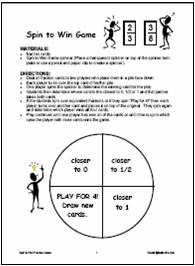
Fractions: Spin to Win Game

It is important that students develop numerical sense in fractions.  One excellent activity is sorting fractions as close to 0, close to 1/2, close to 1.  This activity forces students to think about fractions in a whole different way and enriches student understanding.

The Spin to Win Game was developed to provide fun practice in this skill.  Students play in pairs. Each student draws a card from the fraction deck. One student spins the spinner. If the spinner lands on "closer to 0" then the student whose fraction is closer to 0 wins both cards. The same holds true for "closer to 1/2" or "closer to 0." If the students turn over equivalent fractions, they pick another card and spin to win all 4 cards. 

Materials: