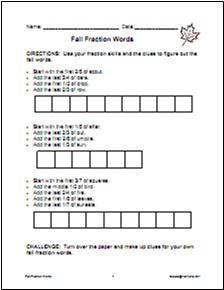
This activity requires students to put together fractional parts of words to create a new word. It's a verbal take on the fractional set model. If correctly solved, the fractional parts spell out a fall word.
Extension: Students may enjoy creating their own fraction words, using local clues, seasonal prompts or even holidays. Use student-generated fraction word activities as an easy do-now exercise at the beginning of class. It's a great way to develop understanding of the set model of fractions.
Download the Fall Fraction Words handout and answer key.
Tuesday, November 1, 2011
Friday, October 28, 2011
Pascal's Ghosts
How Many Ghosts Do You See?
This activity encourages students to apply the patterns in Pascal's Triangle. A teacher instructional plan with mathematical background, answer and challenge is included to explain how to present this problem, which is also an outgrowth of the Rutgers Discrete Math Institute.
A recording sheet is also included as part of the teacher packet so that students are able to record all different solutions using a systematic counting method, which is a goal of discrete mathematics.
Download Pascal's Ghosts problem, instructional plan, student recording sheet and answer key.
Be sure to check out Pascal's Pumpkins in an earlier post. This is an easier introduction to the patterns in Pascal's triangle.
This activity encourages students to apply the patterns in Pascal's Triangle. A teacher instructional plan with mathematical background, answer and challenge is included to explain how to present this problem, which is also an outgrowth of the Rutgers Discrete Math Institute.
A recording sheet is also included as part of the teacher packet so that students are able to record all different solutions using a systematic counting method, which is a goal of discrete mathematics.
Download Pascal's Ghosts problem, instructional plan, student recording sheet and answer key.
Be sure to check out Pascal's Pumpkins in an earlier post. This is an easier introduction to the patterns in Pascal's triangle.
Thursday, October 27, 2011
Fall Problem Solving
These open-ended assessments require students to apply mathematical concepts and skills to solve problems and explain their thinking using words, pictures and/or numbers.
Candy Corn presents a triangular numbers problem using a candy corn pattern. Younger students might use candy corn to model the problem. A sample solution shows how older students might use an input-output table to model the pattern and find the solution without the use of manipulatives.
Annual Fall Parade challenges students to use the triangular pattern to figure out how many students are in the fourth grade. Given the number of full rows, students must apply the pattern and use effective recording (picture, table, etc.) to explain their reasoning.
Pumpkin Picking is a pattern problem that can be solved using a picture or an input/output table. [contributed by Shannon Collier, Joseph C. Caruso School, Keansburg, NJ]
Trick or Treat requires students to create a table of values and identify the pattern or rule to solve the problem.
Grade 2 Halloween Word Problems were written by Tammie Holcombe and Karen Zeigler, second grade teachers at Port Monmouth Road School in Keansburg, NJ.
Younger students will enjoy analyzing and completing
Fall Patterns. They should then classify the pattern and explain their reasoning as part of the class discussion. It is possible that students will see different patterns in some of the items so their explanation and justification are very important mathematical discourse.
Younger students will enjoy analyzing and completing
Labels:
fall,
math seasonal activities,
patterns,
problem solving
Wednesday, October 26, 2011
Measurement Man
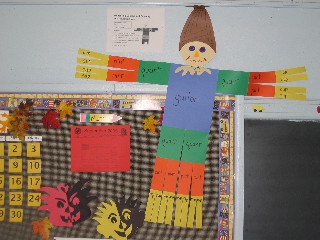
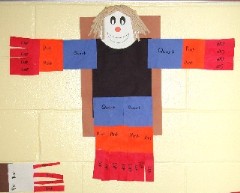
Measurement equivalents are always a tough challenge in elementary classrooms. This visual helps students master the equivalent units and helps them compare and rename these common measurement units.
Subscribe to:
Posts (Atom)