Tuesday, September 7, 2010

Number Line-Up


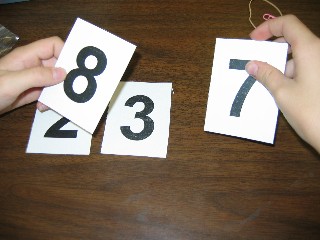
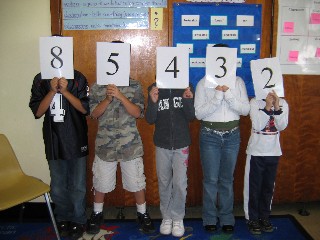
This activity was designed to practice place value.  In its simplest form, students with the demo digits are asked to form a specific number.  Students arrange themselves to form that number.  The teacher may then ask students what number is in the hundreds place, or the thousands place, etc. 

Ask the students to form number answers for these challenges:
  • the largest number
  • the smallest number
  • a multiple of 25
  • a multiple of 4
  • an even number greater than 4000
  • an odd number less than 5200
  • the largest even number
  • the smallest odd number
  • the largest multiple of 5

Build a Number
To extend the activity, next ask students to use the digits 2,3,7, 8 to form:

  • the greatest number
  • the smallest number
  • a number between 3000 and 7000
  • an even number
  • an odd number between 2000 and 3000
  • the largest even number
  • the smallest odd number


Students at their desks work with small decks to digit cards to produce similar results.  Students may work individually or in pairs, rearranging their small digit cards to produce numbers to satisfy each condition.  It's best to have students working in pairs because they will "talk math" as they figure out how to rearrange their number cards AND they will also discuss how their solution is the same/different than the standing group AND whether they are both possible solutions.

Materials:  Visit Mathwire to read more about Number Line-Up and Build A Number.  There you may download both demo size and individual size digit cards to print out for use in your classroom.  I suggest that you print them on cardstock or laminate them for classroom use.  The demo digits may also be placed in sheet protectors, if desired.

Math Warm-Up Activity:  use the digit cards for quick warm-up activities in the week(s) following initial instruction.  Pose conditions that fit the level of instruction and have students quickly assemble a solution on their desks.  Students enjoy this break from pencil and paper tasks and the digit cards are an easy visual for a teacher to  check quickly as he/she walks around the room.

Differentiation:  this activity is easily differentiated by varying the number of digit cards used (the size of the numbers) and the difficulty level of the task conditions.  Teachers may also pair students to increase the likelihood of success.

Saturday, August 28, 2010

Data Collection: Tossing Two Dice

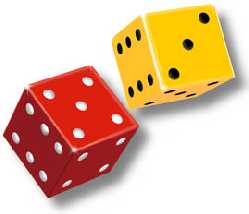
Students LOVE working with dice, almost forgetting that they're doing math.  While standard probability lessons ask students to calculate the probability of tossing an even number, a sum of 10, etc., students are more highly motivated when they generate their own experimental data.

The Mathwire collection contains many examples of both one-die toss activities and two-dice toss activities.  These data investigations begin with a game but make data collection an integral part of the activity, so that students begin to examine the underlying probability of the game and can use appropriate strategies in future play.

Students will generate their own small set of data, which should be combined with the whole class data for a larger set.  Teachers may ask questions to help students draw conclusions and make generalizations about the probability of dice tosses.

After this initial hands-on data collection and analysis, extend the activity by asking students to use online dice simulators to generate even more data to test their hypotheses and generalizations.  This option allows students to quickly generate large sets of random data.  It is helpful to pair students for this activity:  one student at the computer keyboard and the other student recording the results of each simulated dice toss.  Again, ask students to post their results to a class data collection display (e.g. tally chart, graph, etc.) so that the class is able to analyze the larger sample.

Check out these online dice-toss simulators:
  • Coins & Dice:  A Probability Simulator records the results of each dice toss, making it easy for students to record the result of each dice toss
  • Dice Roll displays the results in a bar graph so that students visually see the results of extended dice tosses
This data collection and data anaylsis approach provides students with hands-on data collection activities that generate real-life data for analysis.  Students then take advantage of technology to simulate the activity, quickly collecting larger sets of random data.  It's the best of both worlds!

Sunday, August 8, 2010

Writing in Math Class

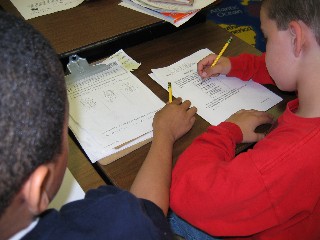
Teachers incorporate writing in math class to help students reflect on their learning, deepen their understanding of important concepts by explaining and providing examples of those concepts, and make important connections to real-life applications of the math they are learning. Teachers use the writing assignments to assess student understanding of important concepts, student proficiency in explaining and using those concepts and each student's attitude toward learning mathematics.

Writing in mathematics is a win-win for both teacher and student. Although it may be difficult to introduce this practice, it is well worth the effort. Look for simple ways to incorporate short writings throughout daily lessons and longer writings over the course of weeks or math units.


  • Use whiteboards often throughout a lesson.  Ask students to define a term in their own words, explain why an answer is correct/incorrect, show their thinking using words, pictures, numbers, etc.  For some students, the "forgiveness" of an erasable whiteboard encourages them to write more.  For others, the color and novelty motivate active participation.
  • Plan regular Think-Write-Pair-Share opportunities:  plan to stop instruction to include these student-controlled learning opportunities in which students are asked to think (nonverbally respond to a question or prompt), write their response, pair share their responses, then share responses with the class.  This strategy is particularly effective for shy or struggling students as they have time to practice their response on a peer, hear their partner's response, and finally combine responses to share with the class.  This practice also helps students make the connection between oral and written responses. Teachers may elect to chart responses in bullet format to post for student review.


Read more about strategies for including Writing in Mathematics Class with links to additional internet resources.

Sunday, August 1, 2010

Three Strikes and You're Out!


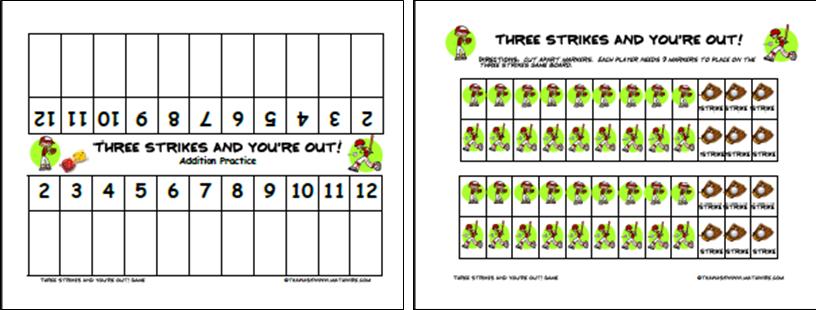
Summer means baseball games so capitalize on this favorite sport with the game Three Strikes and You're Out!  The game was designed to practice addition and subtraction facts while incorporating a basic introduction to probability outcomes. 

Players will enjoy choosing the numbers for their players and their strikes.   As they play the game, they'll learn which numbers are best for placing players and which numbers are best left as strikes, developing a basic understanding of probability.  They'll practice addition or subtraction facts while learning that the dice toss is often unpredictable and random.

The game uses the sum of two dice to practice addition facts, but may easily be adapted to practice subtraction facts by using two 12-sided dice and finding the difference. The game handouts include directions, variations in play and scoring, game boards for both the addition and subtraction games, as well as game pieces that may be used to support the baseball theme.  

Download the directions and gameboards for Three Strikes and You're Out.