Showing posts with label real-life application. Show all posts

Saturday, March 17, 2012

Math Alive!

The Smithsonian Institute is currently hosting the Math Alive! exhibit.  From the website:

  • MathAlive! is designed to inspire, to spark the imagination, to reveal not only math at work, but the endless possibilities of math. Designed for families and students the exhibition brings to life the real math behind what kids love most - video games, sports, fashion, music, robotics, and more - and creates interactive and immersive experiences that bring to life the math at work in each, whether in design, application or use. 
If you're planning a trip to the Washington, DC area, be sure to include this exhibit in your itinerary.

Visit the Math Alive! website for more information on the exhibit and to sample some of the online games and activities.

Monday, November 28, 2011

Integers: Elevator Model

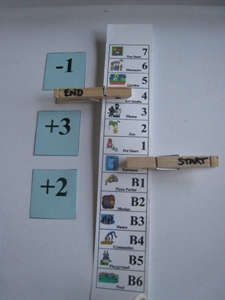
Students intuitively use this model to describe riding up (+) and down (-) in an elevator.  This real-life application is one some students might have encountered if they live in a large city or have visited taller buildings.  Generally problems involve starting at one floor and going up (+) or going down (-) floors to get to another location within the building.  This provides a gentle introduction to integers in a familiar format.


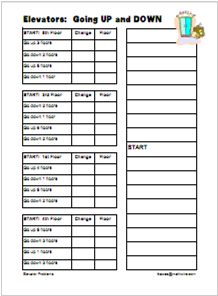
The Elevator Template may be laminated or placed in a clear sheet protector for student use.  Students use dry erase markers to number the starting floor.  They may then move up or down, as dictated by the problem, using a clothespin to mark the ending floor.  NOTE:  The template was purposely left unnumbered so that it works for all types of uses and ranges of numbers.


The Elevator Problems set suggests students use an elevator template to track multiple moves from floor to floor, recording each change as an integer.  Ultimately students work through these moves to identify the final floor.


Some teachers create a fictional store with special floors (e.g. 2 - Kids' Clothing, 3 - Furniture, 4 - Toys, etc.) so that students experience this real-life application of integers.  It's easy to generate integer problems using this model:  If I get back on the elevator at the 2nd floor, ride up 5 floors, then back down 1, what floor am I on now?


Challenge students to write their own Where in the building am I now? problems.


Read more about Integers:  Elevator Model on Mathwire.

Tuesday, November 15, 2011

Changes in Temperature Template

Changes in temperature are a real-life application of integers in mathematics.  3 degrees warmer would be represented as +3 while 5 degrees colder would be represented as a change of -5.  This change in temperature use of positive and negative integers is in addition to the absolute temperatures on a thermometer which might read below 0 in some climates.


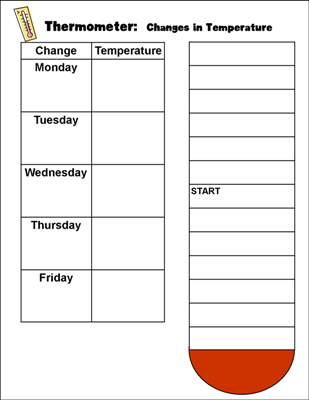
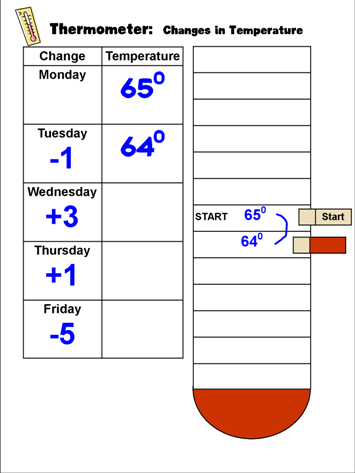
Students use this template to record data to solve changes in temperature problems. Using the 5-day forecast, the teacher tells students Monday's temperature and the change (+ or -) for each day of the week. Students use this information to figure out the actual temperature for each day of the week. Note that the change should reflect the change from the previous day. For example, a change of -3 for Wednesday means that the temperature went down 3 degrees from Tuesday's temperature. Additionally, if the teacher uses the actual changes in the 5-day forecast for the area, the students can also assess the accuracy of a 5-day forecast as the week's weather plays out.


Place the template in a clear sheet protector and provide dry erase markers for students to use.


The thermometer strip is available as a visual representation for students to use in solving the changes in temperature problems. Students write Monday's temperature in the START space. They may then simply count up or down spaces to get to the next day's temperature. 


The template was designed so that students could use a clothespin to mark the daily change for ease in recording on the template pictured above. The clothespin simply clips onto the appropriate space as a placeholder while students write in the temperature and record the information in the weekly chart.


Download the Changes in Temperature Template which also includes thermometer strips that may be laminated for student use in these lessons.