Tuesday, October 25, 2011

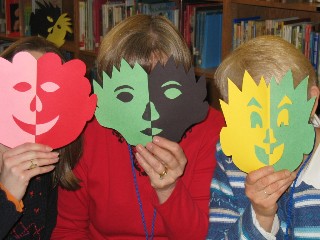
Symmetric Faces


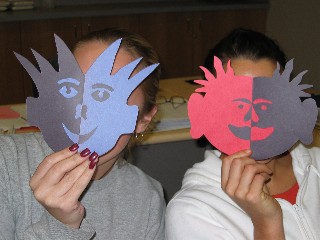
Halloween masks become a math activity when students create Symmetric Faces. Students demonstrate a working knowledge of symmetry as they make these unique masks using 1.5 sheets of construction paper, scissors and glue. Students outline the features on the half-sheet of paper, then carefully cut the pieces, and position them on the opposite side to create a symmetric face in opposite colors.

Download directions for making  Symmetric Faces.

Don't limit this mask activity to Halloween, as these versions would be equally effective opportunities to introduce this symmetry project:
  • Patriotic masks created in red, white and blue
  • Mardi Gras masks using yellow, green, and purple construction paper combinations to simulate Mardi Gras colors.
  • School Spirit masks created in school colors
  • Valentine masks created in red, pink and white
  • Or...you get the idea!

Be sure to check out the Symmetric Faces Photo Gallery for more inspiration.

Monday, October 24, 2011

Estimation Station


Establish a regular center in the room which changes weekly. A simple clear plastic container is filled with different items each week. These items should vary in size to challenge students' developing concept of volume, as it relates to smaller or larger units. Use seasonal items: acorns, leaves, candy corn, popcorn kernels, pumpkin seeds, etc. to spark student interest. Keep a class journal of these activities in which students may record their estimates. Record the item and the actual count along with a digital picture, if possible, of the container and the student(s) whose estimates were closest. Some classes involve parents by asking for volunteers to send in appropriate items to be counted. It is important to use the same container for several weeks so that students build an understanding that size matters in estimating how many items there are in the jar.
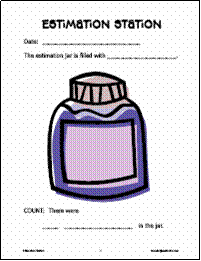
  • Download  Estimation Station Recording Sheets to use for this activity. Keep sheets in a binder to provide a growing record of student growth in estimating.
  • Suggestions for using recording sheets: Have each student write his/her name and estimate on Page 2. After counting, circle or color in the student(s) whose estimates were closest. Teachers may elect to print in names at the beginning of the year and simply copy each week so that student names are always in the same location for easy checking.
  • Take a picture: Use a digital camera to record the winner(s) holding the jar each week. Add the picture to page one by simply covering the estimation jar clip art.

Math-Literature Connection - Estimation: The Biggest Pumpkin Ever by Stephen Kroll would be a great literature connection for a Huge Pumpkin Estimation Station or to introduce a class pumpkin sorting activity.


Math-Literature Connection - Estimation: The Candy Corn Contest by Patricia Reilly Giff would be a great literature connection for a Candy Corn Estimation Station, as described in the book. The sneaky teacher in this story required that students read a page in a library book for each guess they submitted. Math teachers might vary this requirement to include some fun math practice as a way to earn guessing rights. Either way, incorporating the actual candy corn jar estimation is a great seasonal variation of the Estimation Station described above.

Friday, October 21, 2011

Spider Names


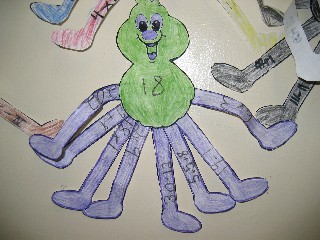
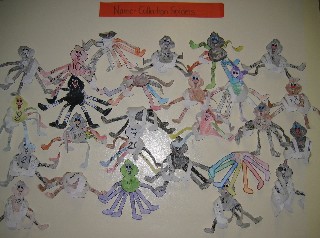
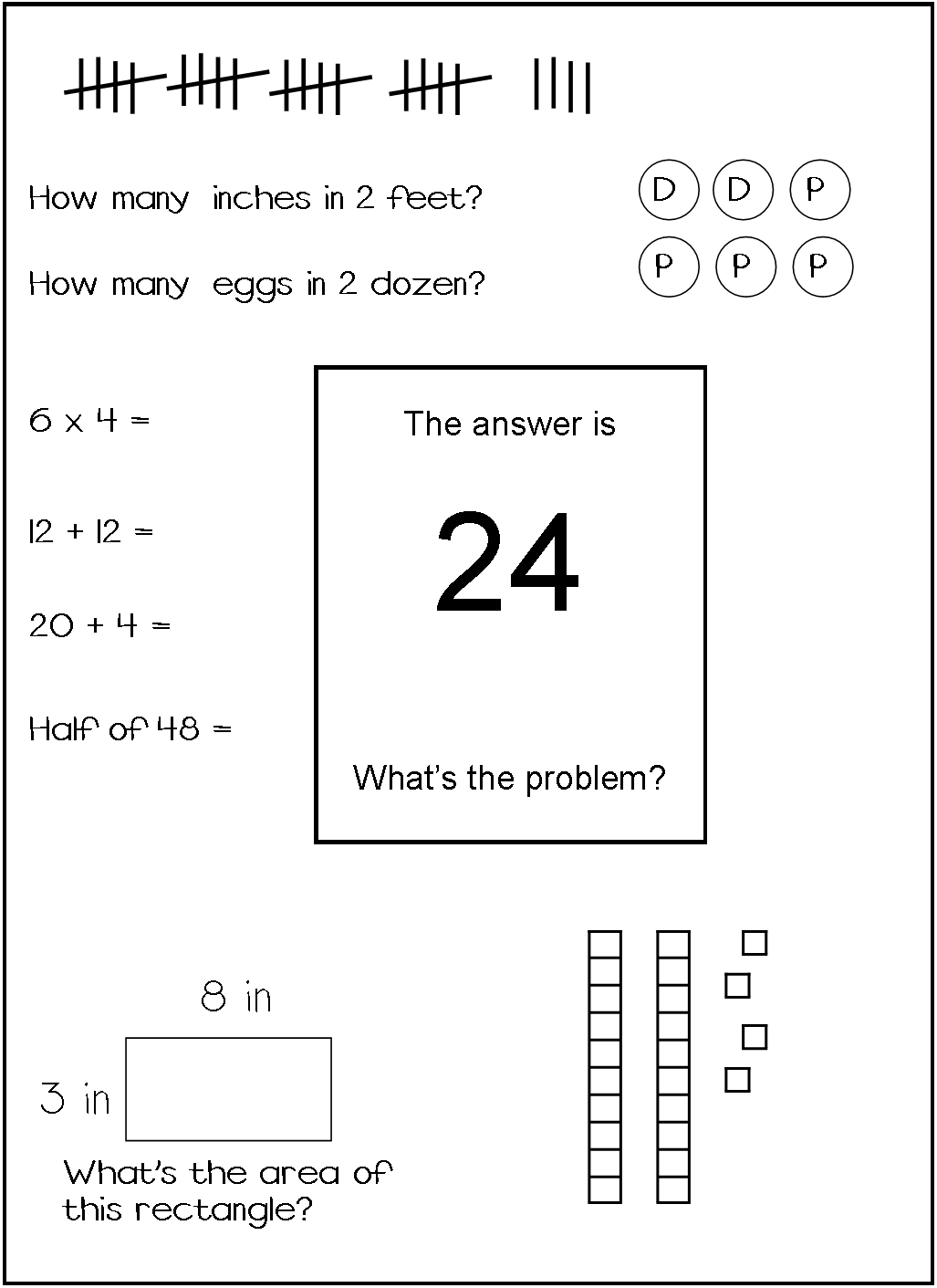
Ms. Collier's and Ms. Rachko's classes created Name-Collection spiders for Halloween.   These fourth grade students extended the Everyday Math name-collection box routine to writing 8 different names for each number, one for each spider leg.  


This activity builds on students' ability to recognize and create different names for the same number.  NCTM originally proposed the open-ended activity:


Students are encouraged to write questions drawn from all areas of mathematics for which the answer is 24.  Here's an example of a student's response:


This activity is easily used as a transition activity.  Students complete the activity as the teacher checks homework or distributes materials.  Make it a once a week activity, copy the best responses onto chart paper and post it in the classroom for student reference.

Thursday, October 20, 2011

Bats on Parade

This book is a literary introduction to square numbers and the patterns they form as square arrays.   The bats march in parade formation and different sections of the band, being different sizes, march in different arrays: "In nine rows of nine those trombones reported, while there, right behind them, the tubas retorted."   The pictures and rhyme reinforce the mathematics of the patterns and teachers can easily ask students to predict how many bats will be in the next section or ask them to figure out how many bats are in the whole band before reading those pages.   Add this book to your collection of problem-solving literature prompts.


  • Multiplication Arrays: The book is a great introduction to multiplication arrays. Use the book illustrations to show students how to use an array to model a multiplication problem then ask students to create arrays for different multiplication facts.
  • Class on Parade Book: Challenge students to design an array and a rhyme for an original page in theClass on Parade book. Decide on a theme and let pairs of students work on both the math and the language for a page.

Bat Jamboree by Kathi Appelt

Bat Jamboree introduces the triangular number pattern as bats assemble for the final number beginning with 10 bats in the bottom row, 9 in the next row, etc. to the very top row with 1 bat.   Students are introduced to the 55 bats in formation and their various acts but the book "isn't over until the bat lady sings."   Students will enjoy this introduction to an important mathematical pattern.   Teachers can find many problems that build upon this triangular number pattern and extend the experience.
  • Student Written Problems: ask students to write original problems that use the triangular number pattern. Being able to write similar problems and solve them require higher-order thinking skills as students apply, synthesize and evaluate both the problems and the solutions.

Bats Around the Clock by Kathi Appelt

Take a humorous dance through time.   Click Dark and American Batstand introduce a new dance each hour.   Students move through time, enjoy some rhyme and learn the names of some oldie-but-goodie dances along the way.
  • Making Time: For the second reading, give students individual clocks and ask them to move the hour hand to the next hour and say the time before reading the book section for that hour.
  • School Time: Provide copies of the  School Time Template and have students choose a time in the school day, draw the hands on the clock, write a verse and draw an illustration that shows what the class does during that hour. Assemble the individual hours into a class booklet or booklets, depending on the number of students in the class. This activity is easily differentiated to feature time on the hour, or to use the real time schedule of activity changes the class follows. The template clock deliberately shows no hands, allowing teachers to customize the activity to the appropriate mathematical level of students in the class.