Showing posts with label estimation. Show all posts

Wednesday, February 22, 2012

More Seussical Fish

Even the class estimation station can be a part of Dr. Seuss math celebrations.  After reading One Fish, Two Fish, Red Fish, Blue Fish, have students estimate the number of fish in a jar.  Use fish manipulatives, goldfish or gummi fish to fill the estimation jar.  Have students post their estimates on post-it notes, or fill in a class recording grid.


Download the Estimation Station file which includes a class recording grid as well as a form for the actual counting of the contents.  Some teachers keep these records in a class estimation counting folder or binder for future reference.  This is especially helpful when trying to develop how the size of a unit impacts the number of units that can fit into the same jar.  Keeping the documentation allows teachers to call upon the information in future discussions.

Monday, October 24, 2011

Estimation Station


Establish a regular center in the room which changes weekly. A simple clear plastic container is filled with different items each week. These items should vary in size to challenge students' developing concept of volume, as it relates to smaller or larger units. Use seasonal items: acorns, leaves, candy corn, popcorn kernels, pumpkin seeds, etc. to spark student interest. Keep a class journal of these activities in which students may record their estimates. Record the item and the actual count along with a digital picture, if possible, of the container and the student(s) whose estimates were closest. Some classes involve parents by asking for volunteers to send in appropriate items to be counted. It is important to use the same container for several weeks so that students build an understanding that size matters in estimating how many items there are in the jar.
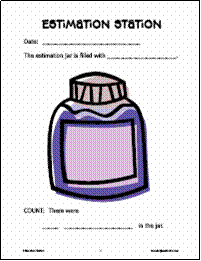
  • Download  Estimation Station Recording Sheets to use for this activity. Keep sheets in a binder to provide a growing record of student growth in estimating.
  • Suggestions for using recording sheets: Have each student write his/her name and estimate on Page 2. After counting, circle or color in the student(s) whose estimates were closest. Teachers may elect to print in names at the beginning of the year and simply copy each week so that student names are always in the same location for easy checking.
  • Take a picture: Use a digital camera to record the winner(s) holding the jar each week. Add the picture to page one by simply covering the estimation jar clip art.

Math-Literature Connection - Estimation: The Biggest Pumpkin Ever by Stephen Kroll would be a great literature connection for a Huge Pumpkin Estimation Station or to introduce a class pumpkin sorting activity.


Math-Literature Connection - Estimation: The Candy Corn Contest by Patricia Reilly Giff would be a great literature connection for a Candy Corn Estimation Station, as described in the book. The sneaky teacher in this story required that students read a page in a library book for each guess they submitted. Math teachers might vary this requirement to include some fun math practice as a way to earn guessing rights. Either way, incorporating the actual candy corn jar estimation is a great seasonal variation of the Estimation Station described above.

Thursday, October 22, 2009

The Candy Corn Contest


Math-Literature Connection - Estimation:
The Candy Corn Contest by Patricia Reilly Giff

This is a great literature connection for a Candy Corn Estimation Station, as described in the book. The sneaky teacher in this story required that students read a page in a library book for each guess they submitted. Math teachers might vary this requirement to include some fun math practice as a way to earn guessing rights. Either way, incorporating the actual candy corn jar estimation is a great seasonal variation of the Estimation Station described below.


Estimation Station

Establish a regular center in the room which changes weekly. A simple clear plastic container is filled with different items each week. These items should vary in size to challenge students' developing concept of volume, as it relates to smaller or larger units. Use seasonal items: acorns, leaves, candy corn, popcorn kernels, pumpkin seeds, etc. to spark student interest. Keep a class journal of these activities in which students may record their estimates. Record the item and the actual count along with a digital picture, if possible, of the container and the student(s) whose estimates were closest. Some classes involve parents by asking for volunteers to send in appropriate items to be counted. It is important to use the same container for several weeks so that students build an understanding that size matters in estimating how many items there are in the jar.


  • Download the Estimation Station Recording Sheet.
  • Suggestions for Using the Recording Sheets:  Have students record their names and guesses on page 2.  After counting the actual objects, fill in page 1 and post it in the estimation station.  Circle or color in the student(s) whose estimates were closest to the actual count.
  • Take a digital picture of the winner(s) each week and post this picture on page 1, covering the estimation jar clip art.
  • Enjoy!!