Showing posts with label triangular numbers. Show all posts

Friday, November 11, 2011

Candy Corn Pattern


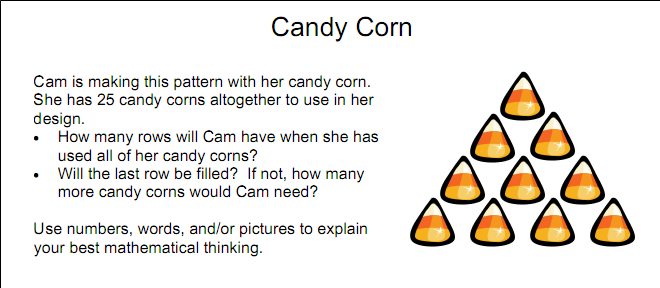
Candy Corn presents a triangular numbers problem using a candy corn pattern.  Younger students might use candy corn or other manipulatives to model the problem.  A sample solution shows how older students might use an input-output table to model the pattern and find the solution without the use of manipulatives.


Wednesday, October 27, 2010

Pattern: Triangular Numbers


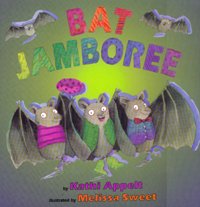
Bat Jamboree by Kathi Appelt introduces the triangular number pattern as bats assemble for the final number beginning with 10 bats in the bottom row, 9 in the next row, etc. to the very top row with 1 bat. Students are introduced to the 55 bats in formation and their various acts but the book "isn't over until the bat lady sings."

Students will enjoy this introduction to an important mathematical pattern. Teachers can find many problems that build upon this triangular number pattern and extend the experience.

  • Annual Fall Parade challenges students to use the triangular pattern to figure out how many students are in the fourth grade. Given the number of full rows, students must apply the pattern and use effective recording (picture, table, etc.) to explain their reasoning.
  • Candy Corn presents a triangular numbers problem using a candy corn pattern. Younger students might use candy corn to model the problem. A sample solution shows how older students might use an input-output table to model the pattern and find the solution without the use of manipulatives.
  • See more Bat Activities in Mathwire's Math Activity Themes:  Bats collection.

Wednesday, October 28, 2009

Fall Problem Solving


The following open-ended assessments require students to apply mathematical concepts and skills to solve problems and explain their thinking using words, pictures and numbers.

  • Candy Corn presents a triangular numbers problem using a candy corn pattern. Younger students might use candy corn to model the problem. A sample solution shows how older students might use an input-output table to model the pattern and find the solution without the use of manipulatives.
  • Younger students will enjoy analyzing and completing Fall Patterns.  They should then classify the pattern and explain their reasoning as part of the class discussion. It is possible that students will see different patterns in some of the items so their explanation and justification are very important mathematical discourse.
  • Annual Fall Parade challenges students to use the triangular pattern to figure out how many students are in the fourth grade. Given the number of full rows, students must apply the pattern and use effective recording (picture, table, etc.) to explain their reasoning.
  • See more Problem Solving Resources from the Mathwire collections.  All problems are classroom-ready in PDF format.  Many contain a sample solution for teacher use.


Wednesday, October 14, 2009

Bat Jamboree


Bat Jamboree by Kathi Appelt introduces the triangular number pattern as bats assemble for the final number beginning with 10 bats in the bottom row, 9 in the next row, etc. to the very top row with 1 bat. Students are introduced to the 55 bats in formation and their various acts but the book "isn't over until the bat lady sings." Students will enjoy this introduction to an important mathematical pattern. Teachers can find many problems that build upon this triangular number pattern and extend the experience.


Student Written Problems: ask students to write original problems that use the triangular number pattern. Being able to write similar problems and solve them require higher-order thinking skills as students apply, synthesize and evaluate both the problems and the solutions.


Check out more Bat Activities in Mathwire's Math Activities Themes collection.