Showing posts with label input-output table. Show all posts

Friday, November 11, 2011

Candy Corn Pattern


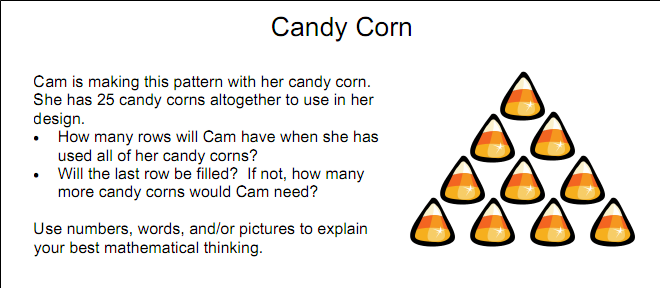
Candy Corn presents a triangular numbers problem using a candy corn pattern.  Younger students might use candy corn or other manipulatives to model the problem.  A sample solution shows how older students might use an input-output table to model the pattern and find the solution without the use of manipulatives.


Tuesday, June 7, 2011

Problem Solving: Pattern Blocks

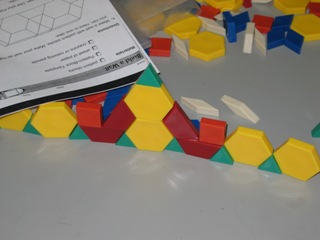
Pattern blocks are a familiar manipulative in most elementary classrooms.  Students learn a lot of geometry from informally interacting with pattern blocks.  These problem-solving activities were specifically designed to target important mathematical concepts using these available manipulatives.


  • In Pattern Block Symmetry students must create a pattern block design to satisy the given conditions involving line symmetry and the number of different pattern block pieces used.
  • Pattern Block Design (Grade 3) requires students to create a design to meet specified criteria.
  • Pattern Block Design (Grade 4) requires students to create a design to meet specified criteria.
  • Hexagon Dragons challenges students to use an input-output table to record dragon growth, then analyze the pattern and write a rule for dragon growth.
  • In Fir Tree, students must use an input-output table to record and analyze data, then write a rule for this growing pattern.
  • Symmetric Snowflake challenges students to use pattern blocks to complete the snowflake design so that it has line symmetry.

Wednesday, October 27, 2010

Pattern: Triangular Numbers


Bat Jamboree by Kathi Appelt introduces the triangular number pattern as bats assemble for the final number beginning with 10 bats in the bottom row, 9 in the next row, etc. to the very top row with 1 bat. Students are introduced to the 55 bats in formation and their various acts but the book "isn't over until the bat lady sings."

Students will enjoy this introduction to an important mathematical pattern. Teachers can find many problems that build upon this triangular number pattern and extend the experience.

  • Annual Fall Parade challenges students to use the triangular pattern to figure out how many students are in the fourth grade. Given the number of full rows, students must apply the pattern and use effective recording (picture, table, etc.) to explain their reasoning.
  • Candy Corn presents a triangular numbers problem using a candy corn pattern. Younger students might use candy corn to model the problem. A sample solution shows how older students might use an input-output table to model the pattern and find the solution without the use of manipulatives.
  • See more Bat Activities in Mathwire's Math Activity Themes:  Bats collection.