Showing posts with label seasonal math activities. Show all posts

Friday, February 22, 2013

Mathwire Dr. Seuss Activities

Many schools celebrate the birthday of Theodor Geisel, better known as Dr. Seuss. Consider adding mathematical activities to these celebrations. One fish, two fish, red fish, blue fish is an especially good introduction to combinations. Use the Mathwire open-ended problems written to accompany this book. The problems may be used with older grades who enjoy hearing their childhood book read aloud.

Primary students will enjoy completing Seussical Patterns, using the classic red and white striped Seuss hat.

See more Mathwire Dr. Seuss activities.

Friday, March 9, 2012

St. Patrick's Day Activities


  •  Shamrock Paths challenges students to use Pascal's Triangle to figure out how many different ways there are to spell Shamrock. Included in the PDF file are an explanation of how this problem relates to Pascal's Triangle and the numerical solution to the challenge.
  •  Shamrock Patterns requires students to rotate shamrocks to complete the pattern. Download some copies of Extra Shamrocks for students to cut apart and glue on to complete the patterns.
  •  Top of the Morning challenges students to identify the 100th and 1000th letter that will be printed on the electronic signboard.

Friday, October 28, 2011

Pascal's Ghosts

How Many Ghosts Do You See?


This activity encourages students to apply the patterns in Pascal's Triangle.  A teacher instructional plan with mathematical background, answer and challenge is included to explain how to present this problem, which is also an outgrowth of the Rutgers Discrete Math Institute.  


A recording sheet is also included as part of the teacher packet so that students are able to record all different solutions using a systematic counting method, which is a goal of discrete mathematics.  


Download Pascal's Ghosts problem, instructional plan, student recording sheet and answer key.


Be sure to check out Pascal's Pumpkins in an earlier post.  This is an easier introduction to the patterns in Pascal's triangle.


Tuesday, October 25, 2011

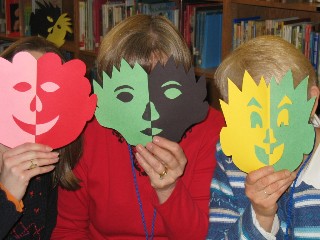
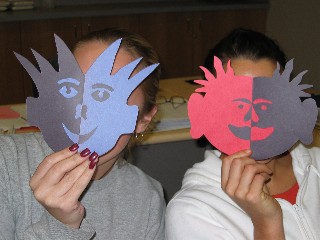
Symmetric Faces


Halloween masks become a math activity when students create Symmetric Faces. Students demonstrate a working knowledge of symmetry as they make these unique masks using 1.5 sheets of construction paper, scissors and glue. Students outline the features on the half-sheet of paper, then carefully cut the pieces, and position them on the opposite side to create a symmetric face in opposite colors.

Download directions for making  Symmetric Faces.

Don't limit this mask activity to Halloween, as these versions would be equally effective opportunities to introduce this symmetry project:
  • Patriotic masks created in red, white and blue
  • Mardi Gras masks using yellow, green, and purple construction paper combinations to simulate Mardi Gras colors.
  • School Spirit masks created in school colors
  • Valentine masks created in red, pink and white
  • Or...you get the idea!

Be sure to check out the Symmetric Faces Photo Gallery for more inspiration.

Friday, October 21, 2011

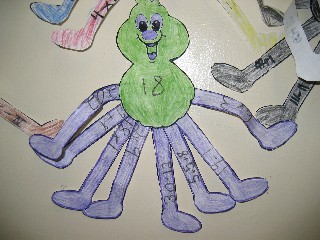
Spider Names


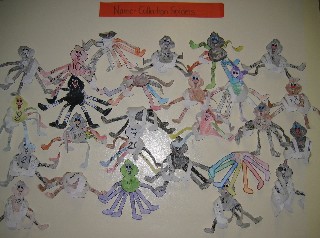
Ms. Collier's and Ms. Rachko's classes created Name-Collection spiders for Halloween.   These fourth grade students extended the Everyday Math name-collection box routine to writing 8 different names for each number, one for each spider leg.  


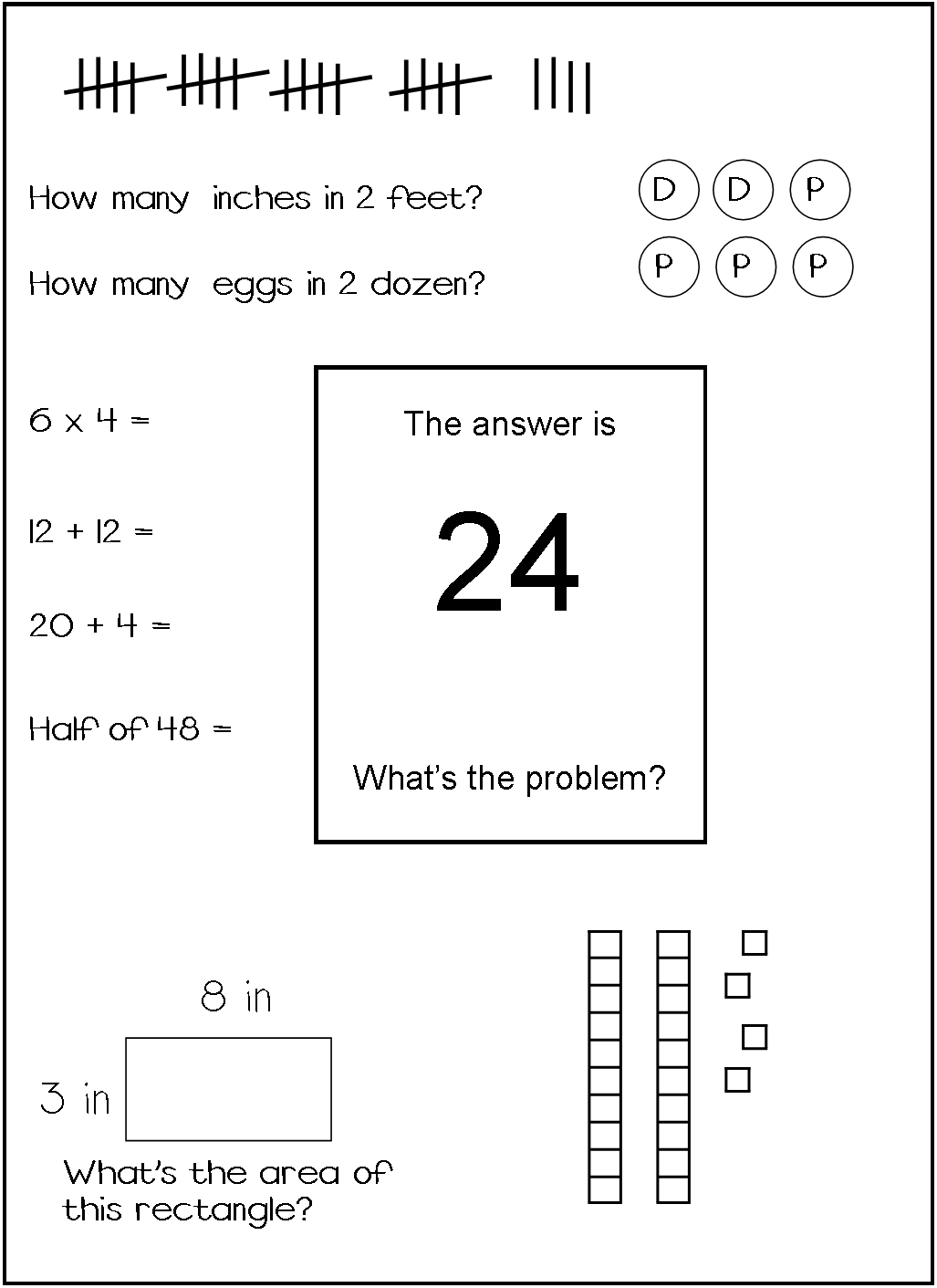
This activity builds on students' ability to recognize and create different names for the same number.  NCTM originally proposed the open-ended activity:


Students are encouraged to write questions drawn from all areas of mathematics for which the answer is 24.  Here's an example of a student's response:


This activity is easily used as a transition activity.  Students complete the activity as the teacher checks homework or distributes materials.  Make it a once a week activity, copy the best responses onto chart paper and post it in the classroom for student reference.

Monday, October 17, 2011

Fat Bat Game


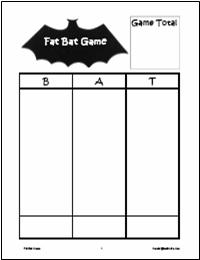
Students roll a die to see how many insects their bat eats. Students may continue rolling, in this Bat version of Pig, until they elect to stop, or until they roll a 1. But be careful! If your bat is still eating (collecting points) when a one is tossed, you are a Fat Bat and lose all of your points for that round.

This game is designed to provide a fun experience in the experimental probability of a single die toss. However, students get lots of practice adding a string of single digit numbers, as they total up their winning points for each round. A data analysis option is included to formally extend the analysis of the game's probability for older students.

Download Fat Bat for the student recording sheet, directions for whole class play, and data analysis option for extending the game.

Tuesday, October 11, 2011

Pascal's Pumpkins

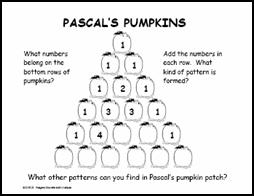
Pascal's Pumpkins   encourages students to look for patterns in Pascal's Triangle.   The handout develops awareness of this important mathematical pattern through a timely seasonal activity.

Students who take higher math courses will meet Pascal again in many different applications, including probability.   This handout is an outgrowth of the Rutgers Discrete Math Institute.

Download Pascal's Pumpkins handout and solution.

Sunday, October 2, 2011

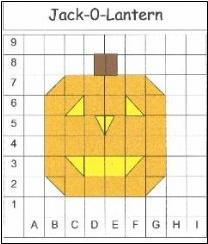
Pumpkin Coordinate Graphing

This activity requires students to use coordinate pairs to correctly color in the squares of the grid to create a jack-o-lantern.  This is an activity from the Mathwire season fall collection.


Introduce young students to coordinate pairs using letters and numbers, reinforcing the concept that the letter (horizontal) coordinate is listed first in an ordered pair. Younger students begin by graphing in the space.  Later, students transition to ordered pairs, graphing the point at the intersection.


Download the Jack-O-Lantern coordinate graphing activity.


See more Mathwire seasonal activities.

Friday, December 18, 2009

12 Days of Christmas


Each year PNC Bank calculates the cost of the gifts in this familiar Christmas carol.  Watch a short video that presents each gift and tells the percent increase or decrease for that gift each year.  Following this presentation, users may select from a number of games available on the site or view a graph of the annual cost index.

Investigate the math behind this holiday gifting by working through DIMACS The Twelve Days of Christmas and Pascal's Triangle.  Students who struggled to figure out the total number of gifts received will be astounded to discover that the patterns in Pascal's triangle may be used for an easy solution.

Students might also enjoy singing 12 Days of Math, a math teacher's parody of the famous carol. 

Print out pictures of the 12 Days Gifts for students to color and/or use as props when singing the song and discussing solutions to the problem of total gifts given in this holiday song.

Wednesday, December 16, 2009

Capture the Penguin Game


Students toss two dice (one regular and one A-F) in this fun game that introduces students to coordinate graphing in the spaces. Students form a coordinate pair based on the dice toss and capture a penguin, if possible. If the space holds a penguin, they capture the penguin for quick points. Create A-F dice using plain dice or purchase small wooden cubes at a craft store to make the dice.

The penguins shown in the picture were created by painting clothespins and clothespin stands, found at craft stores.

Download the Capture the Penguin Game, a PDF which includes directions, game mat, penguin markers and a recording sheet.

Sunday, December 6, 2009

Math Activity Themes: Gingerbread Math


Gingerbread men and gingerbread houses enjoy special popularity around the holidays, but many of these gingerbread activities are timeless and complement literature titles that teachers use at the beginning of school or after the holidays. It's very easy to incorporate mathematics into a study of gingerbread men, and students will enjoy the data collection activities and games while learning math skills and deepening their understanding of important mathematical concepts.


Look through these Gingerbread Man Math activities and add some to your repertoire. Consider broadening the gingerbread math to include measurement, games and problem solving this year. 

Wednesday, December 2, 2009

Gingerbread Math Games


Counting Game:  Run, Gingerbread Man, Run

This game was designed to introduce students to the randomness of spinners and dice. Each color gingerbread man starts at the same place and has the same chance of winning by crossing the finish line, but does it work out that way? Students will enjoy playing the game AND use a clothespin graph [see sample on right] to collect some useful data on the winners.


Once students have collected class data from playing many games, they will come together to analyze the clothespin graph results. Students will be asked to discuss whether or not they think the game is fair for all of the gingerbread men and explain their reasoning.

Download the Run, Gingerbread, Run game so that students can get started playing and collecting data. The pdf file contains the spinner, gameboard, clothespin graph icons, and an optional tally sheet. 


Coordinate Graphing Game:  Catch the Gingerbread Men

For this game, students toss two dice (one regular and one marked A-B-C-D-E-F), form an ordered pair (e.g. B5), then remove the gingerbread man from that space, if there is one. Play continues until the timer rings or until one player has caught 10 gingerbread men. Students love playing the game and they get to practice their coordinate graphing skills in the process.


Coordinate Pairs: This seasonal version of the classic Battleship game provides practice in forming coordinate pairs, identifying the x-coordinate (A-F), then the y-coordinate (1-6) so that spaces are identified as C3 or E6. Hopefully, lots of practice will help students transition to the algebraic ordered pairs (x,y) where x and y are both numbers. Just be certain to reinforce the notion that the x-coordinate (across) comes before the y-coordinate (up or down). The alphabetical cues (across comes before up or down) help some students remember the order.


Download Catch the Gingerbread Men game mat, game pieces and directions for playing the game.

Tuesday, December 1, 2009

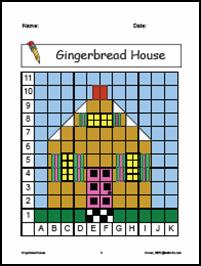
Gingerbread House Coordinate Graphing


Introduce elementary students to coordinate graphing through seasonal coloring activities. The winter Gingerbread House activity requires students to use the grid code and crayons or markers to create a gingerbread house on a blank 11x11 grid. The use of letters on the horizontal axis and numbers on the vertical axis introduces young students to coordinate pairs without the confusion of the standard (h,v) format. Notice that it is important that elementary students become accustomed to listing the horizontal coordinate first as this will transfer to the Cartesian coordinates they will use in later grades.

Tuesday, October 13, 2009

Pascal's Pumpkins


Pascal's Pumpkins encourages students to look for patterns in Pascal's Triangle. The handout develops awareness of this important mathematical pattern through this timely seasonal activity. Students who take higher math courses will meet Pascal again in many different applications, including probability. This handout is an outgrowth of the Rutgers Universiy Discrete Math Institute.

Download Pascal's Pumpkins.  The PDF file contains the student handout and a detailed explanation of the different patterns students might find.  Be sure to make an overhead copy of the pattern so that students are easily able to point out patterns and explain the pattern that they see as they fill in the empty pumpkins.

Extend the activity by asking students to draw and label the numbers in the 7th, 8th, etc. row.  How does identifying the patterns help them complete this task more easily?