Showing posts with label bat. Show all posts
Monday, October 17, 2011
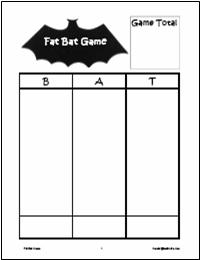
Fat Bat Game
Students roll a die to see how many insects their bat eats. Students may continue rolling, in this Bat version of Pig, until they elect to stop, or until they roll a 1. But be careful! If your bat is still eating (collecting points) when a one is tossed, you are a Fat Bat and lose all of your points for that round.
This game is designed to provide a fun experience in the experimental probability of a single die toss. However, students get lots of practice adding a string of single digit numbers, as they total up their winning points for each round. A data analysis option is included to formally extend the analysis of the game's probability for older students.
Download Fat Bat for the student recording sheet, directions for whole class play, and data analysis option for extending the game.
Sunday, October 16, 2011
Bat Probability
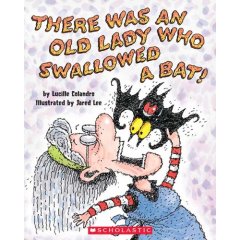
There Was An Old Lady Who Swallowed A Bat!
by Lucille Colandro
After reading the book, investigate Batty Old Lady Probability. Students spin to collect all of the items the Batty Old Lady swallowed, and tally each spin on the recording sheet. They then calculate the total spins it took them to get all 7 items, and add that figure to the class data. Teachers may help students analyze the class data and learn about probability in the process. The pdf document includes directions, game mat, picture cards, spinner, recording sheet and writing to learn handout.
Labels:
bat,
data,
data collection,
math-literature connection,
probability
Wednesday, October 27, 2010
Pattern: Triangular Numbers
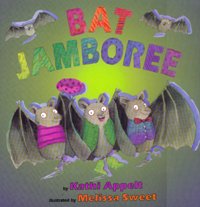
Bat Jamboree by Kathi Appelt introduces the triangular number pattern as bats assemble for the final number beginning with 10 bats in the bottom row, 9 in the next row, etc. to the very top row with 1 bat. Students are introduced to the 55 bats in formation and their various acts but the book "isn't over until the bat lady sings."
Students will enjoy this introduction to an important mathematical pattern. Teachers can find many problems that build upon this triangular number pattern and extend the experience.
- Annual Fall Parade challenges students to use the triangular pattern to figure out how many students are in the fourth grade. Given the number of full rows, students must apply the pattern and use effective recording (picture, table, etc.) to explain their reasoning.
- Candy Corn presents a triangular numbers problem using a candy corn pattern. Younger students might use candy corn to model the problem. A sample solution shows how older students might use an input-output table to model the pattern and find the solution without the use of manipulatives.
- See more Bat Activities in Mathwire's Math Activity Themes: Bats collection.
Wednesday, October 14, 2009
Bat Jamboree
Bat Jamboree by Kathi Appelt introduces the triangular number pattern as bats assemble for the final number beginning with 10 bats in the bottom row, 9 in the next row, etc. to the very top row with 1 bat. Students are introduced to the 55 bats in formation and their various acts but the book "isn't over until the bat lady sings." Students will enjoy this introduction to an important mathematical pattern. Teachers can find many problems that build upon this triangular number pattern and extend the experience.
Student Written Problems: ask students to write original problems that use the triangular number pattern. Being able to write similar problems and solve them require higher-order thinking skills as students apply, synthesize and evaluate both the problems and the solutions.
Check out more Bat Activities in Mathwire's Math Activities Themes collection.
Labels:
bat,
Bat Jamboree,
Halloween,
pattern,
seasonal,
triangular numbers
Subscribe to:
Posts (Atom)