Thursday, February 16, 2012
Domino Facts Template
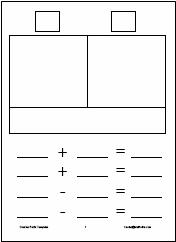
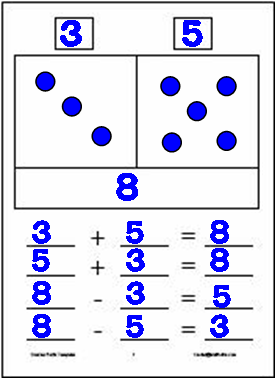
This activity is easily incorporated into daily lessons as a warm-up or do now! activity. Teachers may post the domino of the day or use an overhead domino. Teachers may also elect to distribute dominoes, differentiating the difficulty level to accommodate the needs of varied learners in the class.
Download the Domino Facts Template for student use.
This activity is also an effective math center activity. Provide tubs of dominoes, domino facts templates and/or have students use the Domino Record Sheet to record the sums of dominoes they select to practice basic facts.
Read more about using the Domino Facts Template on Mathwire.com.
Saturday, November 26, 2011
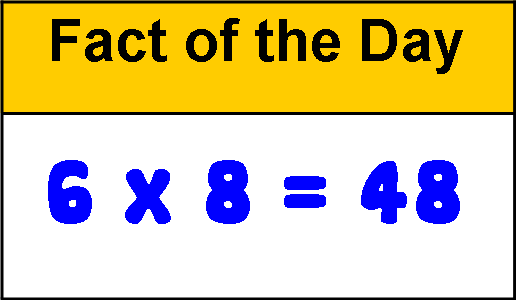
Fact of the Day
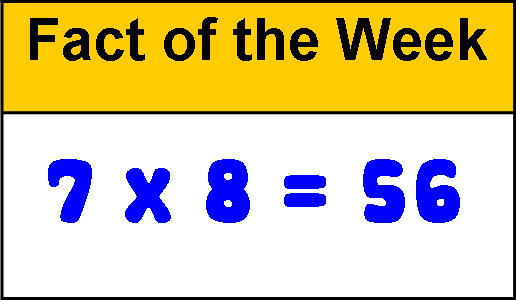
To start slowly or for particularly troublesome basic facts, use a Fact of the Week and follow the same posting and choral recitation procedures.
Monday, March 28, 2011
Mathwire Who Has? Deck Collection
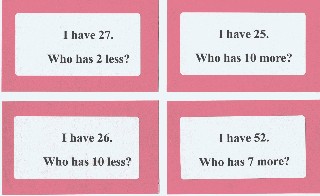
- Download the More or Less Deck
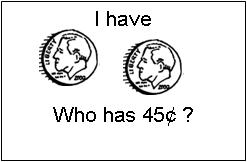
- Coin Deck uses clip art of actual coins on each card. Students answer the question Who has 40 cents? by stating I have 4 dimes, reading the coins on their cards to correctly answer the question. Note that this 20-card version uses both heads and tails of coins.
- Coin Deck with Antennas is the same deck as above, but antennas have been added to coins for an easy coin-counting modification for struggling learners. Read more about the coin antenna strategy in Mathwire's Money Activities & Strategies collection.
Wednesday, February 9, 2011
Who Has? Decks
- Check out the Mathwire Who Has? collection to download practice decks as well as read suggestions for implementation and classroom use.
Saturday, January 22, 2011
Penguin Bowling Game
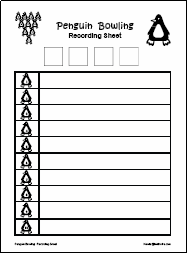
Students use a score sheet to record group scores as one does in real bowling games. Remember to model the scoring process, using an overhead of the scoring sheet, if students are not familiar with scoring regular bowling games. Teachers will especially have to model how to score a strike, as students will be strongly motivated to knock down all ten penguins in each round to gain these extra strike points.
This activity is a great do-now for students at the beginning or end of class to provide basic facts practice that students find highly motivating in a game format. Additionally, students profit from seeing and hearing the expressions their peers created and they are more likely to incorporate similar strategies in future play.
Penguin Bowling Game Materials:
- Download the recording sheet and directions.
- Download the score sheet.
Sunday, January 16, 2011
Penguin Math Games
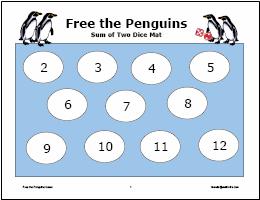
- A-F Dice: Create A-F dice using plain dice or purchase small wooden cubes at a craft store to make the dice.
- Penguin Pieces: Penguins pictured to the right were created by painting wooden clothespins and doll stands, both readily available at craft stores.
Friday, July 30, 2010
Summer Basic Facts Practice
- Mad Minute: insert a facts worksheet into a page protector. The student uses a dry-erase marker to complete as many facts as possible in one minute. Many students respond positively to this experience as it's only a minute. They can practice graphing skills by graphing the number of correct facts for each day.
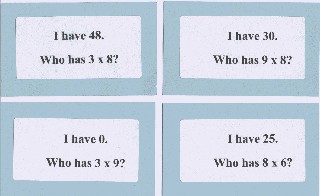
- Who Has? Card Decks: read about and download Who Has? cards from Mathwire's collection, print out the labels and apply to index cards to easily create a deck. Shuffle the deck and deal out the cards. Each player turns over his/her cards. The person who has the I have 0. card begins. After reading a card, the player turns over that card, and play continues. The first player to read all of his/her cards wins. NOTE: This is a totally random winning, but students seem to be challenged by the prospect of "winning."
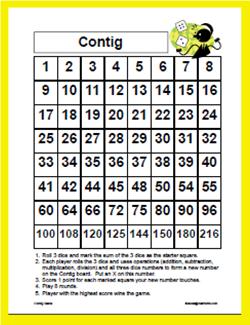
- Contig: Play this game to help older students develop fact fluency with addition, subtraction, multiplication and division facts. The beauty of the Contig game is that students will practice facts for several options, searching for the move that yields the most points. Download the Contig game mat and directions from Mathwire.
Sunday, December 20, 2009
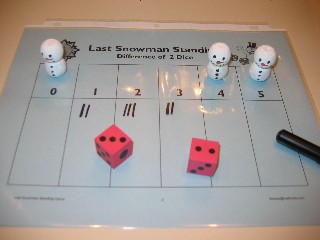
Last Snowman Standing Game
- Sum of Two Dice Version to practice addition facts
- Difference of Two Dice Version to practice subtraction facts
- One Die Toss for a simplified version to analyze the probability of a die toss
Data Collection: The directions for each version also include directions for data collection and analysis of the outcomes of the games. Be sure to incorporate these activities, if at all possible, as games offer a highly motivational study in probability. Students love to "play games" to collect data. They're also eager to analyze games so that they learn how the game works and what strategies they can use to improve their odds of winning.
Friday, September 11, 2009
Using Who Has? Decks to Develop Fact Fluency

Once students have developed conceptual understanding of the basic operations they need to develop fluency with the facts. One quick way to include daily practice and motivate students to master these basic facts is through the use of the Who Has? card decks. These decks can be created for virtually any topic and frequent use as both a whole class practice or as a center activity for partners or small groups will provide facts practice in a highly-motivating format.
Each deck has 24-30 cards that are distributed to students. Give out the extra to student volunteers or to better students who are able to watch two cards at a time. Then select a student to start the round. Alternatively, star one of the cards to be the beginning card. The first student reads his/her card and each student examines his/her card to see if he/she has the answer to that problem. The student who has the answer on his/her card, reads the answer, then reads the next question from the card. Play continues until the question is answered once again by the student who started the round.
I have found this to be the best way to practice basic facts. Students are so excited to play the game, that they forget they are actually learning. The underlying beauty of this game is that each student practices the 30 facts as the game progresses because he/she is checking both his/her card and the accuracy of other students. This activity provides basic fact practice without having to copy worksheets and students are more highly motivated by the Who Has? game.
Teachers may use these decks in several ways: class play, small group play, partner play or send them home for fact practice with parents. Be sure to visit Mathwire's Who Has? Activities page to read classroom management suggestions for implementing this fun activity and to download Who Has? decks.
The Mathwire Who Has? collection is formatted to print on 2 inch by 4 inch labels which may then be affixed to index cards to create the deck. Using different colored index cards for each deck also helps with the classroom management system. Teachers may consider creating multiple copies of each deck to keep in the math center, send home with students, and use as class decks. Each PDF download also includes a page with the complete deck listed for teacher convenience.
Who Has? Decks are an invaluable tool in any classroom. Visit Mathwire Who Has? Activities to download any of these decks for use in your classroom:
- Multiplication Facts
- Multiplication Facts (Spanish version)
- Multiplication Facts, Decks B-D
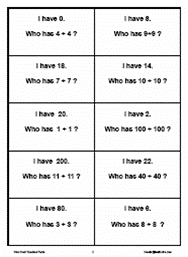
- Addition Facts
- Doubles Facts
- More or Less Facts
- Fractions
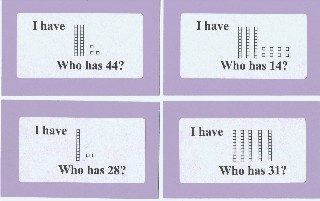
- Base Ten
- Place Value
- Coins
- Algebra Variable Expressions
- Geometry
Sunday, August 9, 2009
Contig and Contig Jr. Games
The Contig Game is one of the best games for practicing basic facts and one of my personal favorites. I have found that both students and teachers quickly become engrossed in the game. It is rewarding to watch students mentally rehearse many different options in search of the best move! Students also learn from each other as they watch partners combine numbers and operations, strategizing aloud to create the perfect move that captures the most points. It is a rich game that allows for differentiation as students begin play at their own entry level of comfort yet accommodates growth as students become more proficient at basic facts and operations.
In the Contig Game, students toss three dice. They use those three numbers and any operations (*,-,*,/) to form a number on the game mat. Players earn an extra point for each covered number their new number touches, so students quickly learn to search for the best move that will yield the maximum possible points. The instructional benefit of the game is that students try many different combinations in search of that best move. Students with solid “fact power” definitely have the edge in this game!
Check out the Mathwire version of Contig to download the directions and game board in PDF format.

Now younger students can also practice their addition and subtraction facts with the new Mathwire junior version of the game. The new Mathwire Contig Jr. game board is obviously different and provides lots of options for students to mark their answers. Scoring is similar to the regular Contig game, in that students earn more points if they can make an answer that lies next to X’s already on the board. The game may also be played in a very simple mode, where students simply use the dice numbers and addition and/or subtraction to make a number that is open on the game board. If they can’t make a number that’s still free, they lose their turn, and the other player goes.
Check out the Mathwire version of the new Contig Jr. game to download the directions and game board.
Implementation suggestions:
· Place the game board in a sheet protector and let students mark their numbers with dry erase markers. They may also keep score in the margins of the game board so that everything is all in one place. Alternately, use manipulatives to cover the numbers.
· Group students homogeneously to play this game so that better students are challenged by equally competent players. Likewise, students who are still mastering basic facts have an even playing field when matched with similar ability students. This should encourage all students to master basic facts in order to capture more points and win the game. This grouping also provides the necessary pacing (faster or slower) to match student needs.
· Limit play time to 5 or 10 minutes, if needed. The winner is the player with the most points at the end of this time period.
· Place the game in the math center and allow students to play when they have finished their work, during indoor playground time, and during other identified times.
· After lots of experience playing the game, organize a class play-off where the winning player advances to the next round to play another winning player, etc. Continue rounds until only one player is left to be crowned Class Contig Champion.
Saturday, August 8, 2009
Welcome to the Mathwire Blog: New Games
Check back often as new activities are featured on the site as well as this blog. Please let us know if you try the activity in your classroom and how you might have adapted it to best meet the varied needs of learners in your class.
New Games on Mathwire
The beginning of the new school year is always a great time to brush up on basic facts mastery. Be sure to check out the new Three Strikes And You're Out Game which provides practice in addition or subtraction facts. You can download the directions, game board and game pieces in PDF format on Mathwire.

Math games are a great way to provide basic facts practice. Students feel that they are playing, but they're really practicing their basic facts over and over, trying to make the best move to win the game. It's a win-win!