Wednesday, October 28, 2009

Fall Problem Solving


The following open-ended assessments require students to apply mathematical concepts and skills to solve problems and explain their thinking using words, pictures and numbers.

  • Candy Corn presents a triangular numbers problem using a candy corn pattern. Younger students might use candy corn to model the problem. A sample solution shows how older students might use an input-output table to model the pattern and find the solution without the use of manipulatives.
  • Younger students will enjoy analyzing and completing Fall Patterns.  They should then classify the pattern and explain their reasoning as part of the class discussion. It is possible that students will see different patterns in some of the items so their explanation and justification are very important mathematical discourse.
  • Annual Fall Parade challenges students to use the triangular pattern to figure out how many students are in the fourth grade. Given the number of full rows, students must apply the pattern and use effective recording (picture, table, etc.) to explain their reasoning.
  • See more Problem Solving Resources from the Mathwire collections.  All problems are classroom-ready in PDF format.  Many contain a sample solution for teacher use.


Saturday, October 24, 2009

Spider Math


Be sure to check out Spider Math in the Mathwire Activity Themes.  The spider collection features math mats, name-collection spiders, glyphs and graphing ideas.  Spiders are also the theme of the day for a whole series of games as well as some problem solving activities including insects and spiders problems, which are a twist on the familiar cow and chicken legs and heads problems. 

The games are original Mathwire games designed to develop students' proficiency with important math concepts and skills.  The downloadable PDF files include game mats, directions, recording sheets and game pieces.  The spider games develop coordinate graphing, probability and map coloring, a discrete math topic.
  • Catch the Spider Game requires students to roll dice, form an ordered pair, and catch the spider in that square, if possible.
  • Spider Game-1 develops the concept of the probability of the outcome of tossing one die.
  • Spider Game-2 expands the game to examine the probability of the outcome of tossing two dice and how that change impacts the outcome of the game.
  • Spider Web Map Coloring Games require students to use map coloring rules to win the most points in this spider web game.
Teachers may use the Spider Math activities as a Halloween treat or add them to thematic spider units.  The games may be introduced as a whole-class activity, then shifted to the math center for pair play during transition times or indoor recess. 

Thursday, October 22, 2009

The Candy Corn Contest


Math-Literature Connection - Estimation:
The Candy Corn Contest by Patricia Reilly Giff

This is a great literature connection for a Candy Corn Estimation Station, as described in the book. The sneaky teacher in this story required that students read a page in a library book for each guess they submitted. Math teachers might vary this requirement to include some fun math practice as a way to earn guessing rights. Either way, incorporating the actual candy corn jar estimation is a great seasonal variation of the Estimation Station described below.


Estimation Station

Establish a regular center in the room which changes weekly. A simple clear plastic container is filled with different items each week. These items should vary in size to challenge students' developing concept of volume, as it relates to smaller or larger units. Use seasonal items: acorns, leaves, candy corn, popcorn kernels, pumpkin seeds, etc. to spark student interest. Keep a class journal of these activities in which students may record their estimates. Record the item and the actual count along with a digital picture, if possible, of the container and the student(s) whose estimates were closest. Some classes involve parents by asking for volunteers to send in appropriate items to be counted. It is important to use the same container for several weeks so that students build an understanding that size matters in estimating how many items there are in the jar.


  • Download the Estimation Station Recording Sheet.
  • Suggestions for Using the Recording Sheets:  Have students record their names and guesses on page 2.  After counting the actual objects, fill in page 1 and post it in the estimation station.  Circle or color in the student(s) whose estimates were closest to the actual count.
  • Take a digital picture of the winner(s) each week and post this picture on page 1, covering the estimation jar clip art.
  • Enjoy!!

Wednesday, October 21, 2009

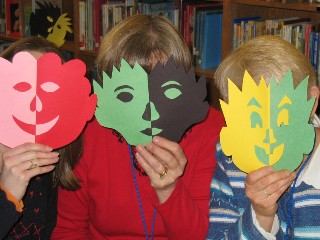
Symmetric Faces


Halloween masks become a math activity when students create Symmetric Faces.   Each student needs a full sheet of one color construction paper and a half sheet of a contrasting color.  Students fold the full sheet of paper and insert the half sheet inside.  They then free-draw the outline of one side of the face including hair, ear, chin, etc.  After cutting, students open the full sheet and position the half sheet on one side.  They then draw the eyebrows, eyes, nose, and mouth on the half sheet.  Students need to carefully cut out these features and position them on the opposite side to create a symmetric face.

This is a fun holiday project and students learn a lot about symmetry as they correctly position the cut pieces.  It's also fun to see the wealth of ideas students generate from their 1.5 sheets of construction paper.  By varying the paper colors, this activity is appropriate for fall, Halloween, Mardi Gras, Valentine's Day, etc.