Showing posts with label online games. Show all posts

Wednesday, April 20, 2011

Developing Number Sense

Students in Everyday Math classes play a game called Name That Number.  Make It Count is a very similar online game.  Students are dealt number cards, given operations and a target number.  The students must use only those cards (all or some) and the given operations to produce the target number.  They click on Submit to check their solution and get immediate feedback.  If the student is stumped by a particular combination of cards, they may click on See Answer to view a possible solution

These games provide practice of basic facts.  The real beauty is that students rehearse many different options in the search for one successful combination, developing number sense.  There are often several possible solutions, so students believe they will be successful, motivating them to search for a solution when one is not initially evident.

After a class presentation of the game, students often benefit from playing as pairs, generating mathematical discussion and debate in the search for a solution.  This online game might also be added to Parent Resources as students may play for free at home.


The Make the Number template may be downloaded and used in class as a warm-up or Do Now! activity.  For renewable use, students insert the template into a clear sheet protector and use dry erase markers to write in the target number and the number cards.  They use the white space to write down and check possible solutions.

NOTE:  Teachers may opt to make an overhead of this template so that students are able to record different solutions they find.  If the overhead is also inserted into a sheet protector, students may use dry erase markers to record their solutions.  The sheet protector is easy to clean and the overhead may be kept in a teacher binder for easy retrieval as needed.
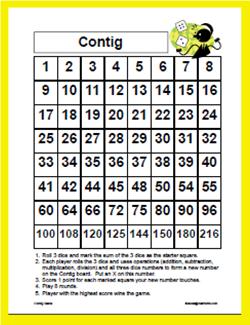

Extension:  The Contig game is a natural extension of this activity and it develops number sense as students search for the best possible solution that will win them the most points.  Students should know multiplication and division facts, but older students are easily challenged by this game.  Try it!


In the Contig Game students toss three dice.   They use those three numbers and any operations to form a number on the game mat.   Players earn an extra point for each covered number the new number touches, so students quickly learn to search for the best move that will yield the maximum possible points.   The instructional benefit of the game is that students try many different combinations in search of that best move. 
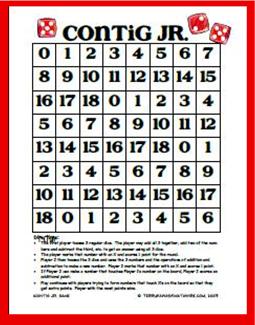


Contig Jr. is designed to provide that same format for younger students who need to develop mastery of addition and subtraction facts. 

Suggestions:   
  • Introduce these games to students and provide students time for supervised play.  
  • Make the games available in the math center for use during center time or indoor recess or game day. 
  • Insert the game mats into clear sheet protectors and use dry erase markers for renewable play. 
  • Home Connection:  Send a copy of the game mat home for students to teach parents and play at home for additional practice.

Thursday, April 14, 2011

Ladybug Links

For those who remember the Logo language, NCTM Illuminations offers a similar experience for students today.  The Ladybug Adventures unit requires students to use geometric and measurement skills to program a sequence to move the ladybug under a leaf or through a maze.

  • Students use NCTM's Hiding Ladybug applet to design a path that will take the ladybug beneath the leaf for a great problem solving experience. This online applet encourages students to refine their paths until they are ultimately successful. 
  • Making Triangles and Making Rectangles require students to teach the ladybug to use specific angles to create shapes that will hide the ladybug under the leaf. 
  • Finally, Ladybug Mazes challenges students to develop a series of moves that will successfully navigate the ladybug through the given maze. 
 These online applets are exceptional tools to help students think about and experience geometric concepts.  Students are motivated by the challenge and get immediate feedback on their success.  The applets allow students to refine their initial attempts, another plus in motivating students to successfully master the skills to meet a challenge.
  •  There are additional Ladybug Links available on Mathwire's Ladybug Themed Activities.

Thursday, February 10, 2011

Game of Pig

Game of Pig:  one die version

This is best introduced as a class activity.   Students collect points for each toss of the die unless a ONE is tossed, which means they lose all of the points they have collected in the round.   To prevent losing their points, students may elect to stop at any point in the game before a ONE is tossed and they get to keep the points they collected but get no further points.   Students love the game and begin to appreciate that theoretical probability and experimental probability are often quite different! 

Game Analysis:  Once students are familiar with the game, encourage small groups to develop a "winning strategy" and explain it to their classmates. Then play the class game with groups competing to see who has the best strategy in the actual game. Repeat, as necessary, for students to modify strategies.  NOTE:  Some student strategies are:  stopping after 5 tosses, stopping when they have 20 points, stopping after the second toss of a 6 or a 5, etc.  Be sure to ask students to explain the thinking behind the strategy.

Terry's Note:  I have used this with students in Grades 1-12 as well as in teacher training sessions and everyone loves it!  Students record each toss and then must add up a string of numbers providing great practice in mental math.  Students also continue to search for that magic strategy that will help them win.  Along the way, they informally experience, and thus learn, a lot about experimental probability.  I found this game to be a great use of those few minutes at the end of class to keep students actively engaged.  No student ever groaned when I said we were going to play pig!
  • Download directions for playing the Pig Game in a whole class setting.
  • Download the Pig Template to use as a recording sheet.  Place the sheet in a plastic sheet protector and use dry erase markers to create a reusable recording sheet.
  • Have students record each die toss in a Pig Tally Template for easy data collection.  This method also groups data so that students see a visual representation of the frequency of each outcome.
  • Use copies of the Pig Handout as a writing activity.  Encourage students to write about the probability in Pig and what they have learned from playing the game.  OR use these sheets for student groups to write out their "winning strategy" and post them on a bulletin board for future reference.  Keep a running total of times each strategy is successful in winning.
  • Play Pig online.
  
Game of Pig:  Two dice version
Students should be familiar with the one-die version of Pig before playing the 2-dice version.   Tossing a one on either die means that the player loses all points collected in that round, if he/she has not stopped before the one is thrown.   Any player who is still playing when snake-eyes (double ones) are thrown, loses all points collected thus far in the whole game! 

Game Analysis:  Students need to develop different strategies for playing this 2-dice version of Pig.   After playing several times, student pairs might analyze the two-dice frequency chart to calculate the probability of a one being tossed.   Students can use this information to develop a winning strategy and compete against other teams to see whose strategy is most successful. 
  • Download  a two-dice toss frequency chart for students to use in determining the probability of different outcomes.
  • See online directions for playing Two-dice Pig.
  • Play an online version of Two-dice Pig against the computer.
  • See Two Dice Roll for an online simulation of two-dice toss that graphs the outcomes.  This is a great way for students to collect larger samples of data to analyze experimental probability against theoretical probability.  Groups of students might also use this simulator to generate dice tosses to test their winning strategies.

 Game of Skunk
After students have mastered the Pig Game, analyzed the probability of the game and identified winning strategies, introduce the Game of Skunk and challenge students to analyze the probability used in this game and develop a winning strategy.   How are the games alike and how are they different?   Does the same "winning strategy" work for both games?  

Wednesday, October 13, 2010

Calculation Nation

NCTM's Illuminations site includes Calculation Nation.  Students may play the games to challenge themselves, playing against the computer, or they may challenge another online player. 

The games practice multiplication facts, factors, prime numbers, area, perimeter and other upper elementary through middle school concepts and skills.  All games add an element of strategy so that students are prompted to try several possible moves before selecting the best move that garners the most points.  Students won't realize they're really doing math as they PLAY these games and they'll keep playing to try to improve their scores and beat the computer or their online opponent.

Add this free resource to your online sites and encourage students to practice regularly.  They may enjoy playing each other, parents, older siblings or students from other schools.