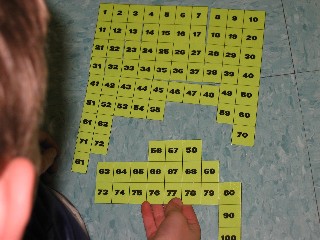
Students learn the patterns in the hundred board by assembling puzzles. Teachers are able to assess student use of patterns in rows and columns by observing the student at work.
Differentiation: This task is easily differentiated to accommodate the varied levels in a first grade class by changing the number of pieces and the shape of the pieces. Puzzle bags should be sequentially lettered so that students progress through harder versions of the task. Finally, students are asked to create their own puzzles for classmates to solve.
Extension: Use a 101-200 number grid so that students extend patterns and become more familiar with 3-digit numbers.
Materials:
- See Hundred Board Activities on Mathwire to download a hundred board template that may be used to create the hundred board puzzles.
- Copy the template onto card stock to make the puzzles heavier and easier to assemble.
Use the book Two of Everything to  introduce students to the doubling pattern. Students will enjoy the story and predict what will happen each time something is put into the magic pot.
Make the math connection even more concrete by using a pot and linking cubes to illustrate the story. Students may use a Magic Pot Workmat to record the input and output, then write a rule.
Extension: Extend the activity by using the magic pot and simple rules to create data sets. Students should guess the rule by giving an input number and telling the output that would result. By not stating the rule, students provide more time for other class members to generalize the rule. Each guess simply provides another data set for students to enter in their table.
Enrichment: After reading Two of Everything, challenge students to solve NCTM's 5 Coins problem: Would you rather have 1000 coins or 5 coins and a Magic Doubling Pot that works 10 times? Students might work in pairs and use in/out charts to record their solutions.
introduce students to the doubling pattern. Students will enjoy the story and predict what will happen each time something is put into the magic pot.
Make the math connection even more concrete by using a pot and linking cubes to illustrate the story. Students may use a Magic Pot Workmat to record the input and output, then write a rule.
Extension: Extend the activity by using the magic pot and simple rules to create data sets. Students should guess the rule by giving an input number and telling the output that would result. By not stating the rule, students provide more time for other class members to generalize the rule. Each guess simply provides another data set for students to enter in their table.
Enrichment: After reading Two of Everything, challenge students to solve NCTM's 5 Coins problem: Would you rather have 1000 coins or 5 coins and a Magic Doubling Pot that works 10 times? Students might work in pairs and use in/out charts to record their solutions.