Tuesday, March 29, 2011

Place Value Game

Games provide extended place value practice for students and allow them to use their conceptual understanding to develop appropriate strategies to win the game.   The best games encourage students to try out many options in search of the best solution.   This search for the best solution prompts additional practice in a highly-motivational setting. 


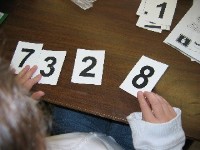
Place Value Game:  Students use number cards to create the largest number possible.

 Materials:
  • Deck of digit cards for each set of partners (2-4 each of #0-9, depending on the level of students and the size of the numbers they will create)   Note: Spinners with #0-9 may be used instead of cards, if desired. 
  • Place value mat for each player.
  • Recording sheet, if desired.
Directions:
  • Partner A turns over the first card and decides where to place that card on his/her place value mat.   Once the card is placed, it may not be moved.
  • Partner B turns over a card and decides where to place that card on his/her place value mat.   Again, the card may not be moved once it is placed.
  • Play continues with each partner turning over a card and deciding where to place it on the place value mat in hopes of building the largest number.
  • When all slots are filled on the place value mats, partners compare numbers to see who created the larger number.   That partner wins a point for the round.
  • Partners record both numbers on their recording sheet and circle the larger number
  • Students clear their mats, shuffle the cards and play additional rounds, as time allows. 
Variations:   Students try to form numbers to meet specified criteria (which will vary from these suggestions, based on the number of digits used): 
  • Students try to form the smallest number.
  • Students try to form a number that is closest to 500 (or 2000 or...)
  • Students try to form a number that is less than 1000.
  • Students form numbers and earn a different number of points, depending on the range within which the number falls (e.g. 1 point for numbers from 0-500, 2 points for numbers from 501-1000, etc.) 

Monday, March 28, 2011

Mathwire Who Has? Deck Collection

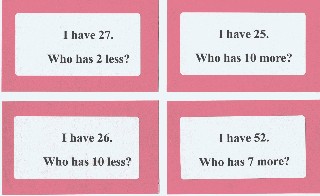
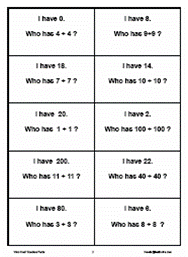
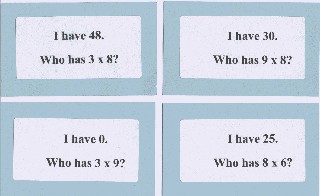
Several decks are available on Mathwire for downloading as PDFs.   All decks are 30 cards so that there are enough cards for most classes.   In fact, some students will probably need to have two cards to use the complete deck.   The decks are designed to print onto 2x4 inch labels (10 to a page).   These can then be affixed to index cards to create each deck.   If labels are not available, simply cut and paste the printout to create card decks. 
  
More or Less Deck:   this deck was developed to help students develop mental math proficiency.  Students will learn to mentally add or subtract a one-digit number or a multiple of  10.  Regular practice helps students develop proficiency in mental addition and subtraction.


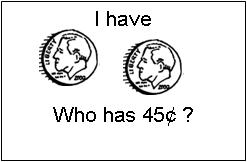
Coins Deck:  Two decks are available for this series. 

  • Coin Deck uses clip art of actual coins on each card.  Students answer the question Who has 40 cents?  by stating I have 4 dimes, reading the coins on their cards to correctly answer the question.  Note that this 20-card version uses both heads and tails of coins.
  • Coin Deck with Antennas is the same deck as above, but antennas have been added to coins for an easy coin-counting modification for struggling learners.  Read more about the coin antenna strategy in Mathwire's Money Activities & Strategies collection.


Doubles Deck

This doubles deck was developed to provide practice in doubles facts.  This 20-card deck is straightforward practice of these important facts.  Regular practice helps students develop mastery of doubles.


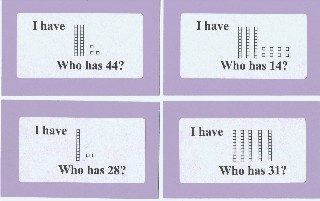
 Base Ten Deck

The Base Ten deck provides practice in recognizing numbers pictured in base ten block representation. 


Mathwire Who Has? Collection

These are a few samples from the Mathwire collection.  See Who Has? Activities to read more about using these decks in the classroom and to download additional decks for fractions, geometry, etc. 

Thursday, March 24, 2011

Who Has? Decks: Multiplication Facts


Once students have developed conceptual understanding of the basic operations they need to develop fluency with the facts.   One quick way to include daily practice and motivate students to master these basic facts is through the use of the Who Has? card decks.   These decks can be created for virtually any topic and frequent use as both a whole class practice or as a center activity for partners or small groups will provide facts practice in a highly-motivating format.


Classroom Management Strategies

There are several strategies that have proven successful when implementing this activity:
  • Distributing Cards:   Distribute one card to each student, then distribute the extras to strong students in the beginning and to random students as the class becomes more familiar with the deck.
  • Class Play:   As you distribute the cards, encourage students to begin thinking about what the question for their card might be so that they are prepared to answer.   When all cards are distributed, select the "0" card or any student to begin.   Play continues until the game comes back to the original card.   That student answers and then says "stop" to signal the end of the game.
  • Timed Play:   Consider using a stopwatch to time the class game.   Record the time on the board so that students try each game to beat their current best time.   This practice encourages students to stay attentive and prompts students to practice basic facts so that the class time improves. 
  • Calling Out Answers:Discourage this practice by adding 5 seconds onto the class time whenever you hear an answer from someone who does not hold the card.   Use the same penalty for students who express vocal displeasure with delays by other students.
  • Partner or Small-Group Play:  
    • One student deals out the cards to all players.
    • Players arrange the cards face-up in front of them.   Students will find that arranging the cards in order from least to greatest will help them locate cards quickly.
    • Play begins with the "0" card or any card held by the player to the dealer's left.
    • Play continues as in the class game. Whoever has the card that answers the question reads that answer and then reads the question on that card.
    • Students turn over the cards after reading them.
    • The first person to turn over all his/her cards, wins the game. [Note: this is completely random but don't tell the students!]
    • Shuffle the cards and repeat the game.
The current record for the multiplication deck was held by a fourth grade class in New Jersey who completed the deck in 59 seconds. 
 
Mrs. Leanne Cherosky's 5th grade class at Buffalo Elementary just e-mailed that they broke the record with a time of :56.593.  Congratulations, 5th graders!!!  

If your class beats this record, be sure to leave a comment on this post with grade level, school and the time.

Wednesday, March 23, 2011

Writing in Mathematics

Getting Started

Often students who have difficulty writing in math class have less difficulty telling the teacher what they think.   Capitalize on this oral strength by incorporating the think-pair-share strategy more often into math lessons as a prelude to writing.  Using either of these options will increase the active participation of all students in the class.  The pause after a teacher's question provides think time for students, accommodating different learning styles and requiring all students to engage and reflect.

Think-Pair-Share: Some students are reluctant to write at first and benefit from practice sharing thoughts with a partner and hearing that partner put thoughts into words.   Reluctant students get to "practice" in a small setting with a partner before speaking to the whole class.   These students can also choose to share their thoughts, their partner's thoughts, or a combination of the two. 

The basic steps of Think-Pair-Share are:
  • Question:   Ask an open-ended question and tell students that they will think-pair-share the answer.
  • Think:   Give students 1-2 minutes to think quietly about their response to the question.   Walk around the room to reinforce this quiet, on-task response.
  • Pair:   Ask students to share thoughts with their partners and ask questions if they don't understand what their partner is saying.   Circulate around the room, listening to student conversations.
  • Share:   Ask for student volunteers to share as you begin this process. Later, you should call on non-volunteers to increase student accountability in this cooperative learning strategy.   Reinforce the expectation of active listening by requiring students to acknowledge the thoughts of classmates by saying:
    • I agree with [name's] answer...,
    • I don't agree with [name's] answer...,
    • I started the problem like [name] but then I...
  • NOTE: It is not necessary and, in fact, it is usually not time-effective to have each group share.   As you circulate around the room during the Pair share, identify students who have used different strategies or great models for thinking about an important concept.   Call on these students or their partners to share with the class. 
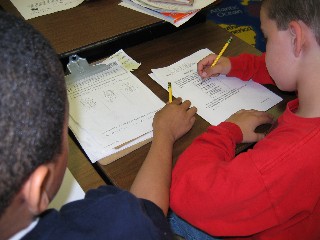
Think-Write-Pair-Share:   Once students are comfortable with the Think-Pair-Share strategy, introduce the Think-Write-Pair-Share strategy.   This strategy incorporates writing into the thinking process.   As students think about the question, they also write their response to the question using a variety of techniques: webbing, words, pictures, numbers, examples.   Teachers might start with a prompt poster that students can use for reference when they don't know where to start.   Effective prompts use successful pre-writing strategies such as:
  • Make a web.
  • Draw a picture and label.
  • Write a definition in your own words.
  • Create examples of the skill/concept and explain.
  • Write about a real-life use of this math concept or skill.
  • Connect the concept/skill to concepts/skills you already learned and use.
  • Reflect on your understanding of this concept/skill on a scale of 1-5 and explain.
  • Create a K-W-L chart of what you already know, what you want to know and what you have learned about the concept/skill.
Students then share their written responses with partners during which time students might elect to edit their own written response, choosing to replace certain words with better mathematical vocabulary, or add ideas and statements from their partner's writing.   Finally the teacher selects some students to share written responses with the class.   This process encourages students to get something down on paper and allows them some editing functions through the partner pairing.   Additionally, students benefit from regular listening to classmates sharing their own writing.